Etienne LeBlanc
All the Light We Cannot SeeEtienne LeBlanc, Marie-Laure LeBlanc’s great-uncle, is a gifted radio engineer whose withdrawal from the world is bound up with wartime trauma and the loss of his brother, Henri LeBlanc. In his crowded house in Saint-Malo, private memory and public resistance converge: a transmitter he built to preserve Henri’s voice eventually carries coded numbers and messages to listeners beyond the city.
Identity and Background
Etienne owns the house in Saint-Malo where Marie-Laure and her father, Daniel LeBlanc, come to stay. Before meeting his great-niece, he is already a presence defined by absence: he has gone out the night before Marie-Laure arrives, and she waits through another night tracing the city on a model while he remains away. When she asks whether she will meet him, Madame Manec can only say that she probably will not. His eventual greeting is soft and apologetic; he tells Marie-Laure that he has been unable to meet her sooner and that he is feeling better.
The house gives physical form to his inward life. Its upper floors contain boxes of jars, metal disks, rusty tools, electrical components, screws, machine parts, and antique dollhouses. Etienne occupies the fifth floor, in a study that can be deeply quiet or crowded with voices, music, and static. Above it, cables run through the attic to a complicated apparatus. To Marie-Laure, the wind-struck, overfilled house seems apprehensive and isolated, yet full of wonders—a fitting environment for a man whose retreat from the world has not extinguished his curiosity.
War, Grief, and the Radio
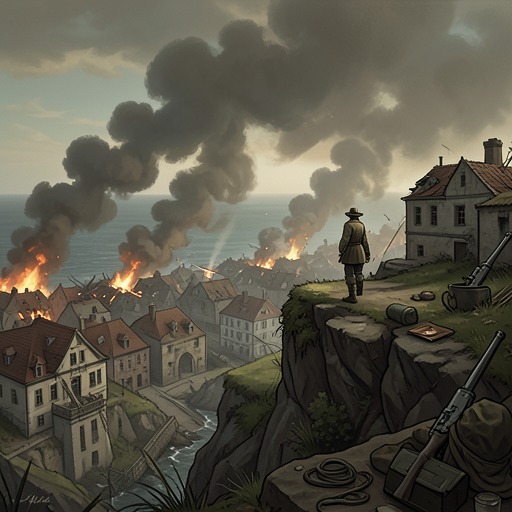
Etienne’s fear reaches back to World War I, when he and Henri served as signalmen, laying telegraph wires between rear command positions and officers at the front. At night, enemy flares lit the trenches while soldiers froze under the glare, listening for the whistle of a sniper’s bullet. Etienne recalls that he sometimes became paralyzed, unable to move even his fingers or eyelids. Henri stayed beside him and whispered the science scripts they had made together, repeating them through the night as if the words could protect them until morning.
Before the war, the brothers had planned to make recordings for children. Henri had the voice; Etienne wrote the scripts. They approached a recording company in Paris, and Daniel, then a boy, came to listen as the work progressed. Etienne remembers that period as one of the happiest of his life. After Henri died, the project’s promise changed shape. The company was no longer interested, but Etienne continued to play the brothers’ ten recordings each night, until most had worn out, along with a recording of Henri’s song.
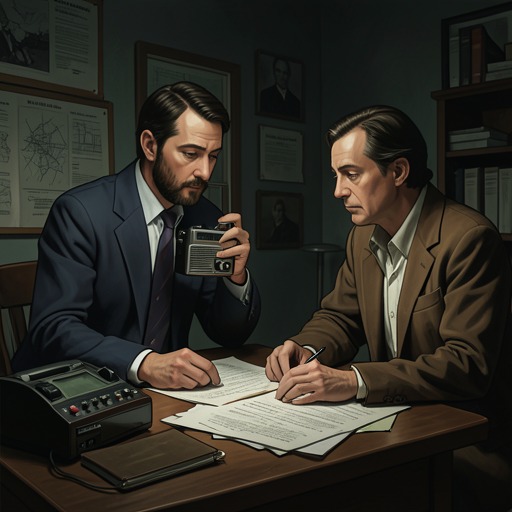
The transmitter in the attic makes that preservation literal. Its controls operate a microphone and phonograph; its components include a premodulation amplifier, vacuum tubes, and coils, while a twelve-meter antenna extends along the chimney. Etienne explains how a voice disrupts the smooth cycles of transmitted energy, but the machine’s emotional purpose is clearer than its technical lesson: it lets him send Henri’s voice out into the air. He tells Marie-Laure that it took him years after the war to build it. The attic thus holds both engineering and mourning, a working apparatus assembled around a past that cannot be recovered.
Care and Withdrawal
When Marie-Laure first explores the fifth floor, Etienne guides her hands over his radios. He has eleven sets, including a stereo heterodyne receiver he assembled himself, and says that from so high in the house he can hear ships at sea and broadcasts from Madrid, Brazil, London, and once Pakistan. His pride briefly makes him sound boyish. For Marie-Laure, who is blind, his explanations and the radios’ sounds open a world of distant places through touch and hearing rather than sight.
His care for her becomes more decisive after a period of grief and seclusion. After four days shut away in his room, Etienne descends to the kitchen and asks Madame Manec’s friends to leave. He says he needed time to say goodbye and must now look after himself and his niece. He then bolts the doors, takes Marie-Laure’s hands, and leads her toward the cellar trapdoor. The movement from mourning to responsibility is quiet but consequential: he does not emerge as a man cured of fear, but as someone accepting a duty to the person now in his care.
His relationship with Madame Manec also exposes the conflict between safety and action. When she asks him to help, Etienne worries about the danger: the attic radio is hidden, and he asks whether someone could find it in a search. The prospect of being discovered is not abstract; people are being rounded up for violating blackout rules. Yet Madame Manec presses him to recognize that inaction carries its own moral cost. His hesitation makes his eventual use of the transmitter a choice made under pressure, not an effortless transformation into a public hero.
Secret Broadcasting and Resistance
Etienne’s first broadcasts send strings of numbers over several frequencies. Marie-Laure hears the numbers travel across rooftops and sea toward unknown destinations; he repeats the transmission on a second and third frequency, then switches the apparatus off and lets it cool. The coded sequences connect the concealed machine to an audience he cannot see, while the repeated transmissions suggest the care with which he tries to make the signal reach beyond the house.
The broadcasts later include messages from ordinary people. Notes arrive from across the region: a birth, a dying grandmother, and a woman’s forgiveness for her son. Some messages might conceal instructions, but Etienne cannot tell. What matters is that citizens need radios and appear to need news of one another. Although he scarcely leaves home and sees no one except Marie-Laure, his work makes him a point in a wider network of information. He reads out numbers and messages across five bands, gives instructions for the next transmission, and plays a piece of an old record; the whole operation takes at most six minutes.
Etienne’s part in the resistance remains precarious. The broadcasts last long enough to frighten him, and he expects the bells to ring or German patrols to come up the stairs. They do not. That reprieve does not make the risk unreal; it leaves him continuing in the interval between exposure and silence. His radio joins technical skill to an act of care: the same man who once used recorded speech to endure the trenches now helps scattered listeners hear from one another under occupation.
Change and Narrative Significance
Etienne’s arc does not erase the fear that has kept him apart from others. Instead, the story gives that fear a history and then places responsibility beside it: Henri’s companionship helped him survive the paralysis of war; grief led him to preserve Henri’s voice; Marie-Laure’s arrival gives him someone to protect; and Madame Manec’s challenge pushes his hidden equipment toward collective use. Each connection is mediated by sound, from whispered scripts and recorded songs to radio signals carrying anonymous messages.
His attic transmitter is therefore more than a technical achievement or a secret weapon. It converts private remembrance into communication, and isolation into a limited but consequential form of participation. Etienne remains largely unseen by the world beyond his house, yet his apparatus reaches outward across rooftops and sea. The contrast defines his significance: a man who fears exposure builds a device for sending voices into the open air, and in caring for Marie-Laure and broadcasting for others, begins to answer the silence that once enclosed him.