Etienne and Marie-Laure hide the attic transmitter
All the Light We Cannot SeeEtienne and Marie-Laure hide the attic transmitter by turning the heavy wardrobe in Etienne’s grandfather’s room into a barrier across the attic entrance. The scene converts the danger of an undisclosed radio into a physical task: after considering whether to surrender it, they work together in darkness to obstruct access to the transmitter before dawn. Their choice preserves the transmitter’s concealment, but leaves the threat of discovery unresolved.
The transmitter and the missed deadline
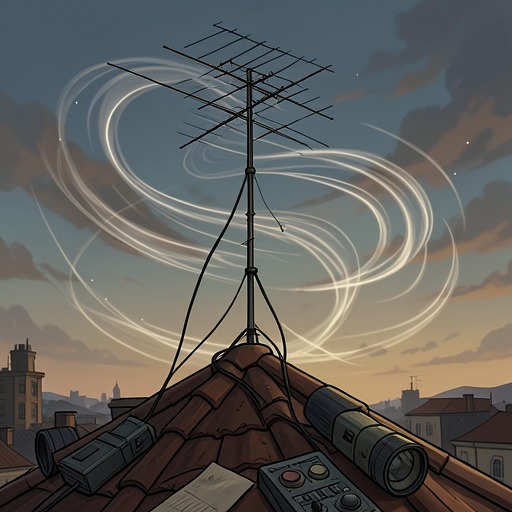
Rain taps at the windowpanes as Etienne, still speaking from a place of acute fear, asks whether all the radios have been surrendered. Marie-Laure answers that she did not mention the radio in the attic, then asks whether Madame Manec knows about it. Etienne says they have never spoken of it. The exchange establishes that this transmitter is not simply another receiver overlooked in the household: its existence has remained unspoken even between people close to the resistance work around them.
Etienne asks whether the transmitter is hidden and whether anyone could see it if the house were searched. His question gives the danger a specific shape: the possibility of a search, and the possibility that the device might be found. He then proposes that they could still turn it in and claim they had overlooked it. But the deadline passed at noon the previous day. Marie-Laure counters that the authorities may not accept such an explanation for a transmitter capable of reaching England. The exchange does not prove that a search is imminent; it shows why the pair cannot safely treat the device as an ordinary radio or the missed deadline as a harmless oversight.
Making a barrier
After a silence, Etienne asks Marie-Laure to help him. He finds an automobile jack in a third-floor room, and together they climb to the sixth floor, to her grandfather’s room. They shut the door and work beside the massive wardrobe without lighting even a single candle. Instead of trying to lift or dismantle the piece, Etienne uses the jack to raise one side, slips folded rags under its feet, and repeats the operation on the other side. The small pieces of cloth let them shift a piece of furniture too large to move by ordinary strength alone.
Etienne directs Marie-Laure to put her hands against the wardrobe and push. As it moves, she understands what they are doing: they intend to park it in front of the small door leading to the attic. The first effort moves it only an inch. Its mirrored doors knock lightly as it glides, while its weight makes the work feel, in Marie-Laure’s perception, like pushing a house across ice. That comparison enlarges the effort without changing its practical scale: their immediate task is to move the wardrobe far enough to wall off one small entrance.
The maneuver proceeds by increments. They push, rest, and push again. Etienne recalls that his father used to say Christ Himself could not have carried the wardrobe upstairs, and that the house must have been built around it. The remembered saying underscores the obstacle they have chosen to use: an object imagined as immovable becomes useful precisely because it is so difficult to shift. Once the wardrobe settles in front of the attic door, Etienne jacks up its feet again and pulls out the rags. The entrance is blocked, not removed; the transmitter remains where it is, behind an improvised barricade of furniture.
Concealment and its cost
The choice to hide the transmitter follows from the practical limits of their alternatives. The surrender deadline has already passed, and Marie-Laure challenges the hope that an explanation will persuade the authorities to overlook a device with a reach to England. The scene therefore turns on a change from anxious discussion to coordinated action: rather than expose the transmitter by handing it over, Etienne and Marie-Laure make the room itself harder to search successfully. Their work does not settle what might happen if the wardrobe is moved or the attic is discovered; it buys concealment without guaranteeing safety.
The darkness shapes both the mechanics and the intimacy of the task. They close the room’s door and use no candle, relying on touch, the jack, and each other’s effort. Marie-Laure’s understanding arrives as her hands meet the wardrobe: she grasps the plan through what they are physically doing. The scene gives her more than the role of an observer. Etienne asks her to push, and the barrier takes shape only through their joint labor.
When the wardrobe finally blocks the little door, neither celebrates nor resolves the danger in words. Etienne sinks to the floor, breathing hard, and Marie-Laure sits beside him. Before dawn rolls across the city, they are asleep. The ending registers the exhaustion of the labor and its limited success: the entrance is walled off for now, while the secret that prompted the work remains hidden rather than surrendered or made safe.