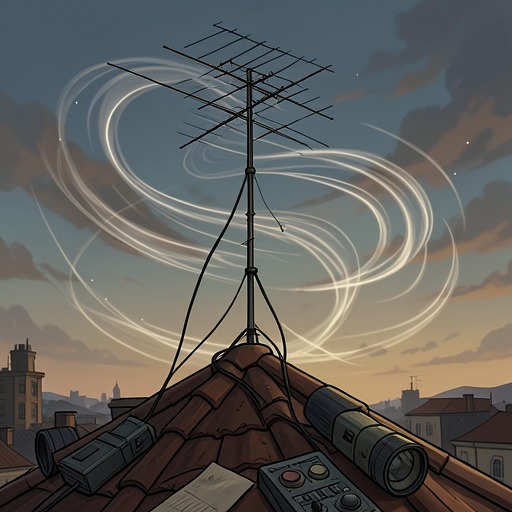
Etienne broadcasts his brother's recordings by radio
All the Light We Cannot SeeEtienne LeBlanc’s broadcasts of his brother’s recordings turn a radio transmitter into both a technical achievement and an act of mourning. Built over years after the First World War, the machine sent Henri LeBlanc’s recorded voice and Clair de Lune into the air. Etienne did not know whether children or anyone else heard the programs. He wanted, above all, to reach his dead brother, whom he imagined he might comfort in return for the protection Henri had once given him.
The recordings before the war
Before the transmitter existed, Etienne and Henri shared a plan to make children’s recordings and sell them. Henri had a voice that drew notice: the nuns at St. Vincent’s wanted to build choirs around it. Etienne had the technical and practical ambition to turn that voice into a project. In Paris, a recording company expressed interest, and Etienne wrote ten science scripts for Henri to rehearse. Daniel LeBlanc, still a boy, sometimes came to listen. Etienne remembered that work as one of the happiest periods of his life.
The proposed commercial future did not last. After the war, the company was no longer interested, but the recordings remained. Etienne kept playing the ten programs, night after night, until most had worn out. Their changing condition gives the broadcasts a physical history: these were not an abstract tribute or a single preserved performance, but recordings repeatedly handled and heard until use itself began to consume them. Henri’s voice persisted on them, even as the medium carrying it deteriorated.
Building a transmitter for a private purpose
Etienne built the attic transmitter after the war, taking years to complete it. Its machinery occupied the space beneath the roof: boxes of tubes, coils, switches, and meters, with a phonograph and microphone among the equipment. The antenna extended upward along the chimney to twelve meters. The apparatus was a working system, not simply a memorial object. A switch powered the microphone; another operated the phonograph. Etienne explained how the machine sent waves and how a voice disrupted their smooth cycles, giving Marie-Laure LeBlanc a tactile, technical account of how a sound in the attic could travel beyond it.
The detail of the microphone makes the broadcasts’ construction especially intimate. Etienne tucked it into the gramophone’s bell so the machine could carry Henri’s records onto the air. He also transmitted Clair de Lune, the piano piece heard through Marie-Laure’s headset when Etienne first demonstrated the equipment. The song and the recorded voice were joined not by a live exchange but by the deliberate arrangement of a record, a gramophone, a microphone, and a transmitter. The broadcast depended on material objects and on Etienne’s learned skill in making them work together.
The brother Etienne hoped to reach
The possible range of the apparatus and the intended audience were not the same. Etienne told Marie-Laure that the signal could readily reach Paris, but he had not been trying to reach Paris or England. He made the broadcasts powerful because he hoped Henri might hear them. Playing Henri’s own voice back to him was Etienne’s way of trying to bring his brother peace and protect him, as Henri had protected Etienne. The dead brother became the imagined recipient of transmissions that were technically capable of travelling much farther.
That hope remained unanswered. Henri never spoke back, and Etienne did not claim otherwise. Nor could he confirm that the broadcasts reached children, the audience for whom the original programs had been written. The absence of a reply leaves the act suspended between communication and remembrance: Etienne could send a voice into the air, but could not know who received it. His persistence matters precisely because the machine could not guarantee the response he wanted.
A machine that carries hope forward
Years later, the transmitter’s purpose changes when Marie-Laure finds it in the attic during the bombardment of Saint-Malo. She raises its chimney antenna by pressing the lever Etienne installed and considers who might be listening: the fire brigade, the resistance, American forces, German troops, or Etienne himself. Where Etienne had sent Henri’s voice toward a brother who could no longer answer, Marie-Laure hopes for a living listener and a sign that someone can hear her. The same apparatus thus connects two acts of reaching outward, first toward the dead and then toward people whose presence and response remain uncertain.
The transmitter’s history also gives the novel’s radio motif a concrete form. Signals cross distance only because someone builds, powers, tunes, and operates a device; transmission is neither effortless nor a promise of contact. Etienne’s long labor preserves Henri’s voice for a time, while the worn recordings and unanswered broadcast mark the limits of preservation. Later, the machine offers Marie-Laure a means to call beyond the attic, carrying forward the possibility of connection without pretending that every call will be answered.