Etienne’s Radio Transmitter
All the Light We Cannot SeeEtienne’s Radio Transmitter is a handmade broadcasting apparatus concealed in the attic of the LeBlanc house in Saint-Malo. Built by Etienne LeBlanc after the First World War to carry the recorded voice and music of his brother Henri, it later becomes a means for Marie-Laure LeBlanc to transmit coded numbers and, during the siege, to read aloud over the radio. The device’s significance lies in that change of purpose: a machine first shaped by bereavement and the hope of reaching one dead listener becomes a fragile channel between people separated by war.
Construction and Operation
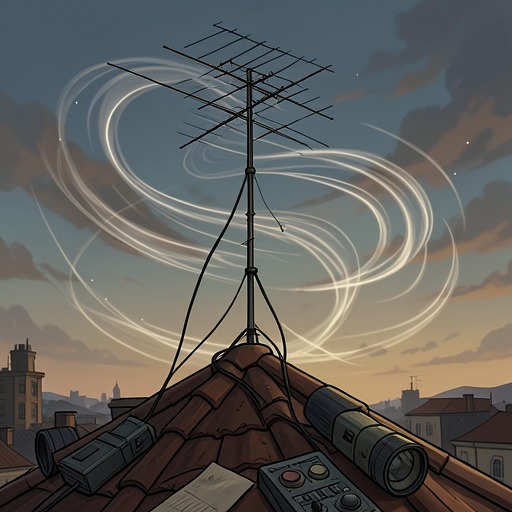
The transmitter occupies a section of the attic reached by a ladder and surrounded by cables and boxes. At its table are tubes, coils, switches, meters, and a gramophone. Etienne explains its working parts through Marie-Laure’s hands: one switch powers the microphone, another operates the phonograph, and the apparatus includes a premodulation amplifier, vacuum tubes, and coils. Its telescoping antenna runs up alongside the chimney and extends twelve meters. The arrangement is not simply a radio receiver that can be switched on; it is a system for generating and sending a signal, dependent on the antenna, power, controls, and someone able to operate them.
The contrast between its technical complexity and the simplicity of its output is central to the object’s presentation. The transmitter can carry a piano recording, a spoken science program, a sequence of numbers, or a living reader’s voice. Its functions depend on the connections made between its components: the microphone turns a voice into an input, the transmitter sends it outward, and a listener with a receiver must be within reach and tuned to hear. The equipment makes communication possible, but it cannot determine who will receive the message or what that person will make of it.
Henri’s Recordings and Etienne’s Purpose
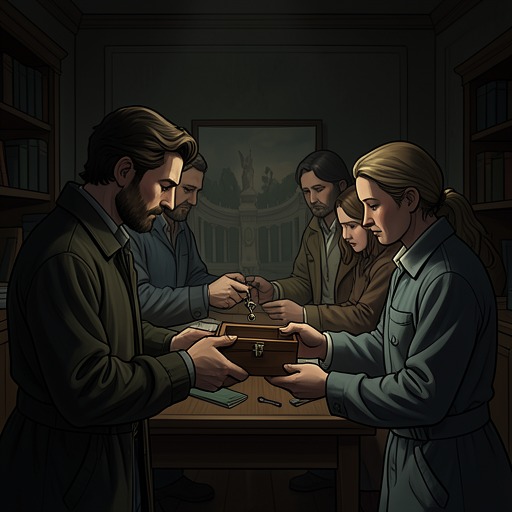
The machine grew out of a family project begun before the war. Henri had a voice admired by others, while Etienne supplied the technical and practical ideas. Together, they approached a recording company in Paris, and Etienne wrote ten science scripts intended for children. Henri rehearsed them, and the brothers began recording. Daniel LeBlanc, then a boy, would come to listen. Etienne remembered this period as one of the happiest of his life, joining the transmitter not only to his brother’s talent but also to a family enterprise and an audience the brothers hoped to reach.
War ended that work. Etienne and his father became signalmen, stringing telegraph wires between rear command positions and officers at the front. At times, flares illuminated the trenches and left soldiers fearing that the light would reveal them to a sniper. Etienne describes episodes when fear left him unable to move. The account gives the transmitter’s later history a particular tension: the apparatus sends signals, but light and communication in wartime can also expose people to danger.
After the war, Etienne built the transmitter over several years. The recording company was no longer interested, but he continued to play the brothers’ ten recordings, most of which eventually wore out, along with Henri’s song. He also broadcast Debussy’s “Clair de Lune,” placing the microphone in the gramophone’s bell. His aim was not primarily to reach Paris or England. He hoped that Henri, after death, might hear the broadcasts and find peace, just as Etienne felt his brother had once protected him. The attic machine was thus both working technology and a private memorial, built around a hope that its maker knew could not be verified.
Concealment and Return to Use
When the household packs up its radio equipment, the transmitter remains undisclosed. Half the house is occupied by receivers and their components, and the other sets are unplugged and lowered into crates, including a Radiola Five, two G.M.R. models, and a Delco farm radio shipped from the United States in 1922. Marie-Laure remembers the attic apparatus but does not tell Daniel or Madame Manec. The scene distinguishes the familiar receivers being removed from the exceptional transmitter hidden overhead, and leaves Marie-Laure weighing whether it should be mentioned.
Later, Marie-Laure and Etienne confront the danger that the attic transmitter could be found. At her question about whether it is hidden, Etienne and Marie-Laure use an automobile jack and folded rags to lift a massive wardrobe and push it in front of the small attic door. The effort makes concealment a physical extension of the transmitter’s construction: the machine is protected not by its own design but by altering access to the space around it.
When they decide to use it, Etienne modifies the house to make the entryway harder to detect. He runs wires through the walls to bells on the third floor, in the attic, and at the front gate; when Marie-Laure tests the gate from the street, the bells ring inside. He also makes a false back for the wardrobe, fitted to a sliding track that can be opened from either side. At dusk, they raise the telescoping antenna beside the chimney, switch on the equipment, and send a sequence of numbers. Etienne repeats the transmission on two more frequencies before turning the machine off. The numbers travel toward unknown destinations, with the possibility of reaching England, Paris, or no listener at all. The transmitter has entered a new role: its signal is no longer only a message directed toward Henri but an outward broadcast made under occupation.
Marie-Laure’s Broadcasts and the Wartime Link
After Saint-Malo has been devastated, Marie-Laure finds the transmitter still standing on its table against the chimney, with two marine batteries beneath it. She uses the lever installed by Etienne to raise the antenna and operates the switches under the table. The vacuum tubes begin to work again. Her choice to return to the apparatus is practical as well as symbolic: with the city in danger and its ordinary means of contact uncertain, the transmitter offers a channel she can operate herself.
Marie-Laure opens a novel and brings the microphone to her lips. Her reading reaches Werner Pfennig, who is trapped beneath the remains of the Hotel of Bees and listening to a repaired transceiver. At first he thinks hunger and fever have made him imagine a girl’s voice emerging from the static. That response marks the distance the signal has crossed: the transmitter does not announce its listener or guarantee that it has been understood. It carries Marie-Laure’s voice into another person’s constrained world, where it is first heard as something that might not be real.
The transmitter’s history therefore moves from a brother’s recordings and a song repeated for the dead, through wartime concealment and coded transmission, to an unexpected human reception. Its technical parts remain essential throughout; the voice cannot cross the distance without the coils, switches, power, microphone, and antenna. Yet the machine’s meaning changes with its users and listeners. Etienne builds it to preserve a bond, Marie-Laure turns it into a means of action, and Werner hears it as evidence of another living person beyond the rubble. The apparatus does not erase separation, but makes a connection possible across it.