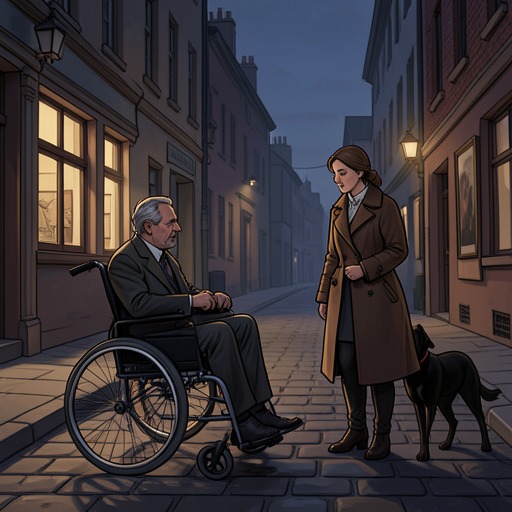
Etienne’s postwar trauma and self-isolation
All the Light We Cannot SeeEtienne LeBlanc’s postwar trauma is presented as a rupture between the man who left for war and the man who returned: he saw disturbing things afterward and, for years, did not go outdoors. Marie-Laure first learns about this history from Madame Manec, then encounters Etienne in the stillness of his home. The contrast leaves his confinement unmistakable without reducing him to it: within the house, he appears kind, curious, and knowledgeable.
War and Its Aftermath
Madame Manec explains that Etienne was with his brother—Marie-Laure’s grandfather—when the brother died in the war. The family’s account uses the old expression “Got a bit of gas in the head” for what happened to Etienne. Madame Manec connects his return from war with a lasting change: he was “not the same as when he left.” The description identifies war as the dividing line in his life, while leaving the precise nature of his experiences and their effects unexplained.
What Marie-Laure is told is not simply that Etienne became afraid. When she asks whether he was more scared of things, Madame Manec corrects her: he was lost, “A mouse in a trap.” She says he saw dead people passing through walls and terrible things in the corners of streets. The images make his altered perception part of the account, but the narration supplies no diagnosis and does not explain whether these visions arose from a particular incident. His trauma is conveyed through what others report and through the limits it places on his life.
The House as a Boundary
Etienne’s withdrawal is described in concrete terms: he does not go outdoors, and, when Marie-Laure asks whether he never does, Madame Manec says, “Not for years.” The statement gives his isolation a duration without specifying its beginning or suggesting that it is voluntary. Marie-Laure is also told that he is there, even if she probably will not meet him immediately; Madame Manec reassures her that he is always there. The exchange makes his presence within the household certain while keeping contact with him uncertain.
The house becomes the setting in which Marie-Laure can meet a different aspect of him. Etienne has the entire fifth floor to himself, a large room with six windows—three facing rue Vauborel and three the alley—and a landing. Its contents include books, a birdcage, beetles kept in matchboxes, an electric mousetrap, a paperweight containing a scorpion, and boxes and jars of electrical parts. These details establish a densely furnished private world, but they do not turn his confinement into a cure or explain its cause. The contrast is between a man who has withdrawn from the outside and a room crowded with things to examine.
Meeting Marie-Laure
When Etienne gives Marie-Laure a tour, he speaks almost in a whisper. She finds him kind, curious, and entirely sane; what he radiates most, the narration says, is stillness. That impression stands beside Madame Manec’s account of his visions rather than erasing it. The scene does not present him as frightening or incoherent in their meeting. Instead, Marie-Laure encounters a composed, attentive man whose manner is quiet, while the earlier testimony has already disclosed the suffering and seclusion behind that quiet.
His welcome also takes the form of shared attention. Etienne reads to Marie-Laure from Darwin’s account of the voyage of the Beagle, translating the English into French as he goes and dwelling on the variety of jumping spiders. The detail that Madame Manec calls him a wonder who knows everything finds a tangible counterpart in his books and in the knowledge he shares. His room, his reading, and his measured tour show that isolation has not exhausted his intellectual curiosity or his capacity to make a place for his great-niece.
What the Account Leaves Open
The evidence defines Etienne’s postwar state through reported history, visions, and a prolonged refusal to go outdoors, but it does not disclose a fuller chronology or a clinical explanation. Nor does it show, in this encounter, that the trauma has ended: the stillness Marie-Laure observes is an impression, not proof of recovery. By placing Madame Manec’s account beside the gentle tour and the reading, the narrative holds two truths together. Etienne is profoundly withdrawn from the world beyond the house, yet within it he remains present, learned, and capable of kindness.