Frank Volkheimer
All the Light We Cannot SeeFrank Volkheimer first appears as a figure whose size seems to define him: a seventeen-year-old cadet, an upperclassman, and a legend among the younger students. Yet the novel repeatedly unsettles that image. The boy regarded as an instrument of strength listens to classical music; the soldier who has served as an instrument of the Reich works through darkness to free others from rubble; and, decades after the war, he carries a letter himself to the sister of a dead comrade. His arc turns on the difference between what a person is made to represent and what he chooses to do.
The cadet called the Giant
At Schulpforta, Frank Volkheimer is introduced in Dr. Hauptmann’s technical-sciences office, occupying an armchair intended for someone much smaller. He is seventeen, enormously built, and already surrounded by stories. The younger cadets say that he once carried three first-years across a river above his head and lifted the rear of the commandant’s car so a jack could be slipped beneath it. Other rumors cast him as cruel: one claims he crushed a communist’s windpipe with his hands; another says he blinded a stray dog to harden himself against suffering. These accounts are rumors rather than verified deeds, but their extremity helps explain the legend that gathers around him. Even in the room’s low light, veins stand out along his forearms, making his strength seem almost emblematic.
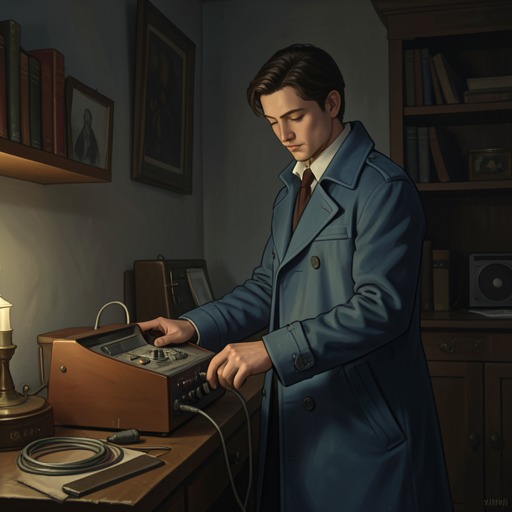
The legend does not contain the whole person. When Dr. Hauptmann is away in Berlin, Frank Volkheimer sometimes takes a Grundig tube radio into the doctor’s office, connects its shortwave antenna, and fills the laboratory with music. He favors Mozart, Bach, and Vivaldi, especially the sentimental pieces. Then he leans back in the chair beneath his weight and lets his eyelids droop as he listens. The scene does not erase the brutal stories or prove them false; instead, it places a private receptiveness beside the public image of the brute. The novel’s recurring contrast is not between strength and weakness, but between strength used to intimidate and strength capable of attention.
From school legend to soldier
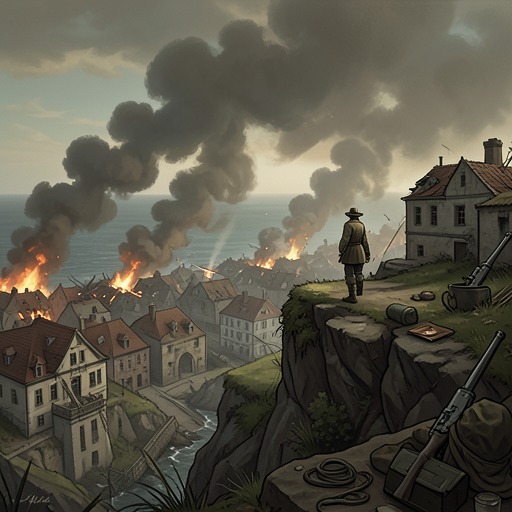
By the siege of Saint-Malo, Frank Volkheimer is a staff sergeant serving in the city’s defenses. Werner Pfennig operates a steel-cased two-way transceiver from a cellar, communicating with another set upstairs, anti-air batteries in the city walls, and the underground garrison command across the river mouth. When Frank Volkheimer comes down the narrow stairs, he ducks beneath the beams, smiles gently at Werner, and sits in a gold-silk armchair with his rifle laid across his huge thighs. The chair and weapon make a striking tableau: the rifle looks scarcely larger than a baton, but the soldier holding it greets Werner with gentleness.
The cellar is struck and collapses around the men. Werner remembers engineer Walter Bernd closing the cellar door, then Frank Volkheimer in the gold armchair as the ceiling light goes out and the roar of the attack engulfs them. Later, Frank Volkheimer’s field light picks out the ruined stairwell: the route out has become a compacted mass of stone, cement, and splintered wood. He searches and clears debris, moving among hanging pipes and rebar, while the cellar continues to tremble and dust falls from above. When he reaches Werner, he touches his cheek with deliberate care; his fingertip comes away bloody. Werner insists they must find another way out, but Frank Volkheimer can only shake his head. The tenderness of the gesture does not soften the fact of their entrapment.
Endurance beneath the ruins
Frank Volkheimer keeps attacking the blocked stairwell with a piece of twisted rebar. His method is practical and exhausting: he studies the debris by flashlight, switches off the light to preserve its battery, and then works in darkness, returning to inspect the results. When the light comes back, the wreckage seems almost unchanged. The task is daunting enough to make escape feel impossible, and the three survivors remain beneath a damaged ceiling supporting the weight of the hotel above, with the dead and unexploded ordnance also overhead.
In this confinement, Frank Volkheimer’s speech breaks into a repeated plea. Werner hears him say, “Please. Please,” as if the words have escaped without his knowing it. The narration associates the sound with a limit reached after years of war: what Frank Volkheimer had endured before this final injustice no longer makes the present tolerable. It also frames him as more than an individual soldier, calling him an instrument and executor of orders. That language places his physical power inside the machinery of the Reich, while the trapped men’s need to survive gives his actions a new, immediate measure: he is not merely the force that can wield a weapon, but the person laboring to open a way through the wreckage.
Werner eventually brings the radio and battery to Frank Volkheimer in the gold armchair and fits headphones over his ears. Werner explains that a French broadcast is telling the story of a submarine, its trapped crew, and a giant squid lodged in its propeller. Frank Volkheimer does not move as he listens. Later, static resolves into music. He opens his eyes wide, listens to the piano’s rising and falling notes, and then puts the headphones on Werner. He urges Werner to listen and tells him to connect the light to the battery. Music here is not a solution to the physical danger, but it changes what the men can hear and do within it: the man who once filled a school laboratory with classical music now uses a moment of listening to direct his companion toward a practical action.
After they make it out, the two men stagger toward the shelter of the ramparts. Frank Volkheimer gives Werner the rifle and tells him to go. When Werner asks what he will do, Frank Volkheimer answers, “Food.” The exchange is spare, its bluntness set against the hours of effort that preceded it. He sends Werner onward while naming the immediate need that remains. The novel does not turn the escape into a triumphant transformation; the men emerge exhausted, and Frank Volkheimer’s final instruction is a fragment of survival rather than a declaration.
The war carried into peacetime
In 1974, Frank Volkheimer is fifty-one and lives in a third-floor walk-up in suburban Pforzheim. His apartment has three windows, but a billboard across the alley dominates the view, its processed meats lit at night by four electric spotlights. The scene gives his later life a sharply bounded, ordinary setting, far removed from the cellar and the school legend. The text offers no account of his intervening years here; the details establish only his age, residence, and the view outside his home.
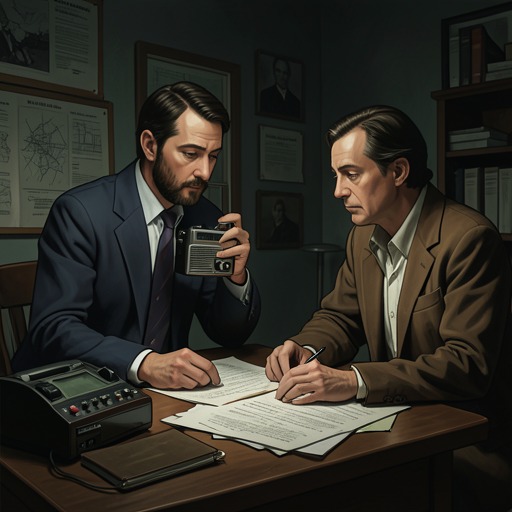
He appears in Jutta Pfennig’s life again when he brings her a letter. Frank Volkheimer says that once the address was found, he asked to deliver it himself, and he takes a folded sheet from his pocket. Jutta is reluctant to accept it. She has tried to keep the war, Frau Elena, and her memories of Werner Pfennig at a distance, and she does not often allow herself to think of her brother. Frank Volkheimer’s visit makes that sealed-off history present again—not through a speech about the past, but through the letter he has carried and the effort of bringing it in person. His postwar role is therefore modest but consequential: he becomes the bearer of a connection to Werner that Jutta has struggled to keep locked away.
Character and narrative significance
Frank Volkheimer’s characterization is built through reversals between public reputation and particular acts. At school, stories make his body a spectacle and his strength a threat; his solitary listening to Mozart, Bach, and Vivaldi exposes a quieter capacity without cancelling the violence attached to his legend. In Saint-Malo, the same immense physical presence that once seemed capable only of force becomes useful in the slow work of clearing debris and caring for Werner. His handling of the headphones links that work to an older habit of listening, while his decision to send Werner onward gives their escape an intimate, practical shape.
The later visit to Jutta extends this pattern beyond the battle. Frank Volkheimer cannot undo his service or restore Werner, and the surviving evidence does not disclose the letter’s contents. What it does show is that he chose to deliver it himself. Across the novel, his strength is therefore not presented as redemption in itself. Its meaning changes with its use: it can sustain a fearsome legend, serve a wartime system, clear a passage through rubble, or carry a message to someone left behind.