Frederick
All the Light We Cannot SeeFrederick is Werner Pfennig’s friend and dormitory companion at Schulpforta, a cadet whose alertness to birds and instinctive pity for the vulnerable place him at odds with the school’s harsh discipline. Their bond develops through small acts of mutual care, but its deepest test comes when Frederick refuses to participate in the humiliation of a prisoner. Later, Werner finds him profoundly changed; the visit makes the distance between their shared boyhood and its aftermath painfully concrete.
Identity and Introduction
Frederick arrives at Schulpforta as a new cadet from Berlin. He and Werner are both fourteen, sharing a tiny dormitory with six other boys. Frederick is slender and pale, with an absent, upward-floating attention that gives the impression he is searching the sky even indoors. His father is an assistant to an ambassador, a detail that places him among the school’s varied recruits without explaining or determining his character.
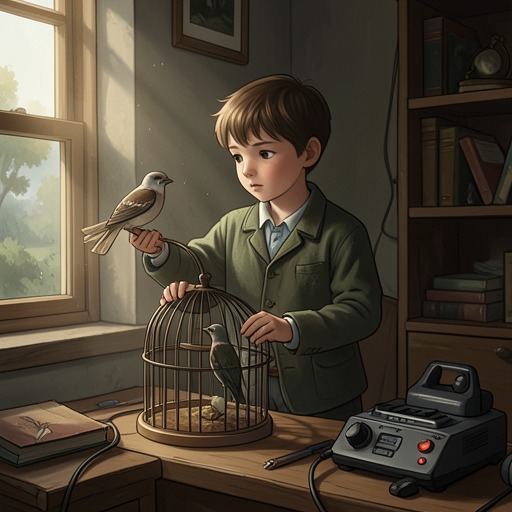
His first overture to Werner is a question about birds. Frederick knows that hooded crows can use traffic to crack nuts, and explains the behavior with the enthusiasm of someone who has watched closely. He quickly predicts that he and Werner will become great friends. The prediction is less a conventional greeting than an invitation into his way of seeing: intelligent life is not confined to people, and a bird’s resourcefulness is worth noticing.
That attentiveness contrasts with the institution around him. On his first day, Werner glimpses a technical sciences laboratory full of new equipment, and Frederick has to urge him onward. In the refectory, meanwhile, the students hear a phrenologist classify people through diagrams of supposedly pure and mixed German blood. The school’s lessons in racial hierarchy and obedience provide the setting for Frederick’s quieter habits of attention, but the evidence does not present him as a public debater or a formal opponent of its ideology. His resistance emerges more plainly in what he cannot accept being done to living creatures and helpless people.
Friendship with Werner
The friendship takes shape through repeated practical kindness. Werner washes Frederick’s mess tin, shares homework answers and shoe polish, and gives him sweets from Dr. Hauptmann. They run beside one another during field exercises, their boots landing together as the cadets move along the trail. The shared rhythm is physical as well as affectionate: in the regimented life of Schulpforta, companionship appears in the ordinary work of keeping pace and looking after someone.
Frederick’s vulnerability is part of that closeness. He is described as thin, and at one later moment he cannot see well without his glasses. Werner’s care does not depend on Frederick being useful to his own ambitions. While Werner’s thoughts turn toward Dr. Hauptmann’s transceiver and the technical work that fascinates him, he still tends to the small needs of his friend. The contrast gives their attachment its particular shape: the school trains boys to compete and comply, while their friendship makes room for unremarkable forms of loyalty.
Birds and the Limits of Obedience
Frederick’s tenderness toward birds becomes explicit when senior cadets fire into trees to see how many they can hit. The birds burst from a linden in a panicked cloud, turning an apparently quiet crown into a scene of sudden destruction. At the dormitory window that night, Frederick presses his forehead to the glass and says that he hates the boys for what they have done. His anger is direct, but it is not detached from the scene: he has watched cruelty turn a living refuge into a target.
The school’s violence later makes that response more consequential. During a forced chase through the snow, Frederick runs hard but is caught just fifteen strides from Bastian. The cadets gather around him, breathing clouds into the cold as Bastian remarks that it usually takes less time for the first boy to be caught. The exercise reduces the boys to pursuers and prey; Frederick’s place at its center exposes the bodily humiliation beneath the school’s language of training.
His clearest refusal comes during the freezing ordeal imposed on a prisoner. Cadets take turns throwing water at the man, and Werner, despite his doubts, follows the others. Frederick has not cheered as each bucket lands. When his turn arrives, Werner understands what he is about to do: Frederick pours his bucket onto the ground instead. The gesture is small and cannot end the punishment, but it breaks the sequence of participation. Where Werner complies, numbed and waiting to be released, Frederick declines to make the prisoner suffer one more time.
Injury and Aftermath
Later, Werner visits Frederick at home and is met first by Franny, then by Frederick’s mother. She warns him not to try to make Frederick remember him because it will only upset him; she adds that Werner’s presence still matters. Her welcome carries both affection and strain. She kisses Werner on both cheeks, but her troubled pause leaves open the pain surrounding the visit without assigning her a blame the scene does not settle.
Frederick’s condition becomes evident in his halting speech and his difficulty meeting Werner’s gaze. Working his mouth as if chewing air, he tells Werner that he looks pretty and mistakes him for his mother. Werner corrects him, but Frederick’s expression remains without artifice. The encounter does not restore their earlier ease: the boy who once approached Werner with a confident promise of friendship can no longer recognize the relationship in the same way. Werner’s inability to bear looking into Frederick’s stagnant gaze makes the damage register as more than a change in conversation; the familiar friend is present, yet separated from their shared past.
Werner’s later nightmares show that Frederick remains bound to his memory. In one, the boys close over Frederick, but as Werner approaches, Frederick transforms into Jutta Pfennig, who stares at him accusingly while the boys carry off her limbs. This is Werner’s nightmare, not an account of a literal event; its transformation joins the friend he failed to protect to the sister whose safety also haunts him. Frederick’s place in that recurring image reveals how the school’s cruelty continues to organize Werner’s fear and guilt long after the immediate scenes have passed.
Narrative Role
Frederick is not defined by a grand challenge to Schulpforta but by recurring acts of attention and refusal: he notices what the birds can do, grieves when they are shot, and will not throw water on a prisoner. These choices distinguish compassion from mere feeling; in the freezing ordeal, pity becomes an action that carries the risk of standing apart from the group.
His friendship with Werner also gives the novel a measure of the boys’ diverging responses to coercion. Werner is capable of doubt and affection, yet he throws the water; Frederick’s refusal marks the boundary Werner does not cross in that moment. The later visit then reverses the intimacy of their early scenes. The school once placed their beds and routines close together; after Frederick’s transformation, Werner must face a friend who is physically present but unable to share their former recognition. Frederick’s story thus holds together the promise of childhood friendship, the pressures that test it, and the lasting cost of the world that shaped them.