German occupation of Saint-Malo
All the Light We Cannot SeeThe German occupation of Saint-Malo turns a polished military arrival into a tightening system of control over the town’s streets, homes, communications, and inhabitants. Its force lies in that progression: the occupation first appears as an orderly presence amid familiar commerce, then as a succession of demands and restrictions that make ordinary life precarious, until evacuation, bombardment, and liberation expose the limits of German control.
Arrival and the Occupation’s Public Face
Marie-Laure LeBlanc’s father watches the arrival from the telegraph office. German motorcycles with sidecars pass through the Porte Saint-Vincent, followed by two trucks and a black Mercedes. Behind drawn shutters, residents watch through gaps in the town’s windows. The procession stops at the Château de Saint-Malo, where the mayor waits with a white handkerchief in his large sailor’s hands; his wrists shake almost imperceptibly.
More than a dozen German soldiers climb out. Their boots gleam and their uniforms are tidy; two carry carnations, another leads a beagle, and several look up at the château’s façade. A short field captain emerges from the Mercedes, brushes at his sleeve, and speaks with an aide-de-camp, who translates for the mayor. The captain then disappears through the château’s doors. Minutes later, the aide opens an upstairs window and unfurls a crimson flag above the rooftops. The flag makes the change in authority visible, but the procession’s immaculate appearance also gives the arrival a composed, almost ceremonial surface.
That surface coexists with the immediate material presence of occupation. German weapons are described as if they have never been fired, and the soldiers’ clean boots and spotless uniforms make them seem to have stepped from comfortable train cars. In the days that follow, townspeople report that German soldiers buy postcards, straw dolls, candied apricots, cakes, shirts, lingerie, butter, cheese, and champagne. The purchases make the occupiers part of the town’s daily transactions even as their presence rearranges who can move, gather, speak, and keep property.
Rules Enforced in Everyday Life
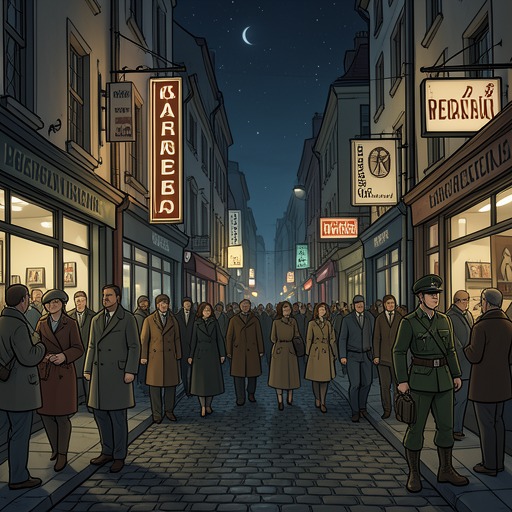
Restrictions accumulate across both public and private life. Curfews are imposed; music audible outdoors and public dances are banned. The mayor announces that the country is in mourning and residents must behave respectfully, although the extent of his remaining authority is unclear. The town’s quiet is not simply a spontaneous response to danger: it is demanded through official rules and reinforced by less formal prohibitions.
In Saint-Malo, residents can be fined for locking their doors, keeping doves, or hoarding meat. Truffles and sparkling wine disappear, and social habits narrow: people avoid eye contact and conversation in doorways; sunbathing, singing, and evening strolls along the ramparts cease. The details show how regulation reaches beyond major political acts into household security, food, leisure, and neighborly contact. Etienne LeBlanc barricades himself inside his brother’s old room. Marie-Laure passes the hours in his study, running her fingers over his seashells and sorting them by size, species, and morphology, then checking their order again. Her careful routine offers a measure of order while her father refuses to let her go out, haunted by the possibility that blind girls might be taken before disabled men.
The occupation also targets communications. Marie-Laure has to ask her father three times before he reads aloud an order requiring residents to surrender all radio receivers to 27 rue de Chartres by noon the following day. Anyone who fails to comply is threatened with arrest as a saboteur. The demand is not merely for equipment: it closes a route by which people might receive information outside the occupiers’ control and makes possession itself a potential accusation. When Marie-Laure asks whether someone is affected, Madame Manec tells her that he is in her grandfather’s old room, connecting the public order to the concealed radio and the private danger inside the household.
Arrest, Resistance, and Escalating Control
The occupation’s coercion is also visible in the arrest of Daniel LeBlanc, Marie-Laure’s father. Policemen in plain clothes seize him outside Vitré while a dozen train passengers watch. French interrogators question him first, followed an hour later by German interrogators. They produce his notebook, tool case, and key ring, counting seven skeleton keys and asking what the keys unlock, why he carries tiny files and saws, and what his architectural measurements are for. Daniel explains that he is making a model for his daughter and that the keys belong to the museum where he works, but the questioning does not resolve into a clear, intelligible process.
He is taken to a cell whose oversized, antiquated lock and hinges prompt him to imagine they might date from the reign of Louis XIV or Napoleon. He expects the museum director or someone from the museum to explain the misunderstanding. The next morning, German interrogators question him again while a typist works nearby. They appear to suspect a plot to destroy the château, though the reason for that suspicion is unclear. They deny him paper, linens, and a telephone, and they have photographs of him. Two days after his arrest, he is driven to a holding pen outside Strasbourg, where he sees other detainees sleeping on straw over frozen mud. The scene sets the occupation’s confident administrative posture against arbitrary suspicion, isolation, and the absence of practical means to challenge the authorities.
Resistance takes shape in small, risky interventions rather than open confrontation. Madame Ruelle, the baker’s wife, straps a stepladder to her husband’s car and drives at dusk along the Route de Carentan with Madame Guiboux. Using a ratchet set, they rearrange road signs, then return to the kitchen at Number 4 rue Vauborel drunk and laughing. Their altered directions turn an ordinary piece of road furniture into a means of disrupting the occupiers’ sense of control. The women’s laughter does not erase the danger; it marks a brief recovery of initiative within a town where rules otherwise dictate even the terms of public life.
Siege, Retreat, and Liberation
As the military situation deteriorates, movement is controlled more directly. Claude Levitte tells Marie-Laure that evacuation orders have been issued and the city gates locked. Men between sixteen and sixty are to assemble at the château’s tower and be marched at low tide to Fort National. The order assigns a whole category of civilian men a route and destination, while the apparently calm sounds in rue Vauborel—the swallows, doves, and passing bicycle—make the threat feel all the more difficult to verify from Marie-Laure’s position.
New orders posted on doors, market stalls, and lampposts forbid anyone to leave the old city or walk its streets without special authority. Soon afterward, a German corporal explains that troops are evacuating toward La Cité Fortress. They are leaving everything behind; the Germans still hold the château and the Bastion de la Hollande, while other personnel are to fall back. The corporal warns that the entire town will be inside the bomb line. The announcement compresses the occupation’s final phase into a reversal: the power that had restricted civilian movement is now retreating, but its withdrawal places the city and its inhabitants in immediate danger.
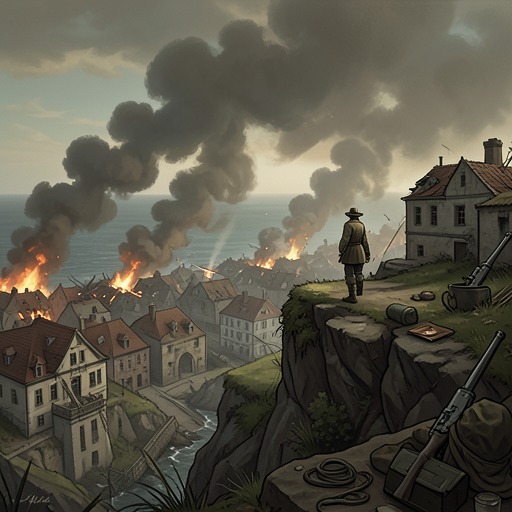
In the days before the end, Reinhold von Rumpel understands that the last German-controlled port in Brittany is nearly lost, with the Atlantic Wall at stake. The occupation’s military collapse is therefore not separate from the town’s destruction: Saint-Malo has become both a strategic position and a battlefield. In the morning, American forces take the château and the last anti-air battery and free the prisoners held at Fort National. Madame Ruelle pulls Etienne out of the processing queue, and he embraces Marie-Laure. The German commander in his underground fortress across the river holds out for three more days, until an American Lightning aircraft drops napalm through an air vent. A white sheet raised on a pole ends the siege.
Afterward, sweep platoons remove incendiary devices, army photographers enter the ruins, and residents return from farms, fields, and cellars to move through the damaged streets. On August 25, Madame Ruelle is allowed back into Saint-Malo to inspect the bakery. Etienne and Marie-Laure instead travel to Rennes, where they find a hotel with a functioning boiler and take long baths. Their departure gives the occupation’s end a domestic measure: after rules, queues, confinement, and bombardment, hot water and the possibility of going to Paris become signs of a life beginning again.
Significance
The occupation is presented not as a single seizure of power but as a changing set of pressures, from the flag above the château to restrictions on radios, homes, food, movement, and public behavior. Its rules are encountered through their specific consequences: a family must decide what to do with a hidden receiver; a father’s ordinary tools become grounds for interrogation; older women turn road signs around; men face forced assembly and transport. These episodes distinguish formal orders from the unsettled, coercive ways they are applied, without making civilian experience uniform.
Saint-Malo’s occupation also binds local resistance to daily life. The resistance act is a rearrangement of signs; the household danger is a radio that must be surrendered; the town’s constrained sociability is registered in its silence and its vanished evening walks. The final evacuation and liberation do not restore the town intact. They end German control while leaving a ruined city, freed prisoners, and survivors who must leave or return to damaged homes. The arc from ceremonial arrival to white surrender flag makes occupation visible as both administration and force—and its end as release accompanied by loss.