Germany
All the Light We Cannot SeeGermany is presented as a place of striking contrasts: a homeland shaped by coal, scarcity, and industrial scale, and a state that promises scientific achievement while directing its young people toward obedience and sacrifice. Werner Pfennig’s life carries the reader from the mining complex of Zollverein to Berlin, while scenes of arrest and occupation reveal how the country’s power reaches beyond its own borders.
Industrial Homeland and Childhood
Zollverein, where Werner grows up, lies three hundred miles northeast of Paris, outside Essen. It is a four-thousand-acre coalmining complex in steel and anthracite country, marked by smokestacks, elevated railway conduits, and slag heaps. The landscape’s industrial scale makes it more than a backdrop: mines and mills dominate the horizon and establish the material world into which Werner is born.
Werner and his younger sister, Jutta Pfennig, are raised at Children’s House, a two-story clinker-brick orphanage on Viktoriastrasse. Its rooms hold sick children and newborns, while battered trunks preserve the few belongings left by parents swallowed by the mines. The setting ties family loss to the labor that structures the surrounding region. Werner’s early years are also marked by poverty: men compete for work at the gates, food is scarce, and during the worst months the house directress feeds her dozen wards cakes made from mustard powder and water.
This hardship stands beside an immense industrial apparatus. From the dormer window, Werner looks across wet rooftops toward the cokery, smelter, gasworks, and winding tower, then outward to villages and cities beyond his sight. Germany appears to him as an expanding machine, supported by millions of men prepared to give their lives for it. The view joins the local landscape of labor to the larger national project that will claim his youth.
Radio, Propaganda, and Youth Formation
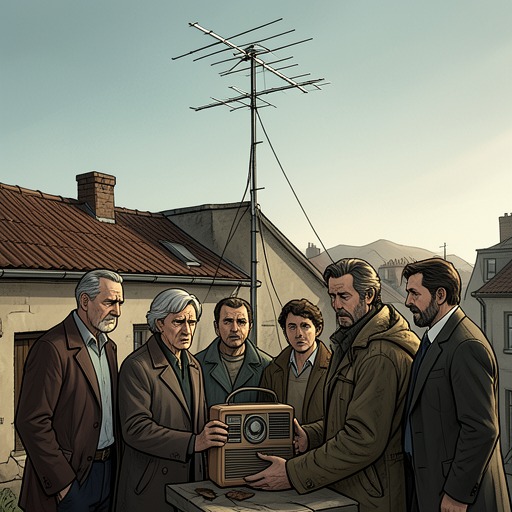
At Children’s House, Werner repairs a radio by collecting copper wire, screws, a bent screwdriver, a broken earphone, and a solenoid from a discarded doorbell. He adds a resistor, makes a loudspeaker, and eventually redesigns the receiver. Each evening he brings it downstairs so Frau Elena and the children can listen together. The radio opens a window onto music, plays, news, and speeches, but it also carries assurances of national unity, confidence, and readiness for attack. Its mixture of entertainment and political messaging makes the device both a source of wonder for Werner and a channel through which official claims enter daily life.
That reach becomes more consequential as Werner grows older. Membership in the State Youth becomes mandatory, and the boys are trained in parade maneuvers, fitness standards, competition, and sacrifice. Werner continues to study mathematics and listen to his radio late into the night, even as schoolwork, chores, and exercise crowd his days. His weariness and irritability trouble Frau Elena, but he gives her little explanation. The demands of the organization and his private intellectual interests press against each other without immediately resolving into open resistance.
At the school he later enters, discipline is made visible in rules governing uniforms, knives, rows, possessions, and silence after lights-out. A one-armed bunk master tells the cadets that they must strip away weakness and move together toward a common cause. Four hundred boys, some as young as nine and others seventeen, are assembled with instructors and staff. The institution’s order is not simply a routine: it is designed to make conformity feel like duty and to train boys to understand themselves as parts of a collective national purpose.
Berlin: Scientific Promise and State Ambition
Berlin appears first as an idea Werner has cherished from a distance. He has imagined its scientists and longed to work among people who make discoveries; when he and Frederick arrive by train, the city seems to confirm the scale of that dream. Their six-hour journey is repeatedly interrupted as trains carrying soldiers hurry toward the front. They reach a dim station, climb into the streets, and enter the largest city Werner has ever seen.
The name Berlin evokes a capital of science as well as a political center. Werner thinks of inventions, discoveries, and scientific achievement, and wonders what science now cultivates there. But the question is shadowed by the militarized ambitions expressed to him at school: soldiers endowed with extraordinary powers, machines that alter the weather, and missiles guided across immense distances. The scientific promise that once gave Werner an image of a possible future is now entangled with military power. His arrival in the city therefore brings both wonder and a sharper sense of what the state expects knowledge to serve.
The streets also complicate the idealized image. Werner encounters shops, crowded housing, street sellers, and people whose circumstances do not resemble the grand story of national progress. The contrast does not erase Berlin’s importance to him, but it makes the city a lived place rather than only a promised home of science. His passage there occurs amid wartime movement: the soldiers’ trains, the boys’ uniforms, and the military visions attached to technology all point toward a country organizing its resources and people for war.
Occupation, Detention, and the Reach of Authority
Germany’s authority is also encountered through the coercive treatment of civilians. In Saint-Malo, a notice read aloud to Marie-Laure LeBlanc states that residents must surrender their radio receivers at a named address by the following day. Anyone who fails to comply is threatened with arrest as a saboteur. The order turns possession of a domestic communication device into a matter of state control, and its threat makes clear that noncompliance can be recast as political wrongdoing.
Daniel LeBlanc’s arrest offers a different view of that power. Seized outside Vitré while traveling toward Paris, he is questioned first by French policemen and then by German interrogators. They examine his notebook, tool case, seven skeleton keys, and small files and saws, demanding explanations for objects connected to his work as a locksmith and his model for his daughter. In a later questioning session, the German interrogators appear to suspect him of plotting against the Château de Saint-Malo, although the basis for their suspicion is unclear. They deny him access to paper, linens, and a telephone, and keep photographs of him.
After two days, Daniel is driven to a holding pen outside Strasbourg. He spends three days there without an officially appointed lawyer, a military tribunal, permission to write, or the telephone access he requests. On the fourth day, the prisoners are loaded onto a cattle truck and driven east. Across the river, Daniel sees snow-dusted fields, bare trees, and vineyards on the German side, but the landscape seems no different from the one he has left. That resemblance makes the crossing feel less like arrival in a foreign world than passage over an abrupt political threshold. His detention, with no rescue arriving from the museum, shows how thoroughly ordinary explanations and professional standing can fail under arbitrary wartime authority.
Narrative Significance
Across these episodes, Germany is not a single, uniform landscape. Zollverein’s coal and deprivation, Berlin’s scientific prestige, the regimented schools, and the administration of occupation present different faces of a country whose industrial and intellectual capacities are harnessed to collective power. The contrast is especially sharp in Werner’s trajectory: the child fascinated by a repaired radio and by the invisible possibilities of science becomes a youth instructed to move in formation and drawn into a technological world increasingly oriented toward war.
The novel also links state power to everyday mechanisms rather than treating it as an abstraction. A radio carries political messaging into an orphanage; compulsory youth training organizes boys’ bodies and time; a surrender notice regulates what residents may keep; an interrogation converts keys, measurements, and a tool case into grounds for suspicion. Together, these details show how national ambition enters homes, schools, streets, and individual lives. Germany’s narrative significance lies in that reach—and in the distance between its promises of discovery and unity and the coercion through which those promises are imposed.