Invisible light and the unseen world
All the Light We Cannot SeeInvisible light and the unseen world connects a mathematical claim about light with the novel’s depictions of radio, memory, and Marie-Laure LeBlanc’s perception. Its central contrast is not simply between seeing and blindness: it is between what appears directly to the eye and the larger world that remains beyond ordinary vision but may be approached through other forms of attention.
A world beyond the visible
The motif takes its most explicit scientific form in the assertion that, mathematically, all light is invisible. The line addresses children, but it also shifts the scale of the surrounding narrative: what people call visible light is not presented as the whole of light. The sentence unsettles the familiar assumption that what can be seen exhausts what exists. In that sense, invisibility is not an empty absence. It marks a limit in perception and invites the possibility of realities that cannot be taken in through sight alone.
The novel gives this idea different forms rather than confining it to a scientific statement. Radio frequencies are searched for without certainty about what might be found; memory brings images into a dark laboratory; and Marie-Laure’s account of the world attends to sounds and structures beyond the immediate visual field. These are not identical experiences, but their recurrence makes the unseen a meeting point for knowledge that is partial, indirect, or difficult to verify at first glance.
Werner Pfennig: circuits, memory, and static
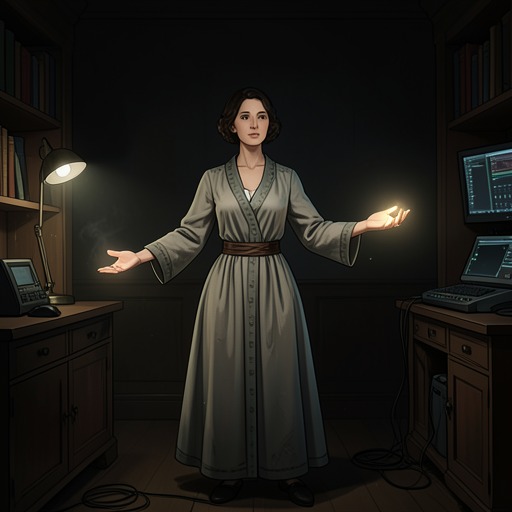
Late at night, Werner sits alone in the laboratory and tunes a Grundig tube radio that Volkheimer had borrowed from Dr. Hauptmann’s office. He searches the frequencies for music or echoes, without knowing precisely what he seeks. His attention moves between the radio’s circuits and images that arrive in his mind: Frederick looking into a book of birds; the machinery and smoke of the mines at Zollverein; and Jutta moving with a lit torch as darkness gathers around her. The passage brings technical systems, industrial labor, and family memory into one unsettled sequence, without making them reducible to a single explanation.
The wind pressing against the laboratory walls adds another kind of unseen force. The commandant has described it as coming from Russia and used frightening, dehumanizing language to cast an imagined enemy as a threat. Set beside Werner’s private search through frequencies, that rhetoric shows how invisible things can be assigned competing meanings: the wind is a physical presence at the walls, but it is also made into an instrument of political fear. The scene does not resolve Werner’s search. Its repeated static and unanswered call leave communication suspended between signal and silence.
A later encounter with a dented radio makes that uncertainty material. Werner examines its case, checks its fuses, valves, and plug pins, changes the leads to the battery, and tries the earphone again. When static returns, the sound recalls his childhood at Children’s House, where Jutta said his name. The memory is joined by an unexpected image of Rudolf Siedler’s house, with a large red banner hanging from ropes at the front. The repaired device therefore produces more than a technical result: its static opens onto remembered voices and images, while the passage places those memories alongside the radio’s present, imperfect operation.
The radio’s static is also registered across Werner’s functioning ear, the device, and the surrounding air. Dust turning in the flashlight’s weak beam accompanies the moment, making a normally overlooked material environment briefly perceptible. The scene does not turn static into a clear message; rather, its steadiness becomes the condition in which memory can surface. What the radio cannot provide as intelligible speech, it supplies as an occasion for recollection.
Marie-Laure LeBlanc and perception without sight
The motif takes a distinct form in the passage centered on Marie-Laure. It contrasts the limits of imagining blindness from the outside with her experience of an older, less surface-bound world. From an attic above the street, she attends to details at different distances and scales: lilies in marshes two miles away, American forces moving across fields and aiming cannons toward the smoke of Saint-Malo, and families gathered around hurricane lamps in cellars. The passage also registers crows, flies, tamarinds, jays, dune grass, the granite on which Saint-Malo stands, and the ocean surrounding it.
This catalogue keeps nearby human activity beside a much broader natural world. Marie-Laure’s attention extends from people living through bombardment to islands, tides, dolphins in the Channel, and the bones of whales far below the water. It reaches, too, to the snails in her grotto. These details do not make blindness a supernatural power; instead, the writing represents her perception through an expansive attentiveness to sounds, remembered knowledge, and the relations between places and living things. The movement from attic to seafloor makes the world feel larger than any single view of it.
Form and significance
The motif’s force comes partly from the different ways the narrative presents what cannot be seen. Werner’s scenes move through technical observation into involuntary memory, while Marie-Laure’s passage builds outward through a sustained inventory of what she attends to. The former leaves uncertainty in the radio’s static; the latter gives the unseen world a wide reach without reducing it to a visible panorama. Together, they distinguish incomplete perception from nonexistence: something may remain beyond direct sight and still shape experience.
Across these episodes, light, sound, and radio are not interchangeable symbols. The mathematical statement questions the authority of ordinary visibility; Werner’s radio makes communication tangible as a device whose operation may yield only static; and Marie-Laure’s perception gives narrative space to details that a sight-centered account might leave out. The recurring unseen is therefore both a limit and an opening. It marks what characters cannot straightforwardly grasp, while showing how memory, attention, and listening can make parts of that larger world present.