Jutta and Marie-Laure meet in Paris
All the Light We Cannot SeeJutta and Marie-Laure meet in Paris when a miniature wooden house brings the sisters of two former wartime adversaries face to face. The encounter joins histories that had remained separated by distance, silence, and death: Marie-Laure recognizes the house her father made, while Jutta learns that the blind girl her brother once helped is alive. Their exchange does not make the past simple, but it gives its scattered objects and memories a human context.
The Journey to Paris
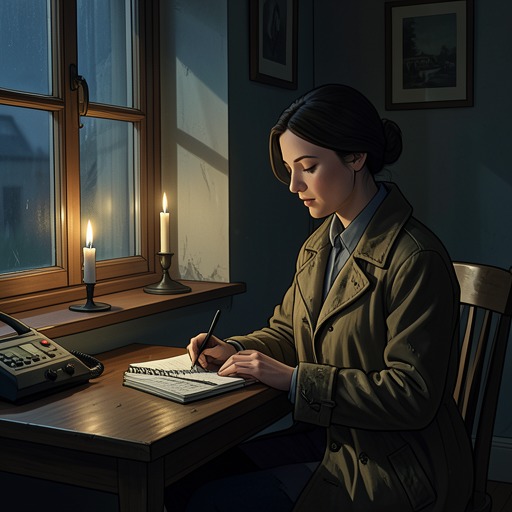
Jutta’s visit begins with a decision to travel rather than remain inside the routines of her postwar life. Her son Max is off school, and she suggests that he could see another country, learn some French, and visit the ocean. She and Albert both understand that the decision is hers to make. Before dawn on June 26, Albert prepares six ham sandwiches, wraps them in foil, and drives Jutta and Max to the station in the Prinz 4. She boards the train carrying Werner’s notebook and the model house in her purse.
The journey carries a history Jutta has tried to keep contained. When Volkheimer once came to deliver Werner’s letter, she did not want to take it or hear what he had traveled to say. In later years she has built a life in which the war is not constantly present: she can buy pork every day, and she can turn a dial to warm a cold house. She seldom allows herself to think of Werner, whose memory has become something to lock away. As a teacher in 1974, she does not speak of the brother who attended the National Political Institute of Education at Schulpforta. The trip therefore places a private memory back into motion, not by erasing Jutta’s distance from it, but by giving it a destination.
A House Becomes an Address
At a museum in Brittany, Jutta unwraps the partly crushed wooden house and tells the bearded man behind the counter that her brother had it and that she believes he found it there during the war. At first he shakes his head. Then he asks to see the model again, turns it beneath a lamp, and studies its recessed front door. Recognizing the house, he leads Jutta and Max through narrow, sloping streets, taking a dozen turns before they reach its real-life counterpart.
The address gives the model a specific history: it is the LeBlanc house at Number 4 rue Vauborel, by then subdivided into holiday flats. Lichens mark the stone; mineral stains trace the walls, and geraniums spill from the flower boxes. Jutta asks whether a girl lived there. The museum worker knows from his mother’s stories that a blind girl had lived in the house during the war and moved away when the war ended. At that answer, Jutta sees green dots across her vision and feels as if she has been staring at the sun. The object has led her not just to a building, but to the trace of someone whose life had intersected with Werner’s.
Recognition in the Laboratory
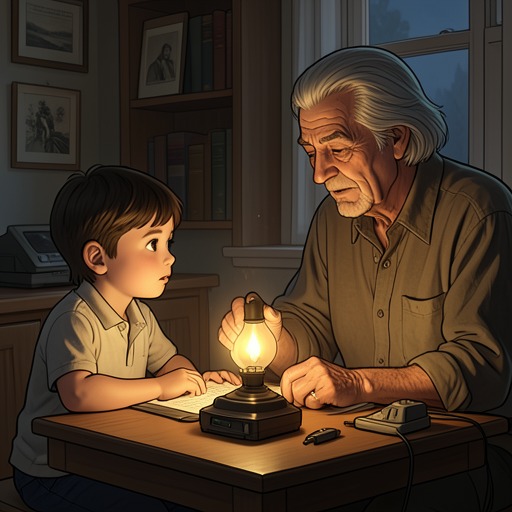
In July, at the museum where Marie-Laure works, an assistant tells her that a woman has come with her address from a museum in Brittany. Marie-Laure is at her Braille typewriter in a laboratory among bubbling aquariums and humming filters when the visitor arrives with Max. She recognizes that the woman learned French as a child; Max, by contrast, greets her in German. Their brief exchange about his French gives way to silence and recognition.
The woman has brought the model, wrapped in newspaper. Marie-Laure knows it by touch: the nicks along its sides and the slope of its roof are familiar from the times she held it. She says that her father made it. When Jutta asks how Werner acquired it, Marie-Laure sets it down suddenly, as if it were hot. The question makes the miniature more than a keepsake: it is an object that passed from Marie-Laure’s family into Werner’s possession, and now returns with his sister.
What the Women Learn
Marie-Laure considers the sequence of what Werner did during the siege. Over time, she thinks, events that once seemed jumbled can settle into place. Werner saved her life three times: first by not exposing Etienne when he could have, then by removing a sergeant major from her path, and finally by helping her get out of the city. She tells Jutta that she spent less than a day with Werner. Their exchange establishes both the brevity of their direct acquaintance and the enduring consequence of his choices.
Jutta tells her plainly that Werner died. The news confirms what Marie-Laure could infer but had not heard from his family. Marie-Laure’s account, in turn, gives Jutta a view of her brother outside the categories that tended to shape postwar stories of Germans: neither a heroic figure nor merely a monster, but a boy whose kindness remained present in a faint, difficult-to-place way. Jutta also says that it was not easy to be good then. Neither woman claims that goodness was simple or that one brief encounter can explain a whole wartime life.
The House and What Remains
Jutta says she wants Marie-Laure to have the little house, because it belongs with her more than with Jutta. As Jutta prepares to leave with Max, Marie-Laure asks her to wait. She tells her that, after the war, her great-uncle returned to Saint-Malo and salvaged the sole remaining recording of her grandfather, a recording about the moon. Jutta remembers it. Marie-Laure offers to mail it to her, thinking Max might like it, and asks her to leave an address.
The exchange leaves both the loss and the connection intact. Jutta brings back the model, but does not keep it; Marie-Laure offers a recording in return, another surviving object carried across the years. Their meeting cannot restore Werner or recover the whole story of the war. It does, however, allow each woman to receive something the other can provide: Marie-Laure learns that Werner’s death is known to his family, and Jutta learns what his actions meant to the girl he helped. The little house makes that recognition possible, while the promise of the old recording carries their conversation beyond the meeting itself.