Madame Manec's Death
All the Light We Cannot SeeMadame Manec’s death occurs in late June 1942, after a fever, and is confirmed only after Marie-Laure LeBlanc discovers her missing from the kitchen and finds her gravely ill. The episode turns a household routine into a vigil: Etienne LeBlanc summons help, women gather, and a doctor comes and goes. Madame Manec is carried out of the house by horse cart; afterward, Etienne tells Marie-Laure that she is dead. The loss also makes his responsibility for his niece newly explicit.
Discovery and Alarm
For the first time since her fever, Madame Manec is not in the kitchen when Marie-Laure wakes. The date is late June 1942. Marie-Laure considers that she might already have gone to the market, taps at her door, and waits. When there is no answer, she opens the rear door and calls into the alley. The morning outside is ordinary; the absence inside the house is not.
Marie-Laure lets herself into Madame Manec’s room and first hears her breathing. She finds Madame Manec in bed and realizes that her condition is serious. Her response is immediate: she hurries upstairs, calls for her uncle, and the household’s familiar spaces become, in her perception, threatened by disaster. The scene is told through Marie-Laure’s movement and alarm rather than through a medical explanation. The narrative supplies no diagnosis for Madame Manec’s illness, only the fever that preceded the discovery and the gravity of what Marie-Laure finds.
The Household Becomes a Vigil
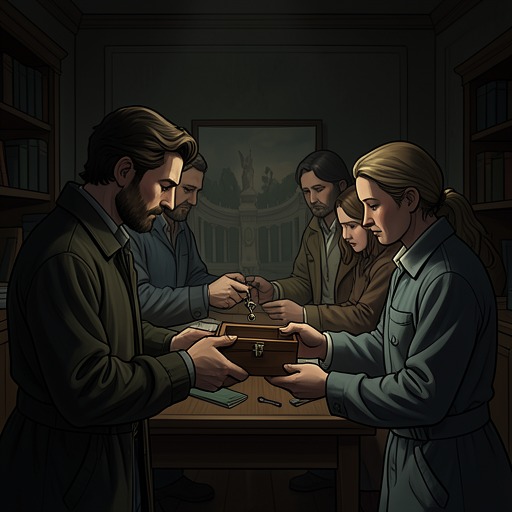
Etienne crouches beside Madame Manec, then goes to the telephone and speaks briefly. He returns to her bedside. Over the next hour, the kitchen fills with women, including Madame Ruelle, Madame Fontineau, and Madame Hébrard. Their arrival makes the domestic space crowded, and Marie-Laure paces the staircase while the doctor comes and goes. The focus remains on the household’s response: a call for help, neighbors assembling, and the wait for what can be done.
Madame Ruelle’s presence connects this gathering with the women’s wider everyday life under occupation. Elsewhere, she is shown taking part with Madame Guiboux in the nighttime rearrangement of road signs, then returning with her companion to the kitchen at Number 4 rue Vauborel. That episode does not establish that the sign-changing activity causes or directly surrounds Madame Manec’s death. It does, however, place one of the women who arrives at the sickroom within a neighborhood network that carries on both domestic and resistant work.
The account marks the decisive transition by the cathedral bells: at exactly two o’clock, the doctor returns with an unnamed man. The man says little, lifts Madame Manec, carries her out to the street, and sets her on a horse cart. The description records the practical sequence without explaining the man’s role or giving a medical judgment. The horse cart moves away; the doctor strips the bed. The actions signal an ending before anyone states it aloud.
Confirmation and Immediate Aftermath
Marie-Laure finds Etienne in a corner of the kitchen. He whispers that Madame Manec is dead. The news reaches her not through the doctor or the man who carried Madame Manec away, but through her uncle, in the house where the women had gathered. The understated confirmation closes the uncertainty of the vigil and changes the meaning of the earlier absence from the kitchen: Madame Manec will not return to her place in the household.
Etienne withdraws after the death. Four days later, he comes out of his room and descends the stairs. The women in the kitchen fall silent. He asks them to leave, explaining that he needed time to say goodbye and now has to look after himself and his niece. His words link private grief to a practical consequence: with Madame Manec gone, he must resume life in the house and take responsibility for Marie-Laure. The women’s presence, which had filled the kitchen during the illness, gives way to his request for privacy and his return to that responsibility.
A Changed Household
The death’s consequences continue in a later encounter between Etienne and Marie-Laure. He comes down the seven ladder rungs, passes through the back of the wardrobe, and takes her hands before telling her that her father had asked him to keep her safe. The scene does not present this promise as a substitute for Madame Manec or as a new event in her illness. Instead, it shows the family obligation that remains after the loss: Etienne’s care for Marie-Laure is grounded in her father’s request, and Madame Manec’s death leaves that care to be carried forward by him.
The episode’s structure moves from absence, to a crowded vigil, to removal and whispered confirmation, and finally to the altered life of the household. Madame Manec’s death is not accompanied by an account of its medical cause or by a description of a funeral. Its significance is conveyed through what others do around it: Marie-Laure searches and calls for help, the women gather, Etienne withdraws and then returns, and his duty toward his niece becomes explicit. The kitchen that first registers Madame Manec’s absence becomes the place where her death is acknowledged and where the survivors begin to reckon with what follows.