Madame Manec’s Resistance Group
All the Light We Cannot SeeMadame Manec’s Resistance Group, also called the Old Ladies’ Resistance Club, is a women’s resistance circle in occupied Saint-Malo whose methods grow out of the work and resources already embedded in daily life. Rather than begin with a dramatic operation, the group identifies the ordinary services on which the occupying power depends, then looks for ways to obstruct them. Its resistance takes practical forms: misleading transport and deliveries, altering road signs, and putting a political message into circulation through money. The women’s activity makes the kitchen at Number 4 rue Vauborel a place where complaints can become plans.
Formation and Purpose
Marie-Laure LeBlanc listens from her customary place near the fireplace as Madame Manec’s friends complain about daily conditions. Their grievances include an indefensible price for carrots, a farcical exchange rate, and duplicity everywhere. Madame Manec shuts the kitchen door with its deadbolt and clears her throat; the women fall quiet. The gesture marks a change in the gathering: what had been shared complaint becomes a discussion of what they might do together.
Madame Manec frames the women’s position through their practical roles in the occupied town. One woman’s son repairs soldiers’ shoes; Madame Hébrard and her daughter sort their mail; Madame Ruelle’s bakery makes much of their bread. The point is not that these women control the occupation, but that its daily operation relies on local labor. Their usefulness to the occupying system also gives them small openings to interfere with it.
The proposal remains deliberately modest. Madame Manec rejects the idea of doing anything overly bold and turns instead to “smaller things” and “simpler things.” That scale is central to the group’s character as presented: resistance is not separated from routine life but worked into familiar tasks, routes, workplaces, and objects. Its actions depend on cooperation and local knowledge rather than on a single spectacular confrontation.
Methods and Operations
One operation uses a stepladder and a ratchet set. Madame Ruelle straps the ladder to her husband’s car, then drives the Route de Carentan at dusk with Madame Guiboux. Together they rearrange road signs. They return to the kitchen of Number 4 rue Vauborel laughing and drunk. The scene gives the resistance a concrete, unassuming method: road signs can be changed using tools and access the women can plausibly bring to an ordinary journey. The narrative reports the alteration, but does not specify its military consequences or how long the signs remain changed.
Other actions target the movement of goods and information. The women send a shipment of rayon to the wrong destination and deliberately misprint a train timetable. These interventions exploit the dependence of wartime administration and logistics on accurate routing and documentation. The women do not need to command the systems they disrupt; they need only introduce errors at points where ordinary work passes through their hands.
Madame Hébrard’s action is more personal and immediate. As postmistress, she takes an important-looking letter from Berlin, hides it in her underpants, brings it home, and uses it to start her evening fire. The letter is removed from the flow of official correspondence and destroyed through an everyday domestic act. The account identifies neither its contents nor the consequences of its disappearance, so the episode establishes the group’s willingness to interfere with communications without revealing what information was lost.
The Five-Franc Campaign
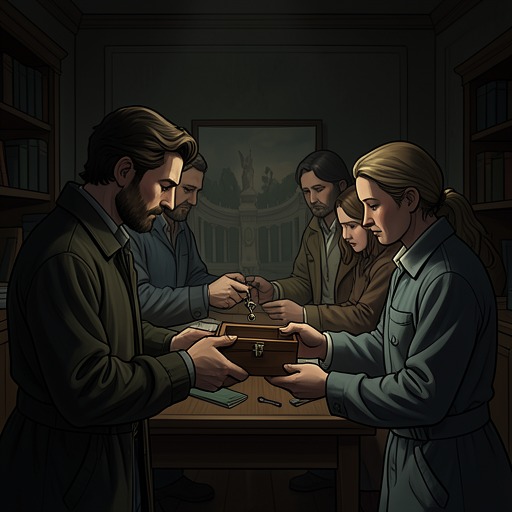
Madame Manec also organizes an effort to circulate a message through money. She asks the women to give their money to Madame Blanchard, assuring them they will get it back, and provides her with Etienne LeBlanc’s fountain pen. Madame Blanchard, whose handwriting Madame Manec praises, is instructed to write “Free France Now” on each five-franc note. The plan relies on the ordinary circulation of cash: because people cannot afford to destroy their money, the marked bills are expected to carry the message as they are spent.
The campaign is designed to extend beyond the women’s immediate circle. Madame Manec says that after the bills have been spent, their message will go out across Brittany. This is presented as the group’s intended result, not as a confirmed account of how many notes are marked or where they eventually travel. The choice of a small denomination and a fountain pen makes the means of communication ordinary; its political purpose turns routine exchange into a vehicle for dissent.
Occupation and Everyday Resistance
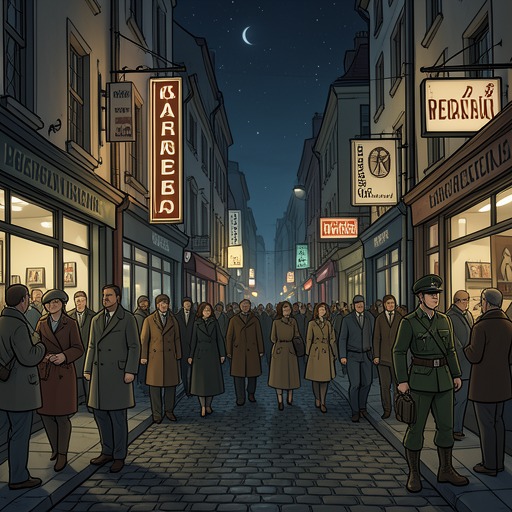
The group’s activities acquire their meaning in a town where occupation reaches into everyday decisions. Marie-Laure has to ask her father three times before he reads aloud a notice ordering residents to surrender all radio receivers. The sets must be delivered to 27 rue de Chartres before noon the next day, and anyone who fails to comply is threatened with arrest as a saboteur. The notice shows the pressure placed on civilian access to communications, though the text does not say that the women’s group owns or hides a radio.
A separate letter from Frau Elena conveys another aspect of the radio landscape: after at least two months without hearing a professor’s broadcasts, she wonders whether the broadcasts have stopped or whether the problem lies with the listeners. She also describes how a powerful transmitter in Brandenburg overwhelms other signals on the dial. This passage is not identified as an operation of Madame Manec’s group. Read alongside the radio surrender order, however, it helps establish that communication is both vulnerable to state control and a matter of everyday concern. The group’s documented actions answer that climate through local acts—altering signs, misdirecting goods, interrupting mail, and marking currency—rather than through any stated radio operation.
The group’s significance lies in the way it converts the language of dependence into a repertoire of action. Madame Manec points out that ordinary work helps the occupying world run; the women then use the routines of that work to make it run less smoothly and to circulate a contrary political message. The evidence offers no complete account of the group’s membership, command structure, or eventual impact. What it does show is a circle that begins in a kitchen, identifies small points of leverage in civilian life, and acts through shared labor and practical ingenuity.