Madame Ruelle
All the Light We Cannot SeeMadame Ruelle, the baker’s wife in occupied Saint-Malo, makes the bakery more than a place to obtain rationed bread: it becomes a discreet point of contact in the local resistance network. Her assistance is practical and repeated, built into ordinary errands rather than separated from them. By passing a folded paper beneath a loaf, guiding messages toward Etienne LeBlanc, and later taking part in the response to the Allied advance, she helps link the daily life of the occupied city to clandestine action.
Identity and Place in Saint-Malo
Madame Ruelle is identified through her connection to the bakery and its domestic setting. She is the baker’s wife, and her work gives her an everyday reason to encounter customers and to pass between the bakery and the household at Number 4 rue Vauborel. The novel makes that familiar commercial routine useful to the resistance: bread and ration coupons can continue to move through public life while a message travels with them.
Her place in the network is collaborative rather than solitary. She communicates with Marie-Laure LeBlanc and Etienne LeBlanc, and her activities also involve other women, including Madame Guiboux. The evidence presents her not as a formal leader with an announced title, but as someone whose local knowledge, access, and willingness to act make resistance possible in practical ways. The bakery’s ordinary purpose supplies cover for exchanges that would be conspicuous if conducted openly.
The Bakery as a Communication Route
Marie-Laure’s journey to the bakery is organized around precise instructions she can follow independently. From rue Vauborel, the route proceeds to rue d’Estrées, then turns by a counted series of storm drains toward rue Robert Surcouf and the bakery. On a later trip, she counts drains along the way, passing the butcher at twenty-one and reaching the bakery at twenty-five. These details establish how measured navigation and a routine purchase become part of a dependable communication system.
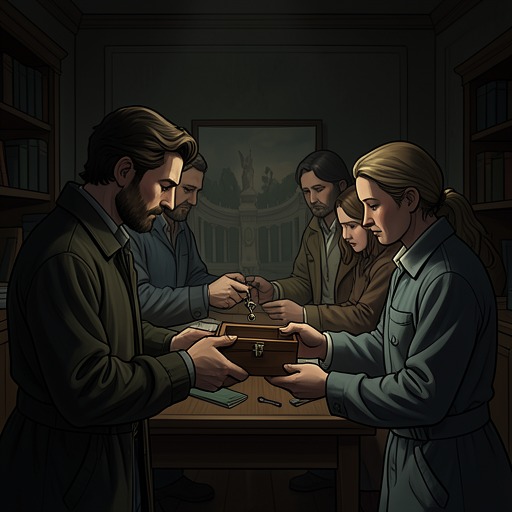
In the summer of 1943, Madame Ruelle uses that routine to pass Marie-Laure a folded piece of paper beneath a loaf. She asks her quietly to find out whether Etienne can read it. Marie-Laure takes the bread and paper home, secures the door, and the message reaches Etienne. The exchange gives Madame Ruelle a precise intermediary role: she does not merely provide a meeting place, but places information into the chain that connects a customer’s errand to the household’s clandestine work.
Etienne reads numbers and messages into a microphone, broadcasts them across five different bands, gives instructions for the next transmission, and plays a portion of an old record. The whole broadcast lasts no more than six minutes. Madame Ruelle’s contribution belongs to the less visible part of that operation—the delivery that allows the message to reach the person who can transmit it. The short duration of the broadcast contrasts with the careful, repeated movements required to keep the channel functioning.
Her work also depends on repetition. Marie-Laure returns to the bakery for a loaf, using the same counted landmarks and presenting a ration coupon. Because the errand remains recognizable as an ordinary part of occupied life, it can carry a second purpose without needing to announce itself. The story therefore presents resistance not only through dramatic confrontations, but through a pattern of small actions whose meaning depends on trust and regularity.
Other Acts of Resistance and the Changing War
Madame Ruelle’s resistance extends beyond the bakery. At dusk, she travels with Madame Guiboux along the Route de Carentan, with a stepladder secured to her husband’s car, and rearranges road signs using a ratchet set. They return to the kitchen at Number 4 rue Vauborel laughing. The episode shows her participating directly in an act that alters the occupied landscape, rather than only carrying information through her work. It also places that action within a small group of women acting together.
As the military situation shifts, the bakery remains a place where news and practical decisions meet. After a German antiaircraft battery shoots down an American plane off Paramé, the pilot reaches shore and is taken prisoner. Madame Ruelle responds with evident excitement about the prospect of the arriving Americans while handing Marie-Laure a loaf. The moment sets her hopeful reaction against Etienne’s view of the crash as a calamity, showing that the same wartime event can be read differently by people confronting different immediate stakes.
Later, with Allied bombs demolishing the rail station, the Germans disabling harbor installations, and American forces nearing the region, Etienne hears reports that liberation may be close. He reaches the bakery as Madame Ruelle opens it. She ushers him inside and asks whether he can manage a request for the locations and coordinates of antiaircraft batteries. The scene records her role in bringing an intelligence task to Etienne at a moment when the approaching liberation makes that information urgent. It does not establish the result of the request, but it does show the bakery and its keeper serving the resistance as the city’s circumstances change.
Liberation and Narrative Significance
After the siege, Madame Ruelle finds Marie-Laure in a requisitioned school, grips her hand, and stays with her. They eat confiscated German chocolate together. The reunion shifts her function from intermediary to companion: the same network that had depended on discreet messages now appears as human contact in the aftermath of battle.
The following morning, American forces take the château and the last antiaircraft battery and free prisoners held at Fort National. Madame Ruelle pulls Etienne out of the processing queue, and he embraces Marie-Laure. Her action helps restore the connection among the people whose cooperation had sustained resistance under occupation. The novel later specifies that on August 25 she is allowed back into the city to check the condition of the bakery. Etienne and Marie-Laure travel in the opposite direction, so Madame Ruelle’s return to her workplace coincides with their departure from Saint-Malo.
Her narrative importance lies in the way she makes resistance legible through ordinary practices: selling bread, receiving a ration coupon, passing a paper, and keeping contact across households. Those acts do not erase the danger of occupation or determine the military outcome, but they give the local network means to communicate and respond. The bakery remains both a place of daily necessity and a working link in a broader chain of resistance, while Madame Ruelle’s final return to inspect it marks the persistence of ordinary life after the city’s liberation.