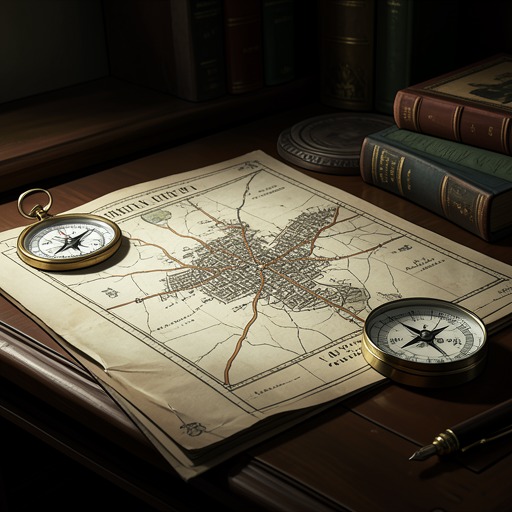
Maps, models, and scale
All the Light We Cannot SeeMaps and models are not simply miniature copies of places in Marie-Laure LeBlanc’s life: they are instruments she learns to read, imperfect translations of experience, and objects that can hold secrets. A model of her Paris neighborhood helps her build a usable sense of direction through touch and sound, while a model of Saint-Malo gives her a detailed route through the city where she is stranded alone during an air raid. Together, they make scale both a problem of representation and a means of survival.
The miniature city as a tactile map
On the sixth floor of the tall house at Number 4 rue Vauborel, Marie-Laure kneels over a model of Saint-Malo, the walled city around her. Its miniature streets and buildings reproduce the place in a scale her hands can explore: the cathedral and its perforated spire, the old Château de Saint-Malo, rows of seaside mansions, the jetty at the Plage du Môle, the seafood market’s vaulted atrium, and tiny benches set in the public squares. The model is not an abstract diagram. Its houses, landmarks, and routes correspond to a lived city, compressed until a fingertip can travel across what a person would have to walk.
Marie-Laure follows the centimeter-wide parapet along the ramparts and traces an uneven star around them. Her fingers locate the opening where four ceremonial cannons face the sea, then descend by a little staircase toward named streets. From the cathedral spire she travels south to the Gate of Dinan. Naming and touching give her a route through the miniature; repeated journeys make its small distances intelligible. While she waits for Etienne LeBlanc, who has been gone since the previous night, she marches her fingers around the model through another revolution of the clock. The city outside is quiet, but the map keeps a route available to her.
Learning the Paris neighborhood
The earlier model of Marie-Laure’s Paris neighborhood initially fails to convey what the real streets are like. A miniature intersection of rue de Mirbel and rue Monge bears little resemblance to the actual one as she experiences it: there, traffic, bakery bread, the pharmacy, flowers, roasting chestnuts, and conversations give the intersection its changing character. The model offers only dried glue and sawdust, static pavements, and empty streets. It records the arrangement of buildings but not the abundance of sound and smell that makes a place familiar. For a long time, it is an insufficient facsimile rather than a guide.
Her father Daniel LeBlanc nevertheless asks her to run her fingers over the model, recognize houses, and attend to the angles of streets. He turns that practice into a real-world exercise after she has been blind for more than a year. Near the Jardin des Plantes, he explains where they are, spins her around three times, and asks her to lead them home by thinking of the model. The scale changes the task: a journey of six blocks has to be reconstructed from relationships among streets, rather than recognized by sight. At first she cannot tell whether the gardens lie ahead or behind. Daniel encourages her to use logic and proceed one centimeter at a time.
The exercise takes shape through repeated failure before it becomes competence. On successive Tuesdays, Marie-Laure leads Daniel on detours that leave them farther from home; she is angry and frustrated by the distance between the model’s order and the confusing world around her. In the winter of her eighth year, she begins to notice that details in the miniature have counterparts outside it: storm drains, benches, trees, and lampposts. She can bring Daniel within four blocks, then three, then two, before making a mistake. The model becomes more useful not because it changes, but because she has learned how to relate its small, fixed objects to the city’s larger spaces.
Scale translated through the senses
The decisive improvement comes when Marie-Laure no longer depends on the model alone. Near the Seine, after Daniel again spins her around and asks her to find the way home, she listens and smells her surroundings. Cars splash along the street; snowmelt drums through runnels; snow ticks through trees. The cedars of the Jardin des Plantes are a quarter mile away. The Metro beneath the sidewalk and the clacking branches near the Gallery of Paleontology help her identify where she stands. She recognizes the corner of the quay and rue Cuvier, then chooses to go left.
Numbers and sensory evidence work together. Six blocks, forty buildings, and ten tiny trees in a square are not merely measurements to memorize; they let her connect one intersection to the next. She follows rue Cuvier, turns onto rue Linné and then rue Daubenton, and counts storm drains. The exercise has changed from a test of whether she can reproduce a model to a method for coordinating remembered spatial relations with present sounds, smells, and surfaces. The miniature supplies a structure, while the city supplies information the miniature cannot contain.
That change also clarifies the limits of scale. A model can show that one street intersects another, but it cannot reproduce the full sensory life of the intersection. Marie-Laure succeeds when she can move between the reduced arrangement and the particular conditions around her. Her father's instruction is not to treat the miniature as the world itself, but to use its relationships as a way of reasoning through the world.
The model house and the stone
During the bombardment of Saint-Malo, the model acquires another, more immediate function. Sirens sound and planes approach, but Marie-Laure returns to the table at the foot of her bed rather than going straight to the cellar. Her fingers locate the miniature ramparts and the Bastion de la Hollande, then turn at the intersection of miniature rue d’Estrées and rue Vauborel. She follows the doorways to the house where she has lived for four years: Number 4, the derelict house owned by Etienne LeBlanc, reproduced within the model of the city.
The scale model contains an object that can be removed from the larger representation. Marie-Laure presses inward on the tiny front door, releasing a hidden catch, and lifts the little house out. It is about the size of one of Daniel LeBlanc’s cigarette boxes. As the bombers draw close enough for the floor to throb beneath her knees, she twists the miniature chimney, removes the three wooden roof panels, and turns the house over. A stone drops into her palm. The city model is thus more than a navigational aid: nested inside its representation of the streets is a concealed space holding the Sea of Flames.
When artillery continues after the bombers pass, Marie-Laure puts the stone back inside the model house, replaces the roof panels, twists the chimney into place, and slips the house into her dress pocket. She has to leave the sixth floor and make her way down through the damaged building, feeling for her cane and checking the air for warmth. The model’s compartments preserve the stone, while its representation of the city has already helped orient her within a place she cannot see. In danger, the miniature is at once map, container, and portable part of home.
Representation, knowledge, and survival
The models connect distinct stages of Marie-Laure’s experience without making them identical. In Paris, her father’s neighborhood model begins as a poor substitute for a world saturated with changing sensations; patient study lets her use it alongside sound and smell. In Saint-Malo, the carefully detailed city model gives her a tactile way to locate streets and landmarks, and its removable house conceals a precious object. One model teaches her how to translate scale into orientation; the other makes the relation between city and miniature materially intimate.
Their significance lies in the work required to move between a representation and the place it represents. The map is useful but incomplete: it cannot include every fragrance, noise, or danger. Marie-Laure’s knowledge grows through touch, repetition, counting, memory, and attention to what the model leaves out. The story’s recurring shifts between miniature and full-size space make scale a practical question—how to find a route, identify a location, or protect what matters—and a measure of how much understanding can be built from partial access to the world.