Marie-Laure LeBlanc and Etienne LeBlanc’s uncle-niece relationship
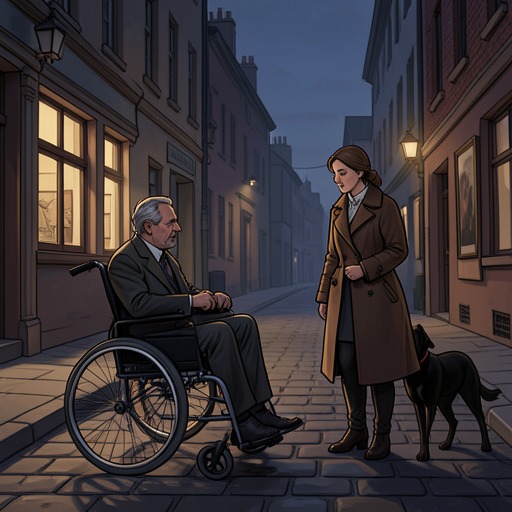
All the Light We Cannot SeeEtienne LeBlanc’s relationship with Marie-Laure LeBlanc is a bond of family care tested by absence, danger, and war. As her great-uncle, he becomes responsible for a blind child whose curiosity and independence exceed his confidence in his ability to protect her. Their closeness is not expressed through constant agreement: he fears the risks she takes, while she worries that her presence has burdened him. It is expressed instead through practical care, trust that must be renegotiated, and Etienne’s unmistakable insistence that her life has enlarged his own.
Family Care and Separation
When Marie-Laure’s father has been missing for twenty days, she withdraws from the household. She stops asking Madame Manec to take her to the station or to pursue another appeal to the authorities, and becomes difficult to reach even for those trying to comfort her. The episode places Etienne’s family relationship within a household struggling with uncertainty: Marie-Laure has lost contact with her father, while her great-uncle and Madame Manec remain among the people responsible for her care. The evidence does not make Etienne the answer to her grief; it shows how profoundly her father’s absence unsettles her despite the family support around her.
Etienne’s protectiveness coexists with his recognition that Marie-Laure has capacities he lacks. He knows she generally goes to the sea, returning with wet shoes and traces of sea plants on her clothes, but does not know exactly where she has been. The walk to the bakery takes four minutes each way, yet another thirteen or fourteen minutes seem to disappear along her route. He has reassured himself that she keeps safe and that her curiosity sustains her, and considers her capable in many ways in which he is not. His trust is real, but it rests partly on what he does not know; her independence creates both admiration and anxiety.
Rescue and Responsibility
When Etienne realizes that Marie-Laure has not returned, his uncertainty gives way to action. A memory of the ruined kennel beneath the ramparts directs him to a place associated with his own childhood, where he used to play with his brother, Henri LeBlanc, and Harold Bazin. He remembers it as a small cavern where a boy could shout and dream. That recollection becomes practically useful: Etienne follows the paths of his youth, turns through the ivy, and reaches the locked gate of the grotto with Madame Ruelle close behind him.
Inside, Marie-Laure is shivering and wet to her thighs, but otherwise unharmed; the remains of a loaf are in her lap. Her first response is to tell Etienne that he came. When he takes her face in his hands, the rescue becomes more than a return to safety: it confirms that, in the moment she was alone and hidden, he found her. The scene joins his remembered childhood geography to his present family duty. A place that once held his boyhood dreams becomes the place from which he brings his great-niece back.
Afterward, Etienne says that he should never have let Marie-Laure take on so much or put herself in such danger, and tells her she can no longer go outside. She is relieved by the restriction. The German who frightened her continues to haunt her in nightmares, so the decision follows a period in which her curiosity has exposed her to danger and fear. Etienne’s response is protective, but the episode also marks a limit: he cannot make her experience disappear, and she cannot simply resume her former freedom. Their care for one another must now account for what has happened.
Mutual Reassurance
The question of whether Marie-Laure is a burden surfaces directly when she asks Etienne if he regrets that she came to live with him and Madame Manec, or ever felt that she brought a curse into his life. The question links her place in the family to the language of misfortune that shadows the story. Etienne answers without hesitation, takes both her hands in his, and tells her that she is the best thing that has ever come into his life. His response does not treat her dependence as a debt to be repaid. It gives her an unequivocal place in his life, directly answering the fear beneath her question.
The exchange also reverses the direction of care. Etienne has acted as protector, but Marie-Laure needs to know what her arrival has meant to him; he, in turn, answers by making the value of their relationship explicit. The contrast between her fear of being a curse and his declaration of gratitude gives their family bond its clearest verbal form. His affection is not presented as an abstract duty owed to a relative, but as a personal attachment he affirms without qualification.
Separation and a Shared Future
During the bombardment, Etienne is held at Fort National while the city burns across the water. He begs his jailers and fellow prisoners to help him reach his blind great-niece, explaining that she is alone. He also tries to persuade the German guard that his papers were taken unfairly and that he is not a terrorist. His appeals do not secure his release: the guard turns back toward the burning city, and Etienne remains separated from Marie-Laure. The episode makes the cost of that separation concrete without suggesting that his concern has diminished; he is focused on her safety even when he has no power to reach her.
At that same moment, with his cheek against a granite paver at Fort National, Etienne imagines a future in which he and Marie-Laure survive. He resolves to let her choose a place near the equator and travel with her by ship or airplane until they reach a rainforest among flowers whose scents they have never known. The imagined journey gives her the choice and gives him a place beside her. It contrasts sharply with his present confinement and the burning city, but it remains conditional on their survival; the evidence presents it as a hope, not an accomplished escape. His family role thus extends beyond immediate protection toward a future in which Marie-Laure can choose where they go.
Across these episodes, their relationship moves between trusting her independence and trying to shield her from danger. Etienne’s confidence in her capability does not prevent fear, and his protectiveness does not erase her agency. When war makes protection impossible, his pleas and his imagined journey preserve the same attachment in different forms: first as an urgent attempt to reach her, then as a hope that they will again be able to travel together.