Marie-Laure decides not to discard the Sea of Flames yet
All the Light We Cannot SeeMarie-Laure decides not to discard the Sea of Flames yet, choosing to conceal it again inside the model house instead of casting it away. Her hesitation holds together the scene’s competing pressures: grief makes the stone seem like the cause of repeated misfortune, its apparent value makes it difficult to relinquish, and her uncertainty about the curse leaves neither disposal nor safekeeping feeling straightforward.
The Stone and the Accumulation of Loss
The Sea of Flames is described as surfaced by hundreds of facets. Marie-Laure repeatedly picks it up only to put it down again, as though it burns her fingers. The gesture gives physical form to her reluctance: she cannot comfortably hold the stone, but she cannot yet make herself part with it. Her question is not abstract. She connects it with her father’s arrest, Harold Bazin’s disappearance, and Madame Manec’s death, wondering whether one rock could have brought so much sorrow.
The remembered words of Dr. Geffard enlarge the object’s history and value. He had imagined queens wearing it and wars being fought over it; the legend also promises that its keeper will live forever while misfortune falls, one after another, on everyone the keeper loves. The stone therefore presents Marie-Laure with more than a costly object. It carries a story that makes possession seem both desirable and dangerous, while her own losses give that story an immediate emotional force.
The Alternatives She Considers
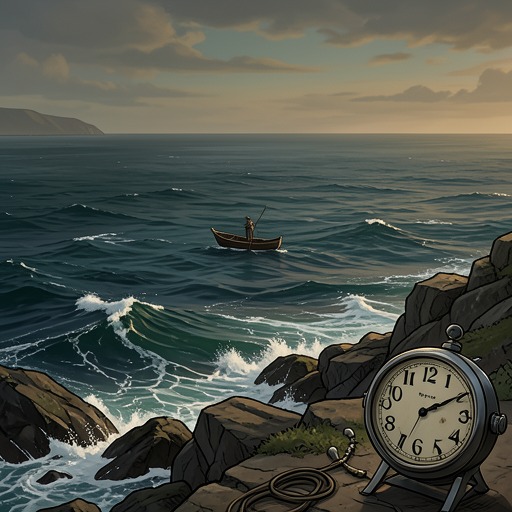
Marie-Laure briefly imagines decisive ways to end the problem: opening the shutters and throwing the stone into the street, giving it to someone else, or leaving the house to hurl it into the sea. None becomes action. The possibility that the German is searching for this particular stone makes it dangerous to treat as an ordinary possession, while its apparent value makes surrendering it to another person no simple solution. She recalls the question of who would willingly throw five Eiffel Towers into the sea, a measure of the scale of its supposed worth.
The curse sharpens the dilemma rather than resolving it. Marie-Laure asks herself whether it could be real and what might happen if she gave the stone to her uncle. At the same time, she knows the rational account of the world: curses are not real, and the Earth consists of magma, continental crust, and ocean, governed by gravity and time. Her hesitation occupies the gap between that material explanation and the story of calamity attached to the jewel. Neither the legend nor the scientific description erases the practical and emotional stakes of deciding what to do with it.
Why She Keeps It
Etienne climbs to the attic and turns on the transmitter while Marie-Laure puts the stone in her pocket and lifts the model house. She is crossing the hall toward the wardrobe when she stops to reconsider what Daniel LeBlanc intended. She reasons that her father must have believed the stone was real: otherwise, she wonders, why construct such an elaborate puzzle box, and why leave it behind in Saint-Malo if not because he feared it might be confiscated on his journey back? Her questions make the model house part of the decision. It is both the container that conceals the stone and a clue through which she interprets her father’s choices.
Marie-Laure also weighs what her uncle might do if she showed him a blue diamond that looked genuine and was supposedly worth twenty million francs. The thought complicates the idea of simply asking him to throw it into the ocean: even if the jewel is only a pebble in one sense, its appearance and attributed value could persuade people to treat it as precious. She does not settle the question of whether the curse is true. Instead, she closes her fist, returns the stone to the model house, slides its three roof panels back into place, twists the chimney ninety degrees, and slips the house into her pocket.
An Unresolved Choice
The action is deliberately provisional. Marie-Laure does not destroy the stone, give it away, or expose it; she restores its concealment and carries the miniature house with her. Her choice preserves her ability to decide later while keeping the object out of view. The small, exact motions of replacing the roof panels and turning the chimney contrast with the immense possibilities she has just considered: a family curse, a fortune, confiscation, or the sea.
Her thought that “Things are just things. Stories are just stories.” offers a counterweight to the legend, but not a command she can simply follow. The stone remains entangled with her father’s puzzle, the losses she associates with it, and the danger of the German’s search. By keeping it for now, Marie-Laure acts without claiming certainty. The decision marks a pause in the conflict between material fact and inherited story: she neither accepts the curse as truth nor treats the jewel as harmless enough to discard.