Marie-Laure learns to navigate home
All the Light We Cannot SeeMarie-Laure LeBlanc’s gradual mastery of the route home transforms her father’s miniature neighborhood from an inadequate copy into a practical map she can carry in her mind. In an exercise set by Daniel LeBlanc, she must orient herself in familiar streets after he has spun her around and find the way back. Her progress is measured not by sight, but by the details she learns to connect: the model’s miniature landmarks, the city’s sounds and smells, and the routes between them.
The Model and the Real Neighborhood
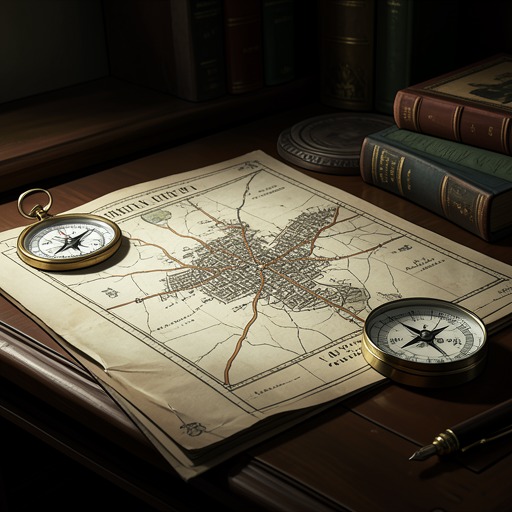
For a long time, Daniel LeBlanc’s model makes little sense to Marie-Laure. Its miniature intersection of rue de Mirbel and rue Monge is only a block from their apartment, yet it bears little resemblance to the place she knows through her other senses. The real intersection changes with the seasons and the hour: traffic and castor oil mix with bread from a bakery, camphor from Avent’s pharmacy, and flowers from a stand; winter brings roasting chestnuts, while summer evenings grow slow with conversation and the scraping of iron chairs. The model offers none of that. It smells of dried glue and sawdust, and its empty streets and fixed pavements seem to her an insufficient facsimile.
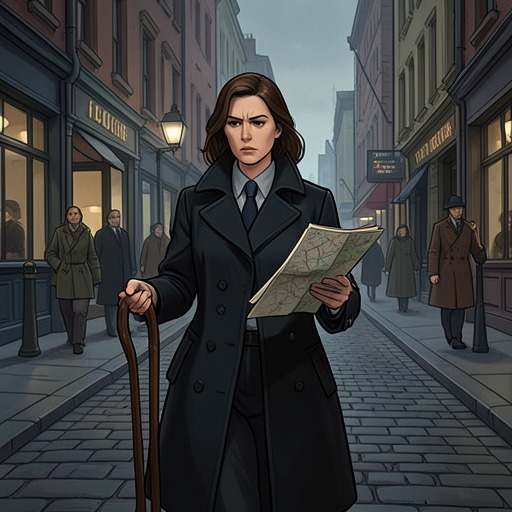
Daniel nonetheless asks her to run her fingers over the model, learning the houses and the angles of its streets. On a cold Tuesday in December, more than a year after Marie-Laure has become blind, he takes her up rue Cuvier to the edge of the Jardin des Plantes and identifies the path they take every morning, with the Grand Gallery beyond the cedars. Then he picks her up, spins her around three times, and tells her to take them home. The model is not merely a miniature to inspect: it is the basis of a test that asks her to connect its arrangement to the city beyond it.
Repeated Attempts
The exercise does not yield an immediate success. Tuesday after Tuesday, Marie-Laure fails, leading her father on detours of six blocks. The repeated mistakes leave her angry and frustrated, and take them farther from home than where they began. Her difficulty reflects the gap between knowing that a model exists and being able to use it to orient herself in a real, changing environment.
In the winter of her eighth year, details begin to accumulate. At the kitchen model, she counts miniature benches, trees, lampposts, and doorways. Each day another correspondence becomes clear: storm drains, park benches, and hydrants in the model have counterparts in the neighborhood. Her attempts bring her father progressively closer to home before she makes a mistake—first to within four blocks, then three, then two. The route becomes legible through patient recognition of its parts, rather than through a single leap from confusion to certainty.
Reading the City Without Sight
On a snowy Tuesday in March, Daniel takes Marie-Laure to a new starting point near the Seine, spins her three times, and asks her to lead them home. This time, dread does not rise in her as it had during previous attempts. She squats on the sidewalk and attends to what surrounds her: the faint metallic smell of falling snow, cars splashing along the streets, and snowmelt running through the channels. Snowflakes tick and patter through the trees; from a quarter mile away she can smell the cedars in the Jardin des Plantes.
These impressions help her locate herself. The Metro hurtling beneath the sidewalk marks the Quai Saint-Bernard; the opening sky and clacking branches identify the narrow gardens behind the Gallery of Paleontology. From those clues she works out that she is at the corner of the quay and rue Cuvier. The passage makes orientation an active combination of listening, smell, memory, and spatial reasoning. As she recalls the model’s six blocks, forty buildings, and ten tiny trees in a square, its measured scale gives structure to the sensory evidence around her. The guiding phrase is “One centimeter at a time.”
Finding the Way Home
Marie-Laure gives Daniel a direction: “We go left.” They walk up rue Cuvier, then turn left on rue Linné and right on rue Daubenton. She counts storm drains as they approach the open ironwork fence of the Jardin des Plantes, recognizing its thin spars by the model’s arrangement. The sequence of landmarks and turns shows her using the model not as a substitute for the real neighborhood, but as a framework for interpreting it.
Halfway up rue des Patriarches, they reach their building. Marie-Laure finds the chestnut tree growing past her third-floor window and touches its bark. In the next moment, Daniel swings her up by the armpits. She smiles; he laughs, and they turn together on the sidewalk as snow falls through the branches. His unrestrained laughter and her recognition of the tree mark the emotional as well as practical end of the exercise: a route that had repeatedly carried them away from home has brought them back to a familiar point she can identify for herself. The scene’s achievement lies in the joining of two kinds of knowledge—the carefully handled model and the living city she learns to read around her.