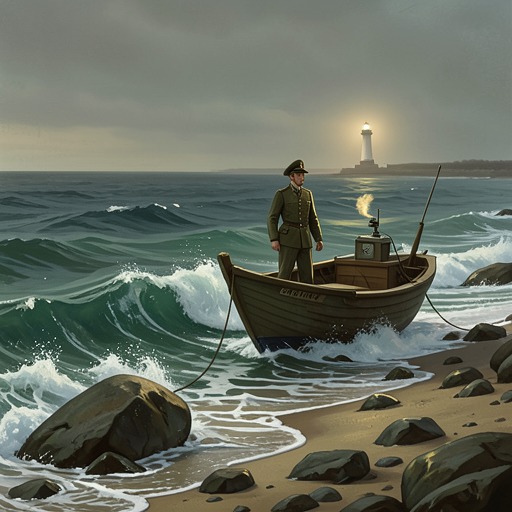
Marie-Laure places the miniature house hiding the stone in the seaside grotto
All the Light We Cannot SeeMarie-Laure LeBlanc places the miniature house hiding the stone in a seaside grotto beneath the ramparts, entrusting it to the tide as civilians stream out of the city. The act is both practical concealment and a decisive relinquishing of control: she makes certain the small wooden object is in the water, then locks the grotto behind her and returns with Werner to the evacuation route.
The Route Through a Departing City
Werner and Marie-Laure move through a city marked by departure. Ahead, three women carry bundles; at a cross street, he sees a woman in blue taffeta dragging an overstuffed suitcase over a curb, followed by a boy in clothes that seem too small for him. Marie-Laure asks Werner for the street name, then leads him onward with her cane tapping back and forth in her right hand. The contrast is immediate: people are leaving with what they can carry, while she guides Werner away from the visible stream of evacuees and toward a concealed destination.
Their route passes a walnut tree that resembles a charred toothpick, two crows picking at something unidentifiable, and ivy hanging above a narrow alley at the base of the ramparts. Werner offers to call to the civilians. Marie-Laure declines, saying she needs only a moment, and leads him deeper into the alley. The ocean air reaches them through a gap in the wall before Werner can see it. That unseen opening directs their movement: the sea is close, but the way to it is hidden.
The Locked Grotto
At the alley’s end, Marie-Laure reaches a narrow gate and takes a key from inside her coat. Werner can see through the gate into a low space bounded by a grate on the far side. Water is already there, and he warns that they must hurry. The tide gives their brief visit a deadline; the grotto is not a static hiding place but a space the sea is actively entering.
Marie-Laure passes through the gate and descends in her big shoes. She moves confidently, running her fingers along the walls as if recognizing old companions. The gesture makes the hidden place seem familiar to her, even as Werner’s warning emphasizes the immediate danger of the rising water. The tide pushes a low ripple through the pool, washing over her shins and dampening the hem of her dress. She takes the small wooden miniature house from her coat and sets it in the water.
Leaving the Stone to the Sea
As she places the miniature house in the pool, Marie-Laure asks Werner whether it is in the ocean and insists that it must be. Werner confirms that it is in the water and urges her to leave. She asks once more whether he is certain; he answers yes. Her repeated question makes the placement’s condition plain: it is not enough for the object to be hidden in the grotto. She needs assurance that the sea has reached it.
The scene does not describe her abandoning the object casually. She has brought it with her, used a key to reach the grotto, and taken the time to put it into the tide despite Werner’s urgency. The water becomes the means by which the miniature house hiding the stone is placed beyond the immediate reach of the departing people around them. The act’s significance lies in its exactness: she wants it in the ocean, and Werner’s confirmation allows her to leave it there.
Return to the Evacuation Route
Marie-Laure climbs out breathless, pushes Werner back through the gate, and locks it behind them. He hands her cane back. They retrace their steps through the alley, her shoes squelching, and emerge past the hanging ivy. At the next intersection, the flow of civilians is still moving: a woman and a child cross with two men carrying a third on a stretcher, all three men smoking. The private, enclosed action therefore sits directly beside the public fact of people escaping a battered city.
The episode ends not with the grotto’s contents being shown again, but with Werner’s physical weakness and his thoughts about time. As darkness returns to his eyes and he feels faint, he remembers broken miners at Zollverein waiting in chairs or on crates. Against that image of time draining away, he thinks of life as a glowing puddle that must be protected from spilling. The thought gives the deposit in the grotto an echo beyond concealment: in a scene governed by limited time, rising water, and exhaustion, Marie-Laure has made one deliberate choice about what to protect and where to leave it.