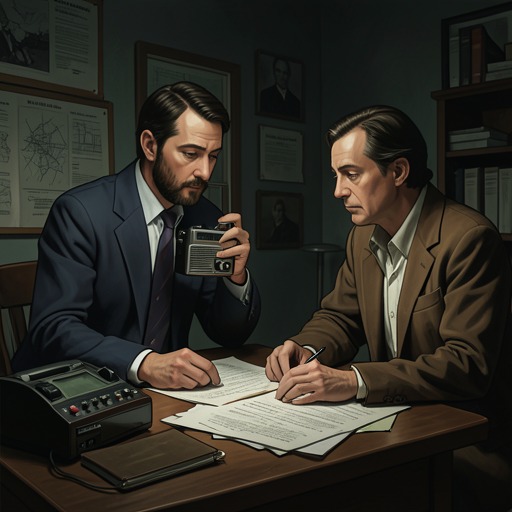
Marie-Laure sends a clandestine broadcast
All the Light We Cannot SeeMarie-Laure sends a clandestine broadcast from a transmitter in the LeBlanc house during the siege of Saint-Malo. Using equipment installed by her uncle, Etienne LeBlanc, she reads aloud into a microphone, unaware that Werner Pfennig, trapped beneath the Hotel of Bees, is listening. The transmission turns a fragile radio signal into an unexpected link between two people separated by rubble, darkness, and immediate danger.
The Transmitter and Its Setting
The transmitter waits on a table beside the chimney, with two marine batteries beneath it. Marie-Laure knows that someone might have a radio: perhaps the fire brigade, the resistance, American forces, German soldiers, or Etienne himself. These are possibilities rather than confirmed listeners. She imagines her uncle turning the dials of another radio and considers that he may need a sign of hope, but she cannot know who will receive her signal.
To bring the apparatus into use, she feels along the chimney stones until she finds the lever Etienne installed. She presses it, raising the antenna above the roof. After pausing to listen for any response from downstairs, she reaches under the table and operates the switches. She cannot remember which controls the microphone and which the transmitter. The vacuum tubes begin to thrum, and she proceeds without certainty that the equipment is working as intended or that the signal will reach anyone.
The material construction of the scene matters: a lever, an antenna, batteries, switches, and tubes make communication possible, but none guarantees a reply. The transmitter had been built years earlier to speak to a ghost; now Marie-Laure puts it to practical use in a city filled with smoke and fires. Her cautious pauses and uncertain handling show that the act depends not on mastery of every control, but on attempting to send a message despite the risk and the unknown audience.
Werner's Receiver
Werner's presence at the other end of the signal has its own history. As a child, he found a crude radio in refuse behind a storage shed with his sister, Jutta Pfennig. The discovery began a relationship with radio as a device assembled from parts and as a means of reaching voices beyond immediate surroundings. Later, he designed transceivers with Dr. Hauptmann. In wartime, those instruments become part of military equipment: a radio truck carries listening decks, an antenna, headsets, maps, and two transceivers he had designed.
At the moment of Marie-Laure's broadcast, however, Werner is not in a functioning truck or a secure station. He is listening on the fourth day after becoming trapped beneath what remains of the Hotel of Bees. He has repaired a transceiver and moves its tuning knob back and forth, searching through the signal. The contrast is sharp: the equipment that once belonged to organized military operations is now being used in a damaged, improvised setting, where a single voice must emerge from interference to be understood.
The Reading and the Warning
Marie-Laure opens a novel in her lap, finds the lines by touch, and brings the microphone to her lips. She reads from Twenty Thousand Leagues Under the Sea. The passage describes the Nautilus colliding with something and the dangers of being caught between walls of ice. Werner hears her in French. At first he thinks hunger, fever, or the strain of isolation may be making him imagine a voice, but he presses the headphones against his good ear and keeps listening.
The choice of reading supplies the broadcast with a sequence of words rather than a direct announcement of who she is or where she is. Werner follows the narrated danger beneath the ice while the static threatens to swallow the voice. The novel does not tell him plainly that the speaker is near; for a time, its imagined world offers a fragile structure for listening, just as his tuning and repair work have made reception possible.
Then Marie-Laure stops reading. When she speaks again, the tone of the transmission changes: she urgently reports that someone is there, directly below her. The warning reveals that danger has reached the space beneath her, but Werner cannot establish the person's identity from what he hears. The signal cuts out. He searches other bands and finds nothing, then removes the headset and tries to alert Frank Volkheimer, who does not respond.
Connection Without Rescue
The broadcast creates contact, but not a conversation. Marie-Laure cannot hear Werner's response, and Werner receives no further transmission after her warning. Her earlier hope that someone might hear her becomes true in a limited, consequential way: Werner does hear her, but the signal does not provide him with a clear location or a means to answer. The connection is real and temporary, not a rescue plan.
The scene also brings together two different uses of radio. Werner's childhood discovery and technical work have taught him how to build, repair, tune, and listen; Marie-Laure's transmission depends on the apparatus Etienne installed and her decision to speak into it. Neither side can control the full path of the signal. Its reach is demonstrated by Werner's reception, while its limits are made plain by the static, the abrupt interruption, and the silence that follows.
As a turning point in the siege narrative, the broadcast connects two characters who are physically close yet cut off from one another. Werner learns that a living person is speaking nearby, and Marie-Laure's warning reaches him at the instant her situation becomes more dangerous. The episode ends not with an exchange or a confirmed rescue, but with Werner holding onto the brief evidence that the voice was real and trying, unsuccessfully, to make contact through the darkness.