Marie-Laure’s radio broadcast to Werner
All the Light We Cannot SeeMarie-Laure LeBlanc’s radio broadcast to Werner Pfennig turns a hidden transmitter and a passage from Twenty Thousand Leagues Under the Sea into a fragile link between two people separated by the ruins of Saint-Malo. The signal reaches Werner while he is trapped beneath the Hotel of Bees anti-aircraft strongpoint, making a private act of reading briefly audible across the city’s wartime isolation. Its abrupt end leaves the connection real but precarious: Marie-Laure has spoken, Werner has heard her, and the danger near her has not passed.
The transmitter and its preparation
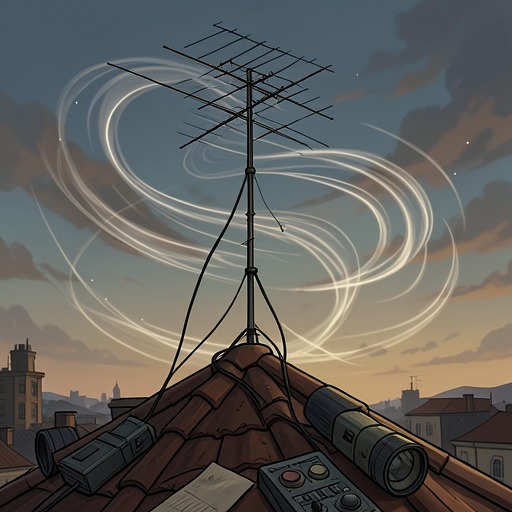
The transmitter waits on a table against the chimney, with twin marine batteries beneath it. Built years earlier to speak to a ghost, it is an old machine pressed into a new, immediate purpose. Marie-Laure considers who might still possess a radio: the fire brigade, the resistance, the Americans firing on the city, the Germans in their underground forts, or perhaps her uncle, Etienne LeBlanc. She cannot know which, if any, will hear her. She can only imagine Etienne at a radio and hope that a small sign of hope might reach him.
To raise the antenna, she feels along the chimney stones until she finds the lever Etienne installed. She puts her weight on it; above the roof, the antenna telescopes upward with a faint grating sound. Concerned that the noise may be too loud, she waits and counts to one hundred. Hearing nothing from downstairs, she traces the cables until she has the microphone in her hand. The scene gives the broadcast a material sequence: lever, antenna, cables, microphone. Communication does not begin as an abstraction; it depends on Marie-Laure finding and operating each part of the apparatus while remaining alert to the sounds around her.
A book carried over the air
Marie-Laure opens the novel in her lap with her free hand, locates its lines by touch, and brings the microphone to her lips. The passage she reads describes the Nautilus colliding with something and becoming trapped amid walls of ice. Its perilous enclosure echoes the circumstances of the listeners without making their situations identical: Werner is buried under the remains of a building, while the book’s characters face confinement beneath the water. The novel reaches him not as a general message but as a voice speaking in French, reading a particular scene.
Werner hears the girl on the morning of his fourth day trapped beneath whatever remains of the Hotel of Bees anti-aircraft strongpoint. He is listening through the repaired transceiver, moving its tuning knob back and forth, when her voice enters his good ear. At first, he suspects hunger and fever have made him imagine speech out of static. That hesitation marks the difference between receiving a signal and trusting it: the voice is clear enough to hear, but his isolation has made its reality uncertain. As she continues, he presses the headphones harder against his ear and struggles to hold on to the transmission as static threatens to overwhelm it.
Recognition, interruption, and consequence
The broadcast briefly creates an intimate listening scene within Werner’s confinement. He hears Marie-Laure’s quiet, carefully articulated French and recognizes that a person is speaking through the radio, although the excerpt does not show him identifying her by name. The narration compares the crispness of her accent with Frau Elena’s, giving the unfamiliar voice a point of reference from Werner’s earlier life. The connection is therefore both distant and close: the speaker is outside his sight and beyond his reach, yet her voice occupies the ear through which he listens.
Marie-Laure stops reading abruptly when she realizes that someone is directly below her. When she speaks again, the narrative presents her warning as urgent; then the transmission cuts out. Werner feathers the tuner and changes bands, but hears nothing more. He removes the headset and moves through total darkness toward Frank Volkheimer, asking for help. Werner tries to pull him, but his strength deserts him almost at once. The broadcast has not freed either character or resolved the danger. Its consequence is narrower and more consequential: Werner receives proof of a living voice beyond the rubble, while Marie-Laure’s interruption reveals that a threat is immediately near her.
Narrative significance
The scene moves between Marie-Laure’s careful operation of the equipment and Werner’s uncertain reception of its signal. The reader first sees the labor required to transmit, then experiences the voice as Werner does: against static, through a single good ear, and under the pressure of believing or dismissing it. This shift in viewpoint makes the radio more than a device in the background. Its functioning depends on physical actions at one end and delicate tuning at the other, while the signal’s arrival briefly joins two otherwise separate scenes.
The choice to read from a novel also shapes what the transmission can do. Marie-Laure does not send a direct explanation of her circumstances before reading; the book supplies words that travel beyond the room and reach Werner inside his darkness. When she breaks off to announce the immediate danger, the broadcast changes from reading into warning. The abrupt cut prevents the contact from becoming a safe or complete exchange. Instead, the scene holds connection and interruption together: her voice crosses the distance, Werner hears it, and then the signal vanishes while the danger remains unresolved.