Moral choice under coercion
All the Light We Cannot SeeMoral choice under coercion is a recurring ethical problem in the novel: characters are pressed to obey systems that define hesitation as weakness, yet remain answerable for what they do within those constraints. Werner Pfennig’s conduct makes that tension concrete. He fears exposure and punishment, but later actions recalled by Marie-Laure LeBlanc and Jutta Pfennig show that pressure does not wholly determine his choices.
Coercion as a system of expectation
Werner’s fear is not abstract. While Volkheimer keeps the men moving through villages along the Rance River, Werner believes the broadcasts may be blamed on him and that he may be found out. He imagines the officers who might already suspect him and wonders whether Volkheimer knows. His mind reaches for an impossible rescue: as a child, he had wished for ice to spread from the canals, crush the machinery, and erase the world he knew. The remembered fantasy of destruction measures how little control he feels he has in the present. The danger lies not only in punishment, but in being trapped inside a system whose judgments he cannot reliably see.
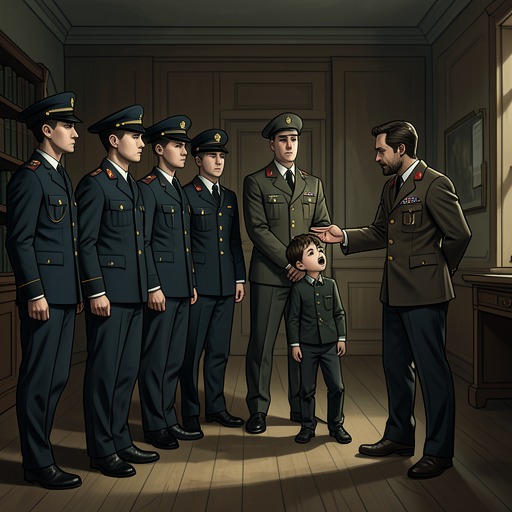
The language of Werner’s training gives that system its moral vocabulary. Bastian promises that certainty, purpose, and clarity will strip hesitation out of him. The military maxim that its followers are a volley of bullets, cannonballs, and the tip of a sword makes individuals sound like instruments: useful insofar as they move as one, with no space for private judgment. The question of who is weakest turns moral life into a test administered by power. Hesitation is treated as a defect to remove, rather than a pause in which a person might judge whether an order is right.
Choices made under pressure
Against that training, Werner’s actions are significant precisely because they occur within a coercive environment, not outside it. Marie-Laure later sorts their confused history into three occasions on which he saved her life: he did not expose Etienne LeBlanc when he could have; he took a sergeant major out of the way; and he helped her get out of the city. Her retrospective count gives each decision a distinct consequence. The first protects Etienne from disclosure, the second removes an immediate danger, and the third helps Marie-Laure escape. These are not presented as effortless gestures. They are choices whose significance becomes clearer after the danger has passed.
As Werner and Marie-Laure move through the damaged city, he thinks of Jutta and recognizes that he has finally listened to her. The thought connects his action to a relationship and a prior appeal, rather than to the military language of certainty. The surrounding circumstances remain coercive: Werner has reason to fear discovery, while the ruined streets leave the pair exposed to both the Americans and his own army. Yet he takes Marie-Laure by the hand to help her over the rubble and continues with her. The scene places care beside danger without suggesting that care makes the danger disappear.
Jutta’s account of goodness
The later conversation between Marie-Laure and Jutta gives Werner’s choices a second perspective. Marie-Laure asks whether he took something from her; Jutta’s question reflects the limits of what she knows about the encounter. Marie-Laure answers by distinguishing what he did not do from what he did: he did not take it, and she had spent less than a day with him. Their exchange does not make the brief meeting simple. Marie-Laure understands its consequences gradually, as events that first seemed jumbled begin either to confuse her further or to settle into place.
Jutta describes Werner as small for his age and says that he looked out for her, while also acknowledging how hard it was for him not to do what was expected of him. That account keeps two truths in view: his care for his sister and the force of the expectations bearing on him. Jutta does not claim that goodness came easily or that pressure absolved him of responsibility. Her statement that it was not easy to be good then names the difficulty without turning it into an excuse. In this exchange, moral judgment becomes an act of understanding a constrained life, rather than a simple division between the innocent and the guilty.
Moral attention and the temptation of value
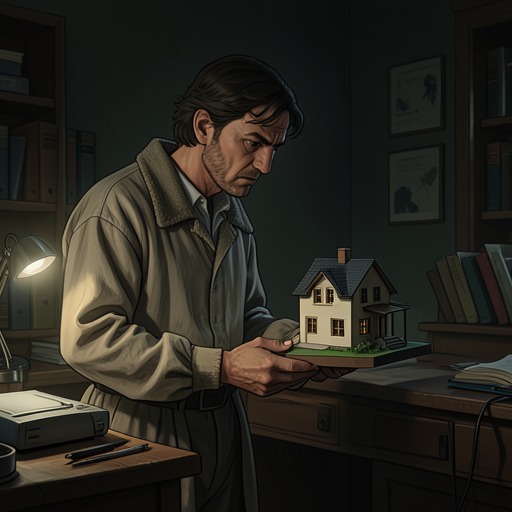
The novel also places choices beside objects that exert their own pull. In Marie-Laure’s memory, Dr. Geffard reflects on how something so small could be so beautiful and valuable, and how only the strongest people can turn away from such feelings. Soon afterward, Marie-Laure opens the model house by turning its chimney and levering off three roof panels. The sequence links ethical strength to the capacity to resist an object’s attraction, though it does not collapse this temptation into the coercive force imposed on Werner. One pressure comes from institutions and expectations; another comes from the desire attached to something precious.
Taken together, these moments refuse the idea that a person is either entirely free or merely an instrument of circumstance. Werner is shaped by commands that train him to suppress hesitation, by fear of being discovered, and by expectations he finds difficult to resist. Still, Marie-Laure’s recollection identifies particular acts in which he protects others, while Jutta’s account makes his struggle legible without erasing its consequences. The moral weight rests in the space between pressure and action: coercion narrows the available choices, but the choices that remain still matter.