Muséum national d’Histoire naturelle
All the Light We Cannot SeeMuséum national d’Histoire naturelle is more than a backdrop in the novel: it is Marie-Laure LeBlanc’s first map of the world, Daniel LeBlanc’s workplace and domain of expertise, and the institution whose hidden vault makes the Sea of Flames a focus of rumor and pursuit. Its public galleries promise ordered access to knowledge, while its locks, restricted rooms, and wartime transfers make the limits of that access part of the story. The museum’s collections are both objects of wonder and responsibilities that expose the people charged with protecting them to danger.
Galleries, Gardens, and the First Map
In 1934, when Marie-Laure is six and her eyesight is rapidly deteriorating, her father sends her on a children’s tour of the museum. A short, hunchbacked warder gathers a dozen children with a rap of his cane and leads them across the gardens into the galleries. The route passes working and stored collections as well as public displays: engineers use pulleys to raise a fossilized dinosaur femur; a stuffed giraffe stands in a closet; taxidermists’ drawers hold feathers, talons, and glass eyes; and old herbarium sheets preserve flowers and herbs. The tour presents the institution as a place where natural history is accumulated, classified, and made available to the curious.
The children climb sixteen steps to the Gallery of Mineralogy, where the warder shows them Brazilian agate, violet amethysts, and a meteorite. From there he takes them down two twisting staircases and through corridors to an iron door with one keyhole. Rather than opening it, he ends the tour and tells them the story of a stone. That movement—from familiar exhibits to a shut door—makes the museum’s hidden spaces imaginable before Marie-Laure knows what they contain. The institution’s architecture creates a distinction between what visitors are shown and what remains under lock.
The warder’s tale traces the Sea of Flames from a blue stone found in a dry riverbed in Borneo. A prince takes it, and misfortune gathers around him and his family; a priest’s dream explains the stone as a gift from the Earth Goddess to the Sea God, disrupted when the prince removes it. Centuries later, a French trader finds a large, blue, pear-cut diamond in the Golconda Mines in India and warns a duke in Lorraine of the curse. The duke nevertheless sets it in his walking stick. After further calamities in his household, he asks the king to place the gem in a specially built museum vault and keep it closed for two hundred years. The story gives the museum a role in the legend itself: it is not merely where a mysterious object is displayed, but the institution entrusted with concealing it.
Keys, Custody, and Marie-Laure’s Daily Life
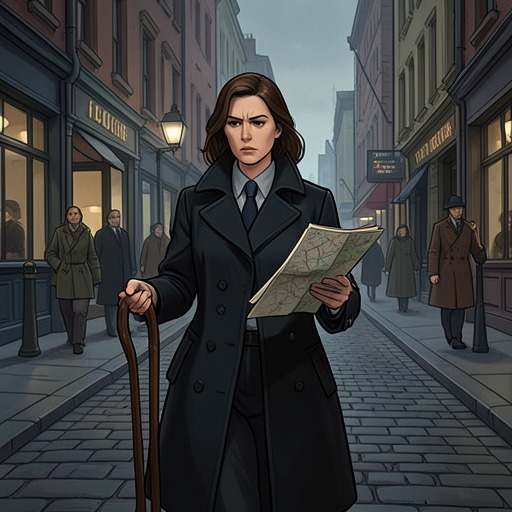
The museum becomes a practical world for Marie-Laure through her father’s work. Six mornings a week, she rises before dawn, takes her white cane, loops a finger through Daniel’s belt, and follows him to work. He unlocks Entrance No. 2 at seven. Their route crosses the Grand Gallery and leads to the key pound, where thousands of iron keys hang in six glass-fronted cabinets. The collection ranges from keys shorter than Marie-Laure’s thumb to ones as long as her forearm; her father quizzes her on their types, on display locations, and on what cabinets contain, while placing objects such as a fossilized fish or a flamingo feather in her hands.
Daniel is the museum’s principal locksmith. Across its laboratories, warehouses, four public museums, menagerie, greenhouses, gardens, gates, and pavilions, he estimates that the complex contains twelve thousand locks. His work makes the institution’s organization tangible: employees receive numbered, color-coded keys, must carry them, and may neither leave their buildings with them nor leave them unattended on desks. Such rules protect collections that include jade, cavansite, rhodochrosite, and a Florentine bowl carved from lapis lazuli. The key system is not incidental background; it gives Daniel both intimate knowledge of the museum and responsibility for the boundaries that protect its holdings.
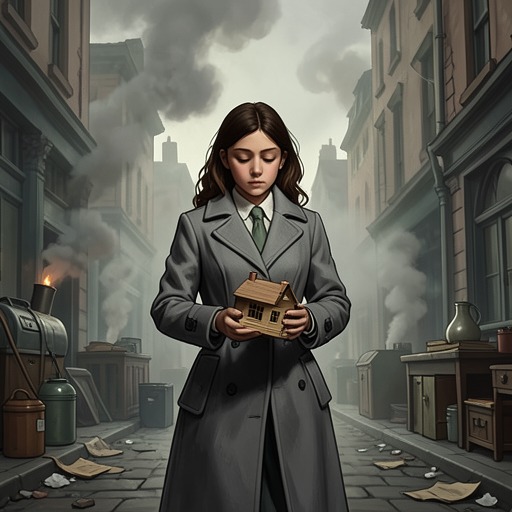
That knowledge also shapes Marie-Laure’s experience of the place. She learns it by repeated routes, sounds, objects, and the information her father shares, rather than by sight alone. The key pound’s inventories and his questions turn the museum’s scale into something she can understand through detail. As her sight worsens, the institution remains legible to her through routine: familiar footsteps in the Grand Gallery, the ring of her father’s keys, and the succession of locks he opens. It is at once a workplace and a structured environment in which her father helps her build confidence and knowledge.
The Diamond and the Rumor Machine
When talk spreads that the museum may display an exceptionally valuable gemstone, its origins change with each telling. Staff speculate that it came from Japan, that it had long been in the museum’s vaults, or that it is another sort of mineral altogether. The names also multiply before the rumor settles on the Sea of Flames. This circulation of competing accounts contrasts with the institution’s official habits of registration and custody: people can repeat a story faster than the museum can establish what the object is or where it belongs.
The gem soon becomes an explanation for ordinary accidents. Staff blame it when electricity fails or a leak destroys pressed botanical samples; gossip intensifies after the director’s wife breaks her wrist on ice. Daniel is called to the director’s office for an unusually long meeting, then begins working in the Gallery of Mineralogy after hours, moving equipment on carts and returning with the smell of brazing alloy and sawdust. He does not tell Marie-Laure what he is building. The museum’s guarded work and the staff’s superstitions develop side by side: one is a practical response to the danger surrounding a valuable collection, the other turns misfortune into a story about the diamond.
Wartime Protection and the Hidden Vault
As war approaches, protecting the collections becomes urgent. Couriers move objects to country estates, while Daniel works late to padlock crates and keep transport manifests secure. Armored trucks arrive at the loading docks; fossils, manuscripts, precious minerals, and other valuables are packed for transfer. Marie-Laure wonders whether the Sea of Flames is among them. The preparations show that the museum’s custody is not fixed in one building: preservation requires moving objects, documenting their journeys, and limiting knowledge of what each consignment contains.
The director’s plan uses three replicas alongside the real diamond. One remains at the museum; the other three travel in different directions, including a stone carried by Daniel in his tool case through a field west of Versailles. The carriers are not told which stone is genuine and are instructed to behave as if each carries the real one. Daniel suspects that his is only a copy, but cannot be certain. The replicas turn the museum’s protection strategy into a problem of provenance: outward appearance cannot establish which object is authentic, and even the people entrusted with transport are denied a complete account.
Later, Reinhold von Rumpel is guided from the Gallery of Mineralogy through a small locked door that requires two keys, down a winding staircase, through another gate, and into an unassuming storeroom. Behind a sheet of plywood, the mineralogist reveals a combination safe; inside it is a second box. The route makes the museum’s security visible as a sequence of barriers, yet also shows how access depends on the cooperation of staff and the knowledge of where to look. Von Rumpel’s search is complicated by the replicas: before the invasion of France, a museum maker had produced three copies from a casting without ever seeing the real diamond. Von Rumpel believes the account. The museum’s vault therefore holds one part of the mystery, not its resolution; the other stones and the uncertain chains of custody keep the search open.
Across these episodes, Muséum national d’Histoire naturelle joins the novel’s intimate and institutional scales. For Marie-Laure, it is a place learned through routes, touch, and her father’s patient instruction. For Daniel, it is a vast system of locks, collections, and duties. For those pursuing the Sea of Flames, it is a guarded repository whose records, vaults, transfers, and decoys make certainty difficult. Its order can protect objects, but it cannot prevent rumor or guarantee that any single person knows where the real stone is. The museum’s defining tension lies between the promise that things can be classified and secured and the possibility that, once moved or copied, they may become difficult to distinguish and trace.