Nazi youth indoctrination and the culling of the weak
All the Light We Cannot SeeNazi youth indoctrination and the culling of the weak at Schulpforta combine political instruction, bodily discipline, and peer violence into a single educational system. The cadets are taught to imagine themselves as parts of a unified national body, while being trained to identify and punish whoever is marked as its weakness. For Werner Pfennig, the institution offers an intoxicating promise of belonging; its escalating tests expose how that promise depends on suppressing doubt and making cruelty feel like duty.
Formation of a collective
Schulpforta first presents itself to Werner as a storybook castle: eight or nine stone buildings below hills, with rust-colored roofs, narrow windows, spires, and turrets. A river winds through the athletic fields, and the air seems startlingly clean after Zollverein’s dust. The beauty of the setting makes the abruptness of its rules more striking. A one-armed bunk master lays down an exacting code of uniforms, posture, weapons, possessions, speech, and correspondence. Cadets must carry a knife, keep their lockers nearly empty, stop talking after lights-out, and send letters home only on Wednesdays. Discipline is announced not as one part of school life but as the means by which boys will be remade.
The scale of the institution reinforces that ambition. There are four hundred cadets, thirty instructors, and fifty staff members; the boys range from nine to seventeen. Their schedule pairs academic subjects with military and bodily preparation: Werner reads Goethe with Frederick, magnetizes needles in field exercises, and encounters timetables that include mechanics, state history, racial sciences, horsemanship, orienteering, and military history. Even the youngest cadets will learn to clean, dismantle, and fire a Mauser rifle. Afternoons turn into sequences of compulsory exertion—running to troughs and flags, climbing hills, carrying one another or rifles, crawling, swimming, and running again.
For a time, common routines appear to erase differences in background. The dormitories hold boys who talk of skiing, duels, jazz clubs, cigarettes, aristocratic mothers, and fathers employed in ministries. Some are polished and accomplished; others possess privilege without any particular merit. Yet all march, eat, salute, shoot, run, bathe, and suffer together. The commandant’s image of four hundred identical pots made from clay captures the school’s project: not simply to gather boys who already agree, but to standardize them through repeated acts. Werner feels an intense hunger to belong to this single-minded collective. Exhaustion and confusion mingle with exhilaration, and he holds doubts at bay by memorizing songs and routes to classrooms, or by picturing the technical-sciences laboratory and its equipment.
Bastian’s lessons in weakness
The commandant, Bastian, gives the school’s physical discipline its violent political meaning. Scarred by smallpox, heavy with medals, and almost never without his hobnailed boots, he demands that cadets memorize maps, study the sun’s angle, and make belts from cowhide. Whatever the weather, he delivers lessons in which prosperity depends on ferocity and the safety of families is attributed to the fists of young men. His formulation of the corps as a body makes individual cruelty sound like a necessary act of collective health: each boy must drive weakness from himself, then learn to drive it from the institution.
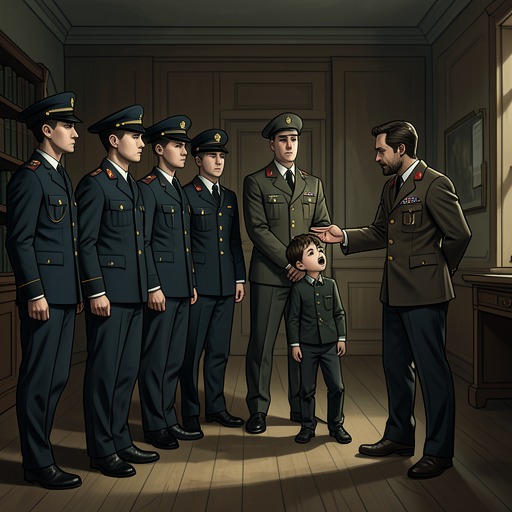
Bastian does not leave this principle at the level of slogans. During field exercises he selects a boy and asks the cadets to name the weakest member of their group. On one occasion, Ernst runs while fifty-nine fourteen-year-olds pursue him. Werner keeps to the middle of the pack, confused by the chase and unsure what the boys are expected to do if they catch their classmate. Yet he recognizes that some part of him already knows. The scene makes indoctrination visible as an action shared among peers: the commandant sets the terms, but the cadets supply the pursuing bodies.
The test grows more explicit when Bastian selects Helmut Rödel and again asks who is weakest. Rödel answers that the weak can differ from one person to another. Bastian’s response reveals the malice beneath the schoolmaster’s theatrical authority: he hands Rödel a three-foot length of black rubber hose and urges him to use it on Frederick. Rödel strikes Frederick across the shoulder, then, at Bastian’s order, catches him on the jaw. Werner’s thoughts turn toward home—the laundry, Frau Elena’s overworked hands, and the soot-stained alleys of Zollverein—and he struggles to admit that what is happening is wrong. The immediate force of the scene lies in its reversal: an exercise supposedly meant to eliminate weakness makes one boy the instrument of violence and another its target, while demanding that the witnesses accept the result as proper.
From exclusion to racial doctrine
Bastian’s rhetoric also teaches cadets to interpret vulnerability as a forecast of death. He divides death into two kinds: fighting like a lion, or going easily, like lifting a hair from a cup of milk. The “nothings” and “nobodies,” he says, die easily, then asks the boys how they will die. The lesson converts a political hierarchy into a test of individual worth. To survive in the imagined order is to fight; to be exhausted, helpless, or different is to become evidence for one’s own supposed inferiority.
The school extends this lesson beyond its cadets. Bastian presents a shackled prisoner to them as a monstrous outsider, calling him a centaur and an Untermensch. The man’s shirt is torn, his arms are bound, and he sways with the slackness of someone suffering from the cold. Bastian claims that the prisoner escaped a work camp and tried to violate a farmhouse and steal milk, then portrays him as a threat to the boys. The scene gives the cadets a prearranged interpretation of the prisoner before they can encounter him as a person: his condition becomes proof of the danger and degradation Bastian assigns to him.
Bastian then orders a public soaking. Instructors are to go first, followed by upperclassmen, until everyone in the school has filed past with a bucket of water. Volkheimer returns with buckets, senior cadets uncoil a hose, and the instructors begin throwing water over the prisoner as cheers rise in the frozen courtyard. The prisoner gradually wakes from his hypothermic slackness. The ritual therefore does more than display force against a captive; it recruits the school’s hierarchy into a collective performance of contempt, with cheers making participation sound like assent.
Dr. Hauptmann supplies the intellectual framework that joins these practices to the regime’s claimed historical purpose. When Werner defines entropy as disorder in a system, Dr. Hauptmann turns the scientific term toward politics. Life, he says, is chaos, while the regime represents an ordering of that chaos, extending even to genes. He describes the project as winnowing out the inferior, the unruly, and the chaff, and as ordering the evolution of the species. The lesson’s structure matters: Werner’s scientific answer becomes an opening for a doctrine that presents hierarchy and exclusion as laws of nature rather than political choices. The cadets write down the principle that entropy in a closed system never decreases, while the institution teaches them to associate its own order with the elimination of people it has labeled inferior.
Belonging, coercion, and the human cost
The school’s appeal and its violence are inseparable. Its synchronized songs, meals, marches, and exercises offer Werner what he has not felt before: membership in something that appears to move with one purpose. The same routines suppress distinctions among boys whose family circumstances and privileges remain unequal outside the uniform. The promise of collective identity is therefore both powerful and coercive: the cadets are told they are alike, while the institution decides whose difference will be treated as a defect.
Werner’s response to Frederick’s beating shows how that coercion works from within. He does not mistake his discomfort for a way out; he tries to smother it with memories of home, even as the scene insists that he knows the violence is wrong. His thought that it is nevertheless right registers the distance between private recognition and public obedience. The school’s achievement is not simply to teach boys violent doctrine. It is to make their own moral perceptions feel incompatible with the group to which they long to belong.
The later image of Frederick sharpens the cost without turning it into an explanation the text does not provide. More than a year after the school scenes, Werner finds him at a glass-topped table, still wearing his black-framed glasses, with porridge on his whiskers and place mat. Franny feeds him spoonfuls and wipes his chin; Werner cannot look at the sight. The passage presents Frederick as dependent on care, a stark contrast with the academy’s ideal of the self-disciplined, forceful boy. Read beside Bastian’s demand that cadets beat weakness out of one another, the contrast exposes what the school’s ideal excludes: a person whose needs cannot be made to conform to its fiction of strength.
Nazi youth indoctrination at Schulpforta thus operates through both abstraction and repetition. Lessons in racial science and genetic ordering give exclusion the language of necessity; schedules, uniforms, weapons, and physical trials give it an everyday form; staged pursuits and assaults make the cadets enact it together. The school’s rhetoric promises unity, but its tests depend on identifying someone who may be cast out or harmed. Werner’s hunger to belong, and his recognition of the wrong he is being taught to accept, hold those opposing truths in the same frame.