Radio propaganda and information control
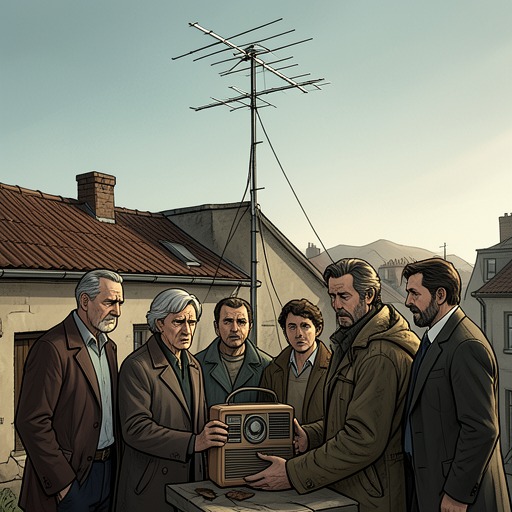
All the Light We Cannot SeeRadio propaganda and information control shape what people hear, what they are permitted to seek out, and how they interpret the world around them. The radio in the novel is at once a physical device, a mass channel for official narratives, and a contested means of communication: state broadcasts cultivate consent and define enemies, while censorship and technical surveillance try to close off alternative voices. Its power is never wholly abstract. It depends on receivers, wires, listeners, and the institutions that determine which signals may pass.
Discovery and Domestic Listening
Werner Pfennig first encounters radio as a boy of eight, scavenging behind a storage shed with his six-year-old sister, Jutta Pfennig. What looks like a spool of thread is a homemade receiver: a wire-wrapped cylinder held between two pine discs, with frayed electrical leads and an earphone. Werner recognizes what they have found and soon makes the apparatus a focus of concentrated experiment. He learns to dismantle and rebuild it, salvages parts, and modifies the set until he can power a loudspeaker. Radio begins in his life as an intelligible technical puzzle, but it quickly becomes a shared household ritual.
Each evening Werner carries the receiver downstairs, where Frau Elena lets the children in her care listen together. The programs range from news and concerts to opera, choirs, folk entertainment, and plays. The children respond differently to the schedule: Jutta likes jazz, while Werner is absorbed by its variety. That variety helps make the medium inviting. Music and entertainment sit alongside speeches, news, and martial songs, so political messaging enters a familiar routine rather than arriving only as an overt command.
The broadcasts describe national confidence and collective readiness as if they were facts that listeners can hear confirmed. At the same time, Werner sees material changes in his neighborhood: food becomes more plentiful, new household goods arrive, and his family receives new clothes and shoes. The broadcasts’ optimism therefore meets visible improvements in daily life. The novel presents the appeal of propaganda not simply as a matter of people being deceived, but as a message reinforced by changing circumstances and repeated through an intimate, dependable household device.
Stories That Manufacture Enemies
In autumn 1936, the children gather around Werner’s receiver for a state-sponsored play from Berlin. Its fictional invaders are portrayed through antisemitic stereotypes: they are represented as dishonest traders who undermine local businesses and plot against German children. A watchful neighbor detects the supposed conspiracy, police intervene, and a patriotic ending restores public happiness. The plot turns prejudice into entertainment and casts exclusion and state force as protection. Because the story is delivered as a drama for children, its political lesson is woven into an evening’s listening rather than separated from ordinary amusement.
The contrast between the broadcast’s triumphant account and the realities around the listeners grows sharper as the novel proceeds. In Zollverein, radio connects enormous numbers of people to a single authoritative voice. The surrounding economy is shown as a chain of labor and production, from coal mines and coke ovens to steelworks and transport; broadcasts give this hardship a language of sacrifice and purification. Their rhetoric presents harsh tests as the route by which the deserving will rise, translating the material demands placed on ordinary people into a national moral story.
Jutta questions that story when she tells Werner that a girl has been excluded from swimming because she is considered a half-breed, and asks whether she and Werner are not also mixed through their parents. Werner identifies the slur as referring to Jewish ancestry and tells her to keep quiet. The exchange places the broadcasts’ and authorities’ classifications inside a private conversation between siblings: propaganda does not remain a remote public performance but helps determine who is marked as belonging, and which questions become dangerous to ask aloud.
Censorship, Reception, and Competing Accounts
The control of radio extends beyond the production of official messages to the regulation of reception. Frau Elena writes to a professor whose broadcasts have gone unheard for at least two months. She wonders whether the program has stopped or whether a powerful new transmitter in Brandenburg has overwhelmed the dial. Her account includes a technical speculation: a wire fence might serve as an antenna, and the silver in a tooth might conceivably receive a signal through a rectifier and speaker. The letter makes the interruption tangible. A broadcast can be lost not only because a listener changes the dial, but because the strength and availability of other transmissions reshape what can be heard.
Frau Elena also warns the children that listening to foreign broadcasts is a criminal offense and may bring hard labor. She says they must come straight home from school, describing poverty as another source of danger even though the children are not Jewish. Radio listening is thus governed by threat as well as persuasion: the state does not merely supply a preferred account of events but seeks to penalize access to alternatives. The risk surrounding Frau Elena’s letter also shows how a private attempt to reach a distant broadcaster becomes an act of initiative under censorship.
A counterpoint appears when Werner repeats an official claim about acting in the interest of peace to Rudolf Siedler. Siedler rejects the comfort of that formula, arguing that victors determine how history is told and that individuals and nations act in their own interests. The scene does not make radio irrelevant; it exposes the gap between a broadcast slogan and an account of political conduct. Later, Jutta tells Werner that German aircraft are bombing Paris, emphasizing that this is what she has been listening to. Her disclosure breaks into Werner’s expectations of what may safely be said. The radio’s contested authority is registered in the siblings’ different responses: Werner fears the consequences of speaking, while Jutta insists on naming what she has learned.
Technical Knowledge Put to Work
Radio is also a discipline learned through materials and practice. At the school where Werner studies, Dr. Hauptmann gives the cadets equipment for building a Morse-code circuit and tests Werner’s ability to make a simple motor from a magnet, wire, screw, and battery. Werner completes the task in seconds. The episode links his childhood gift for repairing receivers to a formal technical education, while placing that skill inside an institution with power to direct its uses.
Dr. Hauptmann later asks Werner to improve a directional radio transceiver so it can be retuned across frequencies and measure the angles of incoming transmissions. Werner reworks the design and applies mathematical procedures to locate a signal. During a demonstration, he calculates a distance of two and a half kilometers and plots the result on a map. In the field, the same principles become a method for searching for unauthorized voices: a military radio team sets up receivers at separated points, forms a triangle through its movements, and scans for transmissions that are not sanctioned. The equipment does not dictate its own purpose. Training, calculation, mobility, and institutional orders turn listening into surveillance.
When Werner is later assigned to a radio truck, he finds listening decks, a folding antenna, headsets, maps, compasses, and two of the transceivers he helped design. He repairs the damaged equipment and joins operations that search the airwaves for prohibited signals. The work makes the tension in the novel’s account of technology especially clear: the same competence that once enabled a child to receive distant programs now supports a system intended to find and silence independent transmitters. Yet the search is not all-powerful; few voices emerge from the static, and the voices Werner does hear are German.
Confiscation and the Possibility of Another Signal
In occupied Saint-Malo, the authorities order residents to surrender their radio receivers. Marie-Laure LeBlanc has her father read the notice aloud: sets must be delivered to 27 rue de Chartres by noon the next day, and failure to comply will lead to arrest as a saboteur. The decree turns possession itself into a matter of public control. Where the children once listened together in Frau Elena’s home, residents are now required to give up the devices that could connect them to other accounts of the war.
Against this measure, the novel places small acts that disturb the occupation’s hold over information. Madame Ruelle and Madame Guiboux use a car and a ratchet set to rearrange road signs, returning to Number 4 rue Vauborel laughing at the confusion they have created. Their action concerns directions rather than radio signals, but it belongs to the same struggle over who can shape the information people use to navigate occupied space.
The transmitter in the attic of Marie-Laure’s home offers a more direct counterpoint to the surrender order. Years earlier, Etienne LeBlanc built it to communicate with a distant, absent listener. During the bombardment, Marie-Laure reaches for the lever concealed in the chimney and raises its antenna, hoping that someone—a fire brigade, the resistance, the Americans, the German forces, or Etienne himself—might be listening. The evidence here is the effort to make transmission possible, not confirmation that a message has been received. That distinction preserves the uncertainty at the heart of radio: a signal may cross distance, but its arrival depends on another receiver being present.
Across these episodes, radio moves from a salvaged object to a household companion, a vehicle for propaganda, a restricted channel, a tool of military tracking, and a possible line of contact under bombardment. Its ability to bind distant listeners gives it force, but that force is divided. Authorities try to determine what can be heard and punish unsanctioned listening; listeners and technicians find ways to question, redirect, or revive transmission. The novel’s recurring attention to radios’ physical construction keeps that political contest grounded in practical conditions: someone must build the set, tune it, supply its power, and choose what to do with the voice that comes through.