Radio signals as a connection across distance
All the Light We Cannot SeeRadio signals as a connection across distance is both a technological motif and a measure of what connection can mean in wartime. A signal may carry a song or a voice toward someone absent, teach a child about a world beyond her reach, or guide soldiers toward a hidden transmitter. Across these uses, connection is never merely abstract: it depends on wire, coils, batteries, tuning, and the people who choose what to send and whom to seek.
Discovery and Material Beginnings
The motif begins with a found object. Eight-year-old Werner Pfennig is searching through refuse behind a storage shed when he comes upon a device resembling a large spool: a cylinder wrapped in wire between two pinewood discs, with three frayed electrical leads and an earphone hanging from one. His six-year-old sister, Jutta Pfennig, asks what it is. Werner recognizes it as a radio, and the discovery opens a possibility beyond the discarded materials from which the siblings’ world is partly made. Radio begins here not as polished infrastructure but as something salvaged, handled, and understood through curiosity.
That material emphasis continues in the attic of the LeBlanc house. Etienne LeBlanc shows Marie-Laure LeBlanc a room crowded with cables, boxes, tubes, coils, switches, meters, and a gramophone. He fits a headset over her ears; a crank and switch bring a piano melody into her hearing, followed by a recorded science program describing the ancient plant matter that became coal. For Marie-Laure, the apparatus makes a distant voice present through sound, while also delivering an account of time and transformation. The radio is not simply a source of entertainment: it turns an unseen world into something she can encounter by listening.
Voices Addressing the Absent
Etienne’s transmitter carries a private history. He explains that he and his brother, Henri LeBlanc, once hoped to make and sell recordings. Henri had a voice admired by others, while Etienne wrote science scripts for children; their father, Daniel LeBlanc, had come to listen during those recordings. The recording company in Paris eventually lost interest, but Etienne kept playing the ten recordings they had made, along with Henri’s song. In the attic, the instrument that once served a shared creative project has become a means of preserving and replaying a voice.
Etienne’s broadcasts were directed toward Henri after his death. He describes making the signal powerful enough in the hope that his brother might hear him, receive some peace, and be protected as Etienne had felt protected by him. The imagined destination matters more than any verified reception: Etienne does not know whether children ever heard the programs, and his hope that Henri could hear them is not presented as a technical certainty. Radio gives grief a form of address. Its signal crosses distance, but the distance it confronts is also the irreversible separation between the living and the dead.
The piano music deepens that connection. Etienne places a microphone inside the gramophone’s bell to transmit Debussy’s Clair de Lune, joining the brother’s recorded voice to music that can travel through the same apparatus. Later, when Marie-Laure approaches the transmitter during the bombardment, the machine is still understood as something built years earlier to speak to a ghost. She considers who might now be listening—a fire brigade, members of the resistance, American forces, German troops, or Etienne—and wonders whether he may need a flicker of hope. The old purpose does not determine the new one: a device made to address the dead becomes a possible lifeline to people who may still be alive.
Transmission as Knowledge and Military Power
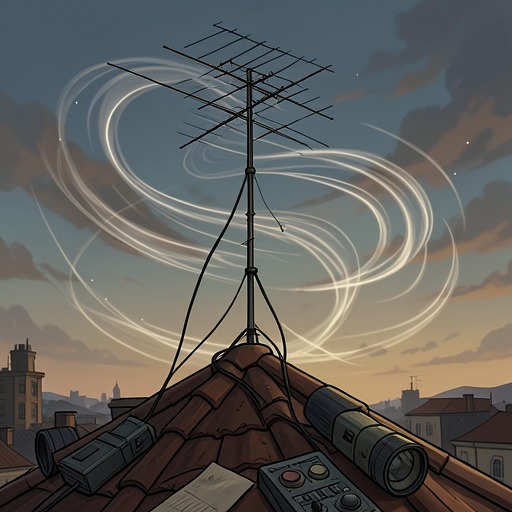
The novel also presents radio as a system that must be learned and operated. Etienne explains the transmitter through its microphone switch, phonograph control, premodulation amplifier, vacuum tubes, coils, and twelve-meter antenna that extends along the chimney. His account links a human voice to changes in the cycles transmitted by the machine. The description makes communication dependent on physical components and practical understanding; a voice cannot travel without a functioning chain of equipment.
At Schulpforta, Werner’s technical skill is enlisted for a different purpose. Dr. Hauptmann asks him to improve a directional radio transceiver so it can be retuned quickly across multiple frequencies and measure the angle of received transmissions. Werner reworks much of the design. Their work can be intellectually absorbing: Hauptmann sometimes explains components such as solenoids and resistors, discusses scientific ideas, and answers Werner’s questions. Yet the same expertise is embedded in a military institution, and Werner is conscious of the power connected to Hauptmann’s position. Radio knowledge offers discovery and possibility, but it also equips authority to act at a distance.
A winter field test makes that dual use concrete. Hauptmann sends Frank Volkheimer ahead with a transmitter concealed in an ammunition box and broadcasting steadily across a ten-square-kilometer search area. Werner sets up two receivers, tunes them to the signal, and uses the readings to calculate a vector and distance. He writes the equation on the transceiver casing, works with a slide rule, then plots the bearing on a map. Repeating the triangulation brings them within half a kilometer of the source; Werner then finds Volkheimer lying in the snow, the transmitter at his feet. The signal that makes a hidden person locatable also makes concealment precarious. Connection here is not mutual intimacy but detection, and the equipment’s accuracy turns an invisible transmission into a path through the landscape.
Rebuilding and Reaching Out
Later, in a ruined city, Werner applies his practical knowledge to damaged equipment. In a radio truck he finds two transceivers he designed with Dr. Hauptmann, but one has a cracked meter, blown fuses, and a missing transmitter plug. The familiar devices offer a moment of recognition, yet they are not ready to work; repair is required before their potential can be recovered. Radio’s promise is repeatedly conditional on material survival.
Pinned beneath rubble with Frank Volkheimer, Werner improvises with what remains around him. He crimps wire to a shorn pipe, wipes it clean with spit, coils wire around it to make a tuning coil, and routes the other end through a bent strut among timber, stone, and plaster. He uses a diode and battery to complete a circuit, then strips the earphone leads against the threads of a screw. The scene reduces radio to a precarious assembly of scavenged materials and electrical contact. It does not make the ruined surroundings disappear; it shows Werner trying to construct a means of reception inside them.
The attic transmitter returns to Marie-Laure as a possible means of reaching others. She searches the chimney stones for the lever Etienne installed and presses her weight against it, raising the antenna above the roof with a faint grating sound. She knows she may be heard by radically different listeners, and cannot know whether Etienne is alive or listening. That uncertainty gives the act its force: the transmitter does not guarantee rescue or reunion, but it gives her a way to send beyond the immediate walls around her.
Across these episodes, radio links intimate memory, education, technical labor, and military surveillance without making them equivalent. A salvaged receiver first invites two children to imagine what an object can do; an attic machine preserves a brother’s voice; a directional set turns a signal into a target; improvised components offer the possibility of listening amid wreckage. The motif’s recurring tension lies between reach and control. Signals can cross barriers, but their consequences depend on who sends them, who can receive them, and what the receiver intends to do.