Radio transmission as connection
All the Light We Cannot SeeRadio transmission as connection describes how a voice can cross physical distance and make strangers, family members, and the dead feel momentarily near. In the novel, radio is both a material technology—carrying lessons and music through dangerous wartime streets—and a figure for the less tangible links that persist in memory. Its meaning grows from Werner Pfennig and Jutta Pfennig listening as children to a voice in France, to Werner Pfennig recognizing Marie-Laure LeBlanc through a broadcast in Saint-Malo, and finally to an image of electromagnetic waves and human lives mingling above Paris.
A Voice Crossing Distance
The idea first takes shape through Werner Pfennig’s remembered connection with his sister. As fog lifts in Saint-Malo, he thinks of Jutta Pfennig writing letters addressed to The Professor, France, and putting them in the mailbox in the square. The recollection turns writing into an act of imagined transmission: he pictures her voice finding his ear, just as a voice from France had reached them. The possibility is astonishingly remote, but distance has not prevented reception. The memory gives Werner Pfennig a private measure of connection at a moment when approaching a stranger could be taken as a threat.
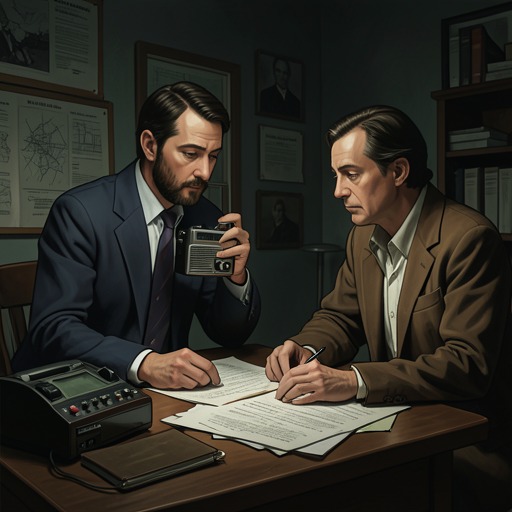
That childhood signal had come through broadcasts by a French science professor. Later, in the damaged house, Werner Pfennig tells Marie-Laure LeBlanc that, as a boy, he listened with his sister to lessons delivered through the transmitter she has. Marie-Laure LeBlanc identifies the voice as her grandfather’s. Werner Pfennig answers that they heard the broadcasts many times and loved them. The exchange joins two histories that had seemed separate: a French family’s voice had entered the childhood of two German siblings, long before the listeners and the speaker’s granddaughter met in person.
Listening as Inheritance
The broadcasts matter not only because they carry information, but because listening becomes an experience shared across generations. For Werner Pfennig and Jutta Pfennig, the professor’s lessons belong to childhood; for Marie-Laure LeBlanc, the voice belongs to her family and to the transmitter in her home. The discovery that they have listened to the same speaker gives their meeting an unexpected point of recognition. Werner Pfennig is no longer simply a German soldier at the door: he is also someone who remembers and values the voice of Marie-Laure LeBlanc’s grandfather.
The connection is reciprocal only in an imperfect, delayed sense. The professor could not know who was listening in Germany, and the children could not know that the voice they treasured would later be connected to the girl they encountered in Saint-Malo. Radio carries the sound without carrying a full account of its listeners or its consequences. Meaning arrives later, when Marie-Laure LeBlanc and Werner Pfennig can compare what each knows. The reunion of those fragments makes transmission more than one-way delivery: what was once anonymous becomes family history, and a childhood memory becomes a basis for recognition.
Recognition Through Sound
The wartime encounter gives the idea an immediate human consequence. Werner Pfennig has come to the house after hearing a broadcast and recognizing its music. Through the wardrobe door, he explains that he has not come to kill Marie-Laure LeBlanc but because he heard her on the radio. He struggles to find the words for the song, recalling its light-of-the-moon quality. The remembered music acts as a signal that guides him toward the source; his explanation, in turn, lets Marie-Laure LeBlanc understand why a stranger has come.
Their conversation then opens onto the older science broadcasts. Marie-Laure LeBlanc’s recognition of her grandfather’s voice changes the encounter from a meeting between people on opposite sides of the war into a meeting mediated by a shared past. Werner Pfennig and Marie-Laure LeBlanc have not known one another, but the transmitter has already connected their lives through music and lessons. The signal does not erase the danger surrounding them: a shell passes over the house, and the setting remains a damaged wartime room. Instead, connection occurs within that danger, briefly making the room a place where memory and recognition can be spoken aloud.
The Air as a Network of Lives
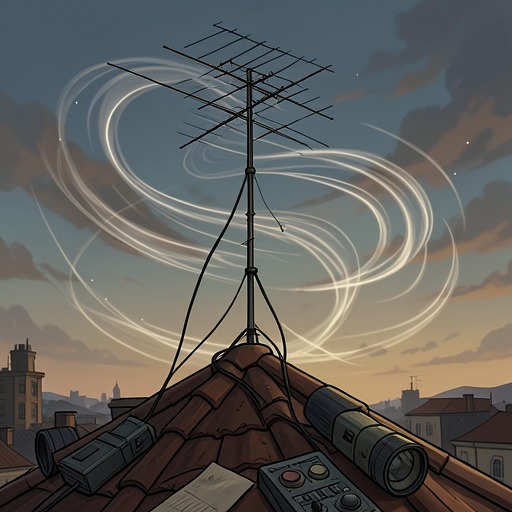
The idea reaches its broadest form in Marie-Laure LeBlanc’s later meditation on invisible waves. In a Paris garden, she imagines electromagnetic signals traveling into and out of a machine, like the waves Etienne LeBlanc once described, but multiplied vastly beyond the world he knew. Her thoughts range across messages, telephone conversations, television, email, and networks of wire and fiber passing through buildings and beneath the city. The sequence makes transmission an ordinary condition of modern life: countless communications cross paths without being visible to the people among whom they move.
From that physical network, Marie-Laure LeBlanc extends the image to the dead. She wonders whether her father, Etienne LeBlanc, Madame Manec, and Werner Pfennig might travel those paths like birds in flocks, their presence faded but still audible to someone who listens. The thought is presented as possibility, not as a claim that radio proves survival. Its force comes from the analogy: if words and signals can remain in the air after they have been sent, perhaps a life also leaves traces that outlast the moment of its speaking.
The closing image gathers the novel’s separate acts of listening into a shared medium. The air becomes a library containing the record of lives and sentences, while the thought that someone for whom the war was only memory disappears each hour insists on the fragility of human remembrance. Against that loss, the closing return to grass, flowers, and songs offers a form of persistence. Radio transmission as connection therefore links technology to inheritance and memory: a voice crosses a border, a song leads one person to another, and the imagined traffic of signals becomes a way to think about the lives that continue to resonate after their speakers are gone.