Reinhold von Rumpel
All the Light We Cannot SeeReinhold von Rumpel is a German sergeant major, gemologist, and skilled diamond cutter whose wartime search for the Sea of Flames binds professional expertise to plunder, obsession, and fear of death. He can distinguish a fake from a genuine stone at a glance, but his knowledge cannot settle the diamond’s identity or secure the immortality he hopes it promises. The contrast between his exacting eye and his increasingly failing body shapes his pursuit from its first promise of triumph to its final, smoke-filled encounter with Werner Pfennig.
Identity and Professional Formation
At forty-one, von Rumpel considers himself young enough to rise further in rank. Before the war, he ran a gem appraisal business from a second-floor shop behind Stuttgart’s old chancellery. Clients brought him stones to value; he sometimes recut diamonds or advised on demanding faceting projects. He admits to himself that he occasionally cheated customers, treating dishonesty as part of the trade rather than as a reason to question its rules.
His expertise rests on years of specialized training and access. He studied crystallography in Munich, apprenticed as a polisher in Antwerp, and once examined a ninety-two-carat rough South African diamond in a London diamond house after passing through locked doors and a guarded entry. He can facet and polish stones at an exceptional level and takes pride in spotting imitations. The precision that makes him professionally formidable also furnishes the confidence with which he enters wartime collections: he believes that patient inspection can separate genuine value from deception.
His private life offers a quieter measure of the distance between rank and intimacy. His wife endures his absences and arranges porcelain kittens by color in their Stuttgart drawing room. He has two daughters he has not seen for nine months; the eldest, Veronika, writes to him in the elevated language of sacred resolve and national accomplishment. These domestic details sit beside his career, but do not soften the choices he makes in service of the regime. The war enlarges his work, and he accepts the resulting access to valuables without asking who was dispossessed to supply them.
Wartime Authority and the Museum
After the capitulation of France, von Rumpel’s duties expand from private appraisal to the assessment and handling of confiscated treasures. He encounters objects on a scale he has never known: an elaborate seventeenth-century globe, an ancient jade dagger handle, and a 570-piece china service bearing a marquise-cut diamond in every dish. He personally packs such possessions while declining to ask how police obtained them. His trained attention to craftsmanship is therefore inseparable from a studied indifference to provenance and coercion.
The regime’s proposed museum at Linz gives this looting a grand cultural justification. Rumor describes a 400-page wish list of objects from across Europe and Russia for a marble-and-granite cultural capital, with a kilometer-long museum at its center. Von Rumpel knows the document exists and works amid a system that presents appropriation as the assembling of humanity’s greatest achievements. The scale of the project feeds his sense that he is participating in an unprecedented historical undertaking, even as the origins of the objects remain unexamined.
The Sea of Flames becomes the most compelling object in that world of acquisition. In Paris, von Rumpel asks the museum’s officials to show him their most protected specimens, specifying a stone he believes has recently been brought out of storage. The assistant director invokes the museum’s duty to preserve collections for future generations; von Rumpel recognizes the defense as an attempt to resist him and calmly waits. Officials eventually lead him through a small locked door, down a winding stone staircase, through another gate, and into a storeroom. Behind plywood, a combination safe conceals a second box. The guarded, layered access confirms that the museum treats the object as more than an ordinary specimen, but does not resolve what the box contains or which stone is genuine.
The Sea of Flames and the Search
The diamond’s wartime trail is deliberately divided. The museum’s director arranges for three decoys as well as the original: one stone is to remain at the museum, while three others travel in different directions with couriers. Each carrier is meant to behave as though carrying the real diamond, without knowing whether the stone is genuine. Daniel LeBlanc, the museum’s principal locksmith, leaves Paris with one in his tool case. The distribution turns the search into a problem of uncertain identity: expertise can judge a stone’s qualities, but cannot by itself reconstruct an intentionally concealed chain of custody.
Von Rumpel’s conviction nevertheless takes hold. He repeatedly recalls holding a pear-shaped diamond between finger and thumb, magnified through his loupe, and believing it to be the 133-carat Sea of Flames. Its ice-blue interior seems to contain miniature mountain ranges and shifting colors. In that moment he feels triumph, but also fear: the stone appears enchanted, an object whose sight cannot be forgotten. The legend makes the diamond more than a rare specimen. It promises that its keeper will live forever, and von Rumpel’s longing for that promise increasingly outweighs the limits of what he can prove.
The search is complicated by the difference between a replica and an original. The jeweler Dupont made three museum replicas during the months before the invasion, using a casting; he never saw the real diamond. Von Rumpel believes Dupont, but the information does not reveal where the genuine stone is. He counts four stones in all, knows that one is locked in a museum safe, and recognizes that three remain to be found. In a later assignment outside Lodz, he supervises a regimented examination of stones removed from their settings: one worker pries them free, another washes them, a third weighs them, and von Rumpel grades their clarity through a loupe while a fifth records the results. The procedure applies his professional skill on an industrial scale, yet the cataloguing cannot remove the central uncertainty of the hunt.
Illness and the Collapse of Certainty
Cancer turns the legend into a personal wager. Von Rumpel undergoes treatments involving injections that leave him dizzy and weak. He struggles to comb his hair and button his coat; his memory falters, and ordinary sounds become painful. Even as his body deteriorates, he continues to gather texts about the Sea of Flames, including copied works on gems. The sparse historical accounts connect the stone to a goddess, a prince who survived catastrophic injuries, and a priest’s warning that the keeper would live forever. In his weakened state, von Rumpel imagines the legend vividly and hears his father’s remembered instruction to treat obstacles as opportunities. Myth and paternal counsel become mental supports, but neither changes the disease.
A doctor later measures the tumor in von Rumpel’s throat at four centimeters and says the tumor in his small intestine is harder to measure. He is given three or perhaps four months. At a dinner party soon afterward, he translates that prognosis into a count of roughly 120 sunrises and the repeated labor of dragging his corrupted body from bed and fastening his uniform. Around him, officers discuss retreating armies and the possible loss of Rome. Their military calculations make his private countdown part of a wider landscape of diminishing German power, while his attention remains fixed on the time left to find the stone.
Final Pursuit and Narrative Role
In a house in Saint-Malo, after four days of searching, von Rumpel begins to doubt every explanation he had treated as certain. Perhaps the diamond remained in the Paris museum; perhaps someone betrayed him or the girl carrying it; perhaps the stone was never real at all. He had believed he had found the hiding place and solved the puzzle, and had expected the diamond to save him. Now the only certainty he recognizes is the cancer spreading through his body. His expertise, once a source of authority, cannot distinguish truth from the competing possibilities that wartime concealment has produced.
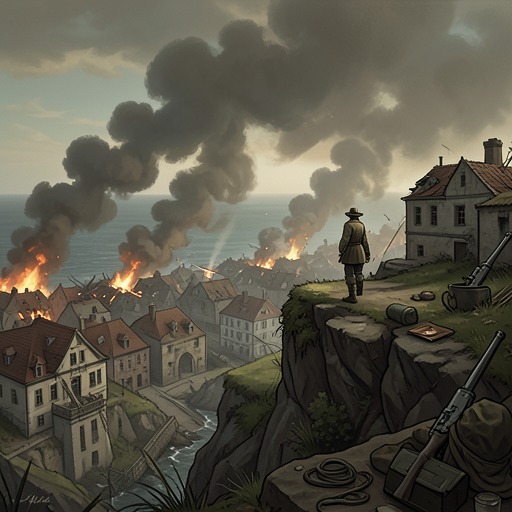
The failing officer nevertheless remains dangerous. Hearing sounds approach through the smoke, he crawls to a window, puts on his helmet, and answers a German corporal who asks whether the house is clear. Werner Pfennig is inside, and recognizes von Rumpel as the officer he had seen near a bakery with a newspaper. Von Rumpel, in turn, treats Werner as a possible accomplice and assumes they have come for the same thing. Between them stands a miniature city of wooden houses. Von Rumpel traces its streets with his fingers, says that only one of them can have what they seek, and points his pistol toward the ceiling while asking where the object might be. A cease-fire is supposedly scheduled for noon, but he insists there is time even as a curtain burns nearby.
His last appearance in the supplied narrative brings his central contradictions into one room: the expert who cannot establish the stone’s whereabouts, the looter who has depended on systems of secrecy, and the dying man who has mistaken possession for rescue. The miniature city makes the search visible in reduced form, its streets offering locations to test but no certainty. Around it, smoke advances and the cease-fire draws near. Von Rumpel’s pursuit has narrowed from a continent-wide operation to a desperate contest in a burning house, with his remaining time measured not by the immortality he sought but by the imminent end of the siege and the failing body he cannot command.