Reinhold von Rumpel’s cancer
All the Light We Cannot SeeReinhold von Rumpel’s cancer makes time a physical burden and sharpens the desperation behind his search for the Sea of Flames. Experimental treatment offers a fragile interval of hope, but its effects weaken him, his tumors progress, and a doctor eventually gives him only three or four months. The illness does not displace his pursuit of the stone; instead, it makes that pursuit feel like his remaining answer to mortality.
Experimental Treatment and Its Costs
At one stage, von Rumpel’s doctor reports that research is being conducted on mustard gases and that chemicals with anti-tumor properties are being explored. The prognosis seems to be improving: lymphoid tumors in test subjects have been observed to shrink. The report describes research in other patients, however, not a confirmed response in von Rumpel himself. His own experience of treatment is immediately punishing. The injections leave him dizzy and weak, and in the days afterward even ordinary tasks become difficult: he struggles to comb his hair and to make his fingers button his coat.
The effects reach beyond strength and coordination. Von Rumpel walks into a room and forgets why he went there; while facing a superior, he loses track of what the man has just said. Passing cars sound to him like fork tines dragged along his nerves. These details make the treatment’s cost concrete without turning it into a simple measure of whether the medicine works: scientific hopes of shrinking tumors coexist with debilitation, lapses in memory, and heightened discomfort. The body being treated is also the instrument with which von Rumpel must continue to pursue his aims.
Progression and Prognosis
The later medical report is more definite and more severe. In Nuremberg, a doctor tells von Rumpel that the tumor in his throat has grown to four centimeters in diameter. A tumor in his small intestine is harder to measure, leaving one part of the disease less precisely quantified even as its presence is clear. The contrast between the measurable throat tumor and the difficult-to-measure intestinal one gives the diagnosis both a numerical certainty and an unresolved extent.
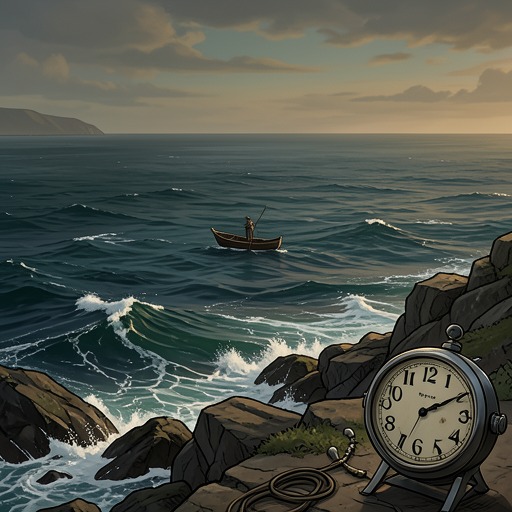
The doctor estimates that von Rumpel has three months, perhaps four. The interval is not left as an abstraction. An hour after the appointment, at a dinner party, von Rumpel counts it as one hundred and twenty sunrises: one hundred and twenty more mornings of hauling his corrupted body from bed and fastening it into uniform. The repeated acts of rising and dressing turn the prognosis into a forecast of bodily effort. Time remains, but it is already imagined as a succession of mornings his body may barely manage.
Illness and the Search for the Stone
The cancer intensifies the significance of von Rumpel’s search for the Sea of Flames. In his hotel, wrapped in blankets and ordering soup, he studies documents sent from Vienna: copies of the Tavernier and the Streeter, along with stencil duplicates of de Boodt’s 1604 Gemmarum et Lapidum Historia. The texts contain nine paragraphs in all about the stone. He has to concentrate to bring them into focus, and their accounts of a goddess, a recovered prince, and a priest’s claim that the keeper of the stone will live forever meet a mind already occupied by illness and dwindling time.
That promise does not establish that the stone can cure him. It is a legend that he hears through the documents, and the narrative places it beside his advancing disease rather than confirming it as medical truth. The distinction matters: von Rumpel’s hope attaches to an inherited story at the very moment his treatment and doctors offer only uncertain or bleak prospects. His pursuit consequently becomes more than a search for a valuable object; the stone’s promise of endless life confronts the sharply limited span measured by his doctor.
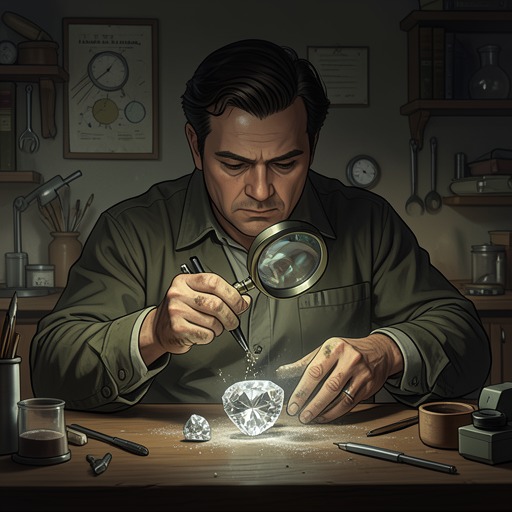
The confrontation becomes harsher when von Rumpel finds what appears to be a blue, pear-cut diamond in a strongbox. For an instant, the red heart inside the stone seems to appear, then becomes inaccessible. He recognizes that the diamond is another fake made by Dupont. By this point he has found all three fakes, his luck is spent, and the doctor says the tumor is growing again. The parallel is exact in its effect, not in its cause: each apparent opening toward hope closes, while the disease advances.
A Private Countdown Within a Retreating War
Von Rumpel’s prognosis unfolds alongside Germany’s retreat. At the dinner party, officers discuss the Eighth and Fifth German Armies moving north through Italy and the possibility that the Tenth Army may be encircled; Rome could be lost. The report of a hundred thousand men gives the gathering another scale of danger, but von Rumpel’s attention is caught by the arithmetic of his own remaining life. Military numbers describe a collapsing campaign; his count of sunrises makes the same conversation intimate and bodily.
The institution around him is also losing its former function. The Einsatzstab Reichsleiter Rosenberg, whose men have been searching across the continent for hidden libraries, concealed prayer scrolls, and impressionist paintings, may soon hand them rifles and send them into battle. Von Rumpel, too, expects to be included. Cancer and military reversal therefore converge: his personal future is contracting just as the organization and war that have structured his work become unstable. His hands feel heavy and his head like a boulder, yet he cannot give up. The illness’s decisive narrative role lies in that tension between bodily decline and continued pursuit, with the promise of the stone set against a prognosis counted in months and mornings.