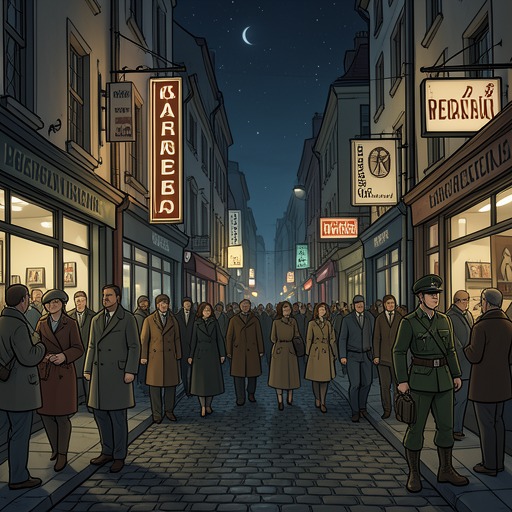
Restrictions on public life in occupied Saint-Malo
All the Light We Cannot SeeRestrictions on public life in occupied Saint-Malo turned ordinary routines—walking, listening, gathering, and even keeping a door locked—into matters subject to surveillance and punishment. Some controls were announced as formal orders; others were conveyed through fines, fear, and rules that nobody needed to write down. Together they made occupation palpable not only in moments of arrest, but in the shrinking spaces of everyday life.
Formal Rules and Public Conduct
Curfews were imposed, and music audible outdoors and public dances were banned. The mayor announced that the country was in mourning and residents must behave respectfully, although the narrative leaves uncertain what authority he still possessed. The announcement nevertheless gave official language to a broader demand for quiet and public conformity. Other restrictions reached into private homes and ordinary possessions. In a radio-surrender notice, residents were ordered to deliver all receivers to 27 rue de Chartres before noon the following day; anyone who failed to comply would be arrested as a saboteur. The threat made listening equipment a source of danger in itself, and the order prompted Marie-Laure LeBlanc to ask anxiously whether her great-uncle Etienne LeBlanc was safe. Madame Manec answered that he was in his grandfather’s old room, locating the immediate fear inside the household rather than in an abstract regulation.
Unwritten Discipline and Domestic Life
The regime’s reach extended beyond posted rules. Residents could be fined for locking their doors, keeping doves, or hoarding meat. Other prohibitions were not formally written down, yet carried the same force: no eye contact, no doorway conversations, no sunbathing, no singing, and no evening strolls with lovers along the ramparts. The distinction between law and social prohibition blurred; people had to anticipate what might draw notice even when no official text named the behavior. The consequences appear in the altered rhythms of the LeBlanc household. As Atlantic winds rise, Etienne barricades himself in his brother’s old room. Marie-Laure, confined indoors, passes the hours in his study running her fingers over his seashells, sorting and re-sorting them by size, species, and morphology. Her father refuses to take her outside even for half an hour, and a remembered warning—that blind girls might be taken before disabled men—makes the danger feel close. Restrictions thus govern not only where residents may go, but also what they fear might happen if they do.
Enforcement, Surveillance, and Movement
Blackout violations could bring fines or questioning. Yet enforcement is shown as uneven: Madame Manec reports that lamps burn through the night at the Hôtel-Dieu, where German officers come and go. The contrast does not remove the threat facing residents elsewhere; it suggests that rules and scrutiny can be applied selectively, while ordinary people remain exposed to punishment. Movement was also subject to direct control. During the evacuation crisis, Monsieur Levitte tells Marie-Laure that the city gates have been locked and that every man between sixteen and sixty is being detained. The men are to assemble at the château tower and then be marched to Fort National at low tide. His report connects restrictions on public life to the seizure of civilians: the order determines where men must go, gathers them under guard, and removes them from the city. Marie-Laure does not answer, and the surrounding street sounds calm, a stark contrast to the coercive process Levitte describes.
Evasion and Significance
Control did not eliminate local initiative. Madame Ruelle, Madame Guiboux, and another companion drive out at dusk with a stepladder and ratchet set to rearrange road signs, then return laughing. Their practical joke gives the rules of movement a vulnerable point: signs intended to direct travel can be altered by the people living under occupation. The act is small, but it turns imposed order into something residents can manipulate. The restrictions also make the household’s radio apparatus newly charged with risk. In Etienne’s attic, Marie-Laure encounters a room of equipment—tubes, coils, switches, meters, and a gramophone—and hears music and a recorded voice through headphones. Against the later order to surrender receivers, this scene underscores the difference between public prohibition and the private survival of communication. The rules seek to regulate what can be heard, where people can gather, and how they move; the narrative answers by showing both the intimate costs of compliance and the limited, concrete acts through which residents resist being entirely governed.