Saint-Malo's older women carry out acts of resistance
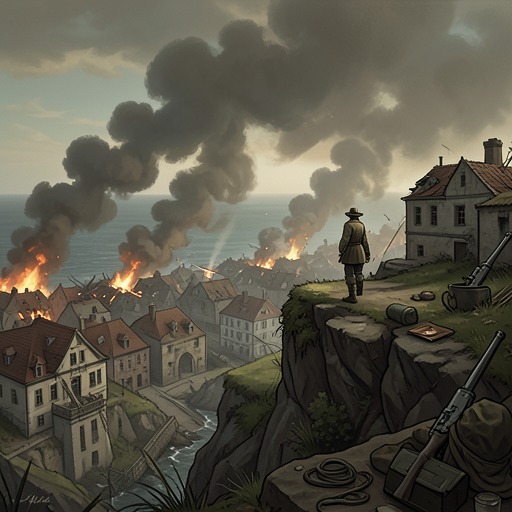
All the Light We Cannot SeeSaint-Malo's older women carry out acts of resistance by converting familiar work, neighborhood knowledge, and everyday objects into instruments of opposition to the German occupation. Organized around Madame Manec, their efforts range from quietly redirecting supplies and information to placing a political message on banknotes. Their resistance is neither a single public confrontation nor an escape from ordinary life: it takes shape inside the jobs and routines that keep the occupying authorities’ world running.
From complaint to collective action
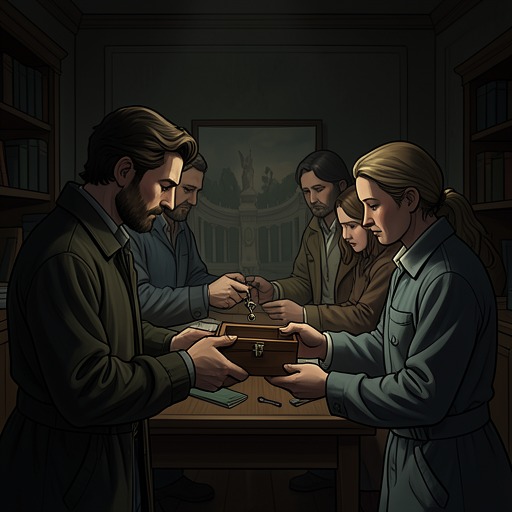
Marie-Laure LeBlanc sits in her customary place in the kitchen, closest to the fireplace, as Madame Manec’s friends complain about the conditions of occupation. Their grievances are practical and immediate: the exchange rate is a farce, carrots cost too much, and duplicity seems widespread. The conversation shifts when Madame Manec deadbolts the kitchen door and clears her throat. The women fall silent, and complaint gives way to a proposal for acting together.
Madame Manec identifies how closely occupation depends on the labor of local people. The women and their families repair German shoes, sort mail, and bake much of the garrison’s bread. Her argument is pointed: “We’re the ones who make their world run.” The line makes their position both a vulnerability and a source of leverage. Their work places them inside the systems the occupiers rely on, where small acts can interfere with routine without announcing themselves as open confrontation.
The kitchen meeting also establishes the social form of this resistance. It is organized through neighbors who already know one another’s work and circumstances, with Madame Manec prompting the group to turn shared frustration into coordinated action. Marie-Laure’s presence makes the planning part of the household’s daily life rather than a separate, distant world of political activity.
Disrupting the machinery of occupation
The women’s actions make use of practical knowledge and ordinary tools. At dusk, Madame Ruelle, the baker’s wife, straps a stepladder to her husband’s car and drives the Route de Carentan with Madame Guiboux. Using a ratchet set, they rearrange road signs. Their return to the kitchen of Number 4 rue Vauborel is described as drunk and laughing, a brief glimpse of camaraderie after an operation whose purpose is to alter how people navigate the roads.
Other actions interfere with the movement of goods and information. The women send a shipment of rayon to the wrong destination and deliberately misprint a train timetable. Madame Hébrard, the postmistress, takes an important-looking letter from Berlin home and uses it to start her evening fire. These acts target different parts of the occupiers’ administrative and logistical world: transport, supplies, and correspondence. Their scale is modest, but each takes advantage of access created by ordinary work.
The women also exploit local information. Three days after the road-sign episode, Madame Fontineau overhears that the German garrison commander is allergic to goldenrod. Madame Carré, a florist, responds by placing great fistfuls of the flower in an arrangement intended for the château. The episode shows how gossip and occupational access can become means of interference: what one neighbor learns is put to use by another, whose work carries the arrangement toward its destination.
A message carried in money
Madame Manec’s most deliberately public scheme uses money as its medium. She asks everyone to give their money to Madame Blanchard and reassures them that they will get it back. She then connects Madame Blanchard’s lifelong skill in handwriting to a specific task, giving her Etienne LeBlanc’s fountain pen and asking her to inscribe every five-franc note with “Free France Now.” The plan depends on the bills continuing to circulate: as people spend them, the message will travel across Brittany through ordinary transactions.
This choice of medium gives the operation its particular logic. The women do not need to distribute a separate printed statement or destroy the currency; the money itself remains useful while carrying a challenge to German authority. Madame Manec’s assurance that no one can afford to destroy money makes the practical premise explicit. The resistance message is designed to pass from hand to hand because the occupied economy cannot simply discard the object bearing it.
Resistance within constraint
The wider conditions make clear why these actions rely on concealment and indirect methods. The occupation imposes orders and threats that reach into private life: Saint-Malo’s residents are told to surrender their radio receivers under threat of arrest, while later a notice announces the detention of men aged sixteen to sixty and their assembly at the château. These measures do not describe the women’s operations themselves, but they establish the coercive environment in which ordinary residents have limited room to act openly.
The women’s resistance therefore works through the spaces occupation has not fully closed off: a kitchen meeting, a florist’s arrangement, a postmistress’s work, a bakery owner’s car, a timetable, a banknote. Their actions do not amount to a military campaign in the evidence presented; they are coordinated disruptions woven into daily labor. Together, they show how people made indispensable to an occupying system can use that dependence to obstruct it, and how a political message can spread through objects that appear, at first, merely practical.