Schulpforta
All the Light We Cannot SeeSchulpforta is a Nazi National Political Institute of Education near Naumburg in Saxony, roughly two hundred miles east of Children’s House. For Werner Pfennig, admission first appears to open a world beyond the mining town and its narrow prospects; the school then subjects him to an education in which technical opportunity and intellectual promise are bound to discipline, racial doctrine, and military service.
Place and Admission
Five days after Werner returns from Essen, a hand-delivered letter summons him to National Political Institute of Education #6 at Schulpforta. He reads it in the parlor of Children’s House, among cracked walls, a sagging ceiling, and benches used by generations of orphans. The contrast between the worn home and the distant school gives the letter its force: Werner understands that he has found a way out.
Schulpforta is a small point on the map, near Naumburg and two hundred miles east. Werner carries the notice to Frau Elena, who is boiling laundry, and she rereads it before raising the question of cost. Werner tells her that payment is not needed. His confidence does not erase the difficulty of leaving: he tries to reassure Jutta Pfennig that he may return after two years, learn engineering, perhaps fly an airplane, and take her and Frau Elena west with him. He imagines a journey through the places Frau Elena described, even as far as Paris. Jutta does not accept the promise as reassurance; she warns him not to lie to her. Ten hours later, Werner is on a train to Schulpforta.
The school’s physical setting initially seems as remote from the mining district as Werner hoped. Its eight or nine stone buildings stand below hills, with rust-colored roofs, narrow windows, and spires; a river runs beside athletic fields. The landscape and architecture give the institution the appearance of a secluded, storybook school. That appearance, however, sits beside an extensive system of control, and the new arrival soon finds that its order is not incidental to its purpose.
Discipline and Ideological Education
A one-armed bunk master lays out the rules in detail. Cadets have parade, field, and gym uniforms; wear their knives at the belt; form ranks in rows of ten; and keep their lockers free of personal belongings apart from the required equipment. They may not talk after lights-out, and letters home are posted only on Wednesdays. The rules reach from clothing and possessions to speech and correspondence, making daily life a rehearsal of obedience.
The scale of the institution reinforces that regimen. Schulpforta houses about four hundred boys, with thirty instructors and fifty additional staff members. Its cadets range from nine to seventeen years old. The school’s lessons combine academic subjects with physical and military training: Werner studies Goethe and magnetizes needles, while the timetable also includes mechanics, state history, racial sciences, horsemanship, orienteering, and military history. Even the youngest cadets are taught to clean, dismantle, and fire a Mauser rifle.
The ideological program is made visible in classrooms and lectures. A portrait of the Nazi leader hangs above every classroom. On Werner’s first day, he sees the technical-sciences laboratory, stocked with sinks, cabinets, glassware, balances, and burners; on the second, a phrenologist presents diagrams that claim to measure racial ancestry and classify which marriages are permissible. Scientific instruction and racial pseudoscience occupy the same institution. The school’s curriculum does not merely teach technical competence: it places that competence inside an official account of national identity and hierarchy.
The commandant also frames the cadets’ lives as service to the nation, presenting their discipline as a duty and their collective effort as fuel for the state. Silk banners later appear above the refectory tables with slogans prescribing physical toughness and condemning failure. In this environment, the language of self-improvement becomes difficult to separate from political conformity: students are urged to overcome weakness, but the terms of that demand are set by the institution.
Technical Work and Werner’s Education
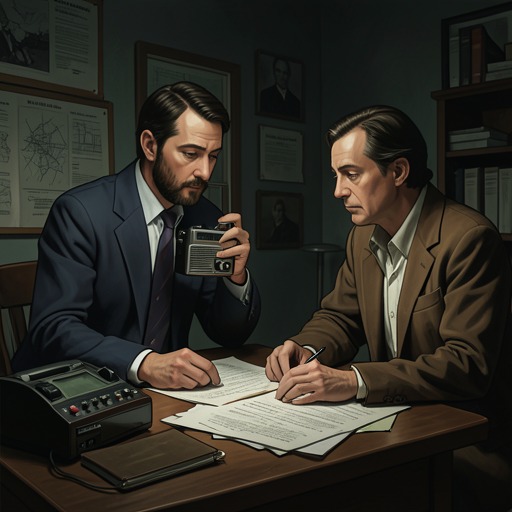
Schulpforta gives Werner access to scientific work he could scarcely have imagined at Children’s House. Each evening he works in Dr. Hauptmann’s laboratory, using triangulation formulas and helping improve a directional radio transceiver. Hauptmann wants the device retuned quickly across multiple frequencies and able to measure the angle of incoming transmissions. Werner reworks nearly the entire design.
The relationship with Hauptmann is intellectually enabling but uneven. Some evenings the doctor explains electrical components, discusses scientific developments, and welcomes Werner’s questions. On other evenings he supervises in silence and allows no exchange. Werner is exhilarated by the connection between laboratory work and the military power surrounding it; the telephone on Hauptmann’s desk suggests access to decision-makers and destructive force far beyond the school. Schulpforta therefore offers Werner real technical instruction while making its possible uses inseparable from the Reich’s authority.
That training is tested in the landscape around the school. At midnight, Hauptmann takes Werner into frozen fields with two transceivers and his dogs. Frank Volkheimer has gone ahead with a concealed transmitter, and Werner and Hauptmann must locate it across a ten-square-kilometer search area. The test turns the school’s technical lessons into practical tracking work and places Werner’s skill in a military chain of command. What he learns is not only how radio signals behave, but how his inventions can be used to find a person who is trying to remain hidden.
Cadets, Violence, and Conscience
The school’s discipline also operates through the cadets themselves. After Bastian’s exercise identifies a boy as the weakest, departures follow: one cadet leaves five days later and two more the next week. The account records the group’s numbers falling from sixty to fifty-seven. Advancement at Schulpforta is thus accompanied by a process that marks some students as expendable rather than treating their difficulty as a reason to protect them.
Frederick’s experience exposes another side of that system. Other boys torment him, while Werner tells himself that he is trying to help: he polishes Frederick’s boots each night to reduce one possible pretext for punishment, and on Sunday mornings he helps him with schoolwork. Frederick speaks of hoping to find skylark nests in spring and sometimes identifies birds by name. Werner’s small acts of care coexist with a more consequential failure. After Frederick is beaten, Werner does not confront Bastian, seek out the responsible older student, or demand justice from Dr. Hauptmann. Frederick nevertheless continues to treat him with gentle kindness and invites him to Berlin to meet his mother. Their friendship makes Werner’s passivity at Schulpforta personal: he is not simply learning how to obey rules, but how easily fear and ambition can keep him from defending someone he values.
In technical sciences, Hauptmann asks the class to define entropy. No one volunteers, and Werner tries to remain still as the doctor moves among the desks before calling on him. The lesson places an abstract scientific concept inside the school’s atmosphere of scrutiny. Werner’s intelligence earns him attention and opportunity, but being singled out also reminds him that his talents are observed and used by those in authority.
Wartime Decline and Departure
As the war consumes the school’s personnel and supplies, Schulpforta’s managed order becomes increasingly unstable. Instructors disappear into military service and are replaced by elderly townsmen whom Werner regards as ill-suited to teaching. The cadets show them less respect, their tempers shorten, and everyday routines grow harsher. Electricity fails and surges, followed by days of darkness; heating and lighting become unreliable, gasoline is scarce, food arrives by mule, and Werner sometimes finds worms in his sausage. New cadets receive cheaper uniforms, and the school no longer has live ammunition for marksmanship practice. These shortages reveal the widening distance between the institution’s grand rhetoric and the resources available to sustain it.
In January 1942, Werner goes to Hauptmann and asks to be sent home, offering to work for his train fare. Hauptmann rebukes him by pointing to the privileges Werner enjoys at school, including concerts, chocolate, and warmth by the office fire. The exchange exposes the terms of Werner’s position: his access to comfort and technical education is treated as an obligation, not as a benefit he can freely leave. In March, Hauptmann tells Werner that he has been called to Berlin to continue his work there. By August, a corporal arrives for Werner, and his induction into the German Armed Forces begins without ceremony. Schulpforta has taken in a boy who hoped its distance would make another life possible; it sends him onward as a trained radio specialist, with his designed transceivers among the equipment awaiting him in a military truck.
Narrative Significance
Schulpforta is both a place of genuine learning and an instrument of state formation. Its laboratory gives Werner the means to develop his abilities, while its rules, racial instruction, weapons training, and later transfer of cadets direct those abilities toward military ends. The school’s promised escape from an orphanage and a mining future is real, but conditional: Werner’s talent is cultivated in a system that claims him in return.
The school’s changing fortunes make that contradiction visible. At first, its castle-like buildings, extensive staff, and specialized laboratory suggest durable privilege and order. As instructors vanish, electricity falters, and basic supplies diminish, the institution’s rhetoric of strength is increasingly at odds with its material decline. Yet it continues to sort, train, and dispatch boys. Schulpforta’s significance lies in this convergence: it is where Werner’s intellectual world expands and where that expanded capacity is recruited into the machinery of war.