Sea of Flames curse
All the Light We Cannot SeeThe Sea of Flames curse is the legend attached to a blue diamond: its keeper will live forever, but calamities will befall loved ones in an unending sequence. The story offers a supernatural explanation for suffering, yet repeatedly places it beside ordinary explanations such as chance, physical law, rumor, and human choice. Its power lies not in proof that the curse operates, but in the way belief in it changes what characters fear, protect, and are willing to relinquish.
The Legend and Its Terms
The legend reaches Marie-Laure LeBlanc as a story told to children at the museum. It is kept behind a sequence of doors, the last a small locked door, and the guide identifies what lies beyond it as the Sea of Flames. The presentation makes the stone both a physical treasure and the center of an inherited tale: access is restricted, rumors flourish, and even the museum’s guards can be imagined as protecting the world from what the jewel might unleash.
In the guide’s account, the stone first comes from a river. A prince finds it after the river dries up and wears it in his crown. Some people regard him as a deity, or believe the stone makes him impossible to kill. But the prince’s good fortune appears to turn: within a month one brother drowns and another dies from a snakebite; within six months his father is dead, and an army is gathering in the east. The sequence gives the legend its central pattern: the keeper seems protected while losses gather around him.
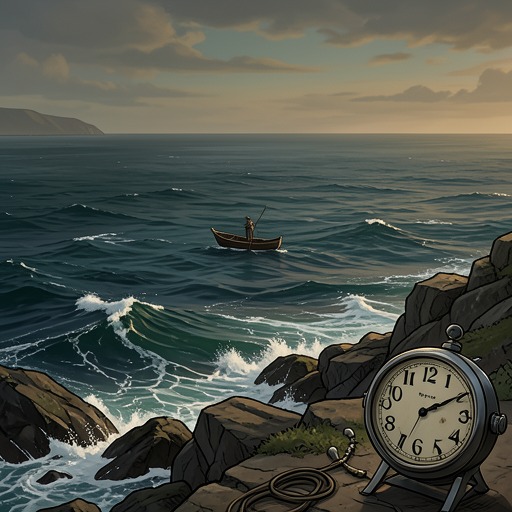
The prince’s advisers urge preparation for war, but a priest offers a different explanation, based on a dream. In it, the Goddess of the Earth made the jewel for her lover, the God of the Sea, and sent it down the river. When the river dried and the prince took the stone, the goddess became angry and cursed both the jewel and its keeper. The curse has two linked terms: the keeper will live forever, while the people he loves will suffer one misfortune after another. Throwing the diamond into the sea would return it to its intended recipient and lift the curse.
The prince considers this choice for three days and three nights, then keeps the stone, trusting the protection he believes it has given him. He has the priest’s tongue cut out. Invaders later destroy the palace and kill those they find; the prince disappears. For two hundred years, accounts disagree about what happened to the jewel and its keeper. The stone may have been cut into smaller gems, or the prince may still be alive somewhere in the world. The legend thus makes immortality itself uncertain: it is promised by the curse but never confirmed by an identifiable survivor.
The Diamond’s Passage into Europe
The tale resumes with a French diamond trader on a journey to the Golconda Mines in India. He is shown a pear-cut diamond of 133 carats, with near-perfect clarity, blue color, and a red flare at its center. The trader warns a duke in Lorraine about the stories surrounding the stone, but the duke wants it and has it fitted to the end of a walking stick. The jewel’s later European history repeats the legend’s pattern with domestic losses: the duchess becomes ill, two servants are injured in a fall, and the duke’s only son dies in a riding accident.
The duke himself is said to look well, but fear increasingly governs his life. Convinced that his diamond is the accursed Sea of Flames, he becomes afraid to go out or receive visitors. He asks the king to seal it in a specially built vault, with the condition that the vault remain closed for two hundred years. The guide’s account places the children’s visit 196 years into that interval. The planned delay transforms the curse into a material rule of custody: the jewel is not merely hidden but kept from view according to a timetable that still has four years to run.
When rumors circulate in the Paris Natural History Museum that a remarkable jewel may be displayed, its identity shifts with each telling. It is variously described as a stone from Japan belonging to an eleventh-century shogun, a specimen already held in the museum, an unusual mineral, a star sapphire, and finally a diamond. Its competing names include the Shepherd’s Stone and the Khon-Ma, but the name that takes hold is the Sea of Flames. Reports of its size and color also change, turning the object into a screen for other people’s imaginations.
Marie-Laure hears staff attribute misfortunes to the stone: an electrical failure, damage to botanical specimens from a leaking pipe, and the director’s wife breaking her wrist after slipping on ice. Her father, Daniel LeBlanc, is summoned to a long meeting with the director and then works for weeks in the Gallery of Mineralogy, moving equipment after closing and returning with the smell of brazing alloy and sawdust. Marie-Laure is not told what he is building. The hidden work and the spreading gossip make the curse consequential before she knows the diamond’s whereabouts: her father’s secrecy gives the rumors a personal stake.
Belief, Chance, and the Hidden Stone
Daniel is entrusted with one of four stones: the real diamond and three decoys, assigned to different routes out of Paris. The plan is designed so that no carrier knows whether he has the genuine jewel, and each is told to behave as though he does. In a field west of Versailles, Daniel opens a linen bag and sees a chestnut-sized stone glowing blue. He tells himself that a tradesman would not be given the real 133-carat diamond, but the possibility unsettles him. Its small weight becomes, for him, a question he cannot dismiss.
Later, as Daniel and Marie-Laure travel through danger, he counters the legend with a material explanation. A diamond is carbon compressed within the earth and brought to the surface by geological forces; cutting and polishing do not give it power. He insists that it can no more hold a curse than a leaf, a mirror, or a life, and that the world contains chance and physics. Yet this rational account does not settle the matter for him: he also tells himself that the stone he carries is only glass, a diversion. The decoy plan and his uncertainty make skepticism practical rather than absolute; he does not know what he has, and must act as if the danger is real.
Marie-Laure hears two explanations in tension. Her father tells her that stones and misfortune are not bound together, and that rare things attract locks because people desire them. She also hears the rumor that the diamond is a piece of light from the original world. Her response is not simply curiosity about its appearance: she wants to believe Daniel has not gone near it. The possibility of the curse gives emotional shape to her fear that her father’s concealed work has drawn him into danger.
Marie-Laure’s Choice and the Unresolved Ending
After the losses of Daniel’s arrest, Harold Bazin’s disappearance, and Madame Manec’s death, Marie-Laure handles the many-faceted stone and wonders whether one object could be responsible for so much sorrow. The story offers no confirmation that it is. She considers throwing it into the street or taking it to the sea, as the legend’s remedy prescribes. But the imagined cost is also clear: the stone appears valuable, and she cannot be certain whether giving it away would merely pass its danger to someone else.
The puzzle house Daniel left in Saint-Malo sharpens that conflict. Marie-Laure reasons that he must have thought the stone real, since he built an elaborate hiding place for it and left it behind. She puts it back inside the model, restores the roof panels, and turns the chimney to close the compartment. Her decision does not establish belief in the curse; she has also considered the geological world of magma, crust, ocean, gravity, and time, and doubts that curses are real. Instead, uncertainty makes disposal difficult. If the curse exists, giving away the jewel might expose another person to it; if it does not, the stone remains a valuable object her father took pains to conceal.
Later, Marie-Laure imagines Werner returning to the hiding place after leaving her. In one possible version, he solves the puzzle, drops the diamond into a pool among thousands of snails, locks the gate, and leaves. In others, he replaces it in the house or puts it in his pocket. These alternatives do not establish what happened to the stone; they preserve the ending as a choice that Marie-Laure cannot witness or verify. The curse therefore remains unresolved alongside the jewel’s fate. It is a story of immortal life and repeated loss, but also a measure of how people try to make suffering intelligible—and how difficult it can be to act when neither superstition nor reason can promise certainty.