The Siege of Saint-Malo
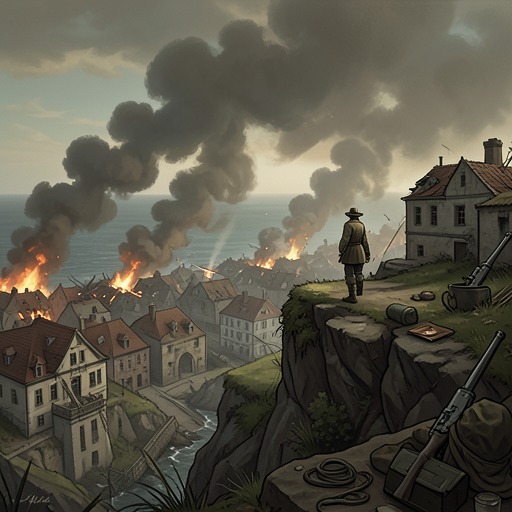
All the Light We Cannot SeeThe Siege of Saint-Malo turns the city into a place where military violence and occupation rule press upon ordinary life at once. Its clearest dated scene falls on 9 August 1944: on the third afternoon of the siege, shelling pauses amid burning trees, cars, and houses. The lull does not bring safety. German soldiers drink in blockhouses, a priest tends the walls of a cellar, and two frightened horses break out of a garage and run through the smoldering streets. Around this scene, the narrative traces a wider system of restrictions, searches, and resistance that gives the siege its human scale.
Occupation and the Conditions of the Siege
Before the shelling scene, occupation authorities impose a direct restriction on communication. Marie-Laure LeBlanc must press her father, Daniel LeBlanc, three times before he reads aloud the notice ordering residents to surrender every radio receiver in their possession. Sets must be delivered to 27 rue de Chartres by noon the following day; failure to comply is punishable by arrest as a saboteur. The notice makes listening and possession matters of official control, and places the threat of arrest behind an apparently administrative demand.
The wider account shows that such control is enforced through uncertain and intimidating procedures. Daniel LeBlanc is seized outside Vitré while traveling toward Paris. Plainclothes policemen remove him from a train in front of its passengers and question him first in a van, then in an office. French interrogators give way to German ones, who examine his notebook, tool case, seven skeleton keys, miniature tools, and architectural measurements. On the following morning, he is questioned again; the Germans appear to suspect a plan against the Château de Saint-Malo, but the basis for their suspicion remains unclear. They withhold paper, linens, and telephone access. The episode does not establish this arrest as a result of the siege; it places it within the coercive machinery surrounding the city.
The Shelling and Its Lull
The dated scene is striking for the contrast between a temporary pause and the damage already in progress. On 9 August, the shelling lulls as if the artillerymen had abruptly fallen asleep at their guns. Yet trees, cars, and houses are burning, and the movement of people and animals through the streets remains governed by fear. German soldiers drink wine in blockhouses while, in a college cellar, a priest scatters holy water on the walls. The detail sets military occupation, religious practice, and civilian refuge side by side without suggesting that any offers protection from the bombardment.
From a cellar, Werner Pfennig hears shells pass overhead and imagines the American artillerymen responsible for them. His thoughts assemble the attack as a sequence of tasks: observers with scopes, firing officers calculating conditions, and radio operators relaying targets. The imagined coordination contrasts with the confusion and immediate danger experienced below. The shells are not merely distant sounds in Werner’s account; they prompt him to picture the organized system producing them, even as he remains trapped in the cellar with the consequences.
Elsewhere, the search for an illicit broadcast continues through the occupied area. Werner and the soldiers accompanying him travel through Saint-Malo, Dinard, Saint-Servan, and Saint-Vincent in a battered Opel whose sides scrape narrow streets. They pass damaged crêperies, shuttered bakeries, empty bistros, conscripted Russian laborers, and women carrying water from wells. Werner can receive BBC broadcasts and propaganda stations, and sometimes picks up stray Morse code, but he finds none of the local announcements or music the colonel’s aides described. The search records how military surveillance persists amid damaged streets and unsettled civilian life; it does not identify the elusive signal as a cause of the siege.
Civilian Restrictions and Acts of Resistance
The occupation’s orders extend beyond radio possession. Residents are told that every man aged sixteen to sixty must assemble at the château tower and then be marched to Fort National at low tide. The instruction presents mass detention as a scheduled movement of people through designated places. Its brief, matter-of-fact wording contrasts with the gravity of removing a broad group of men from the city, and shows how military authority turns civilian life into an object of organized control.
Resistance appears in a smaller, practical form in the actions of Madame Ruelle, the baker’s wife. At dusk she drives along the Route de Carentan with Madame Guiboux, carrying a stepladder and ratchet set, and rearranges road signs. They return to Number 4 rue Vauborel laughing and drunk. The account gives no claim that this act changes the course of the siege; its significance lies in the contrast between the authorities’ control of roads and the women’s quiet alteration of the signs that guide movement through them.
Wider Human Consequences and Narrative Significance
The siege sits within a longer history of separation and strain. On the twentieth morning without news of her father, Marie-Laure stays in bed, stops asking to go to the station or prefecture, and withdraws from ordinary routines. Madame Manec has tried to help her search and petition the occupation authorities, but the absence of news continues to weigh on the girl. This earlier stretch of uncertainty is not identified as a consequence of the shelling; it shows the vulnerability that the wider occupation has already created before the siege’s destruction becomes the narrative’s immediate landscape.
Letters from Germany offer another, distinct view of wartime pressure. Jutta Pfennig writes to Werner about cold, fuel scarcity, shortages of fabric, and laundry work repairing clothes for reuse. In a later letter to his sister, Werner describes hardship but much of the text is censored. These separated voices do not supply a direct account of the siege; they widen the novel’s frame beyond Saint-Malo, showing how wartime control and deprivation reach characters far from the bombardment. Much later, Jutta hesitates to accept a letter brought by Frank Volkheimer and has kept memories of Werner and the war largely sealed away. Against that long aftermath, the siege’s brief lull is not a resolution: it is a suspended moment in a conflict whose effects continue through absence, memory, and silence.