The invisible world
All the Light We Cannot SeeThe invisible world in the novel is not an empty space beyond sight but a crowded reality that ordinary perception cannot register: radio waves crossing walls, light beyond the visible spectrum, and the immense histories stored in everyday matter. The broadcasts Werner Pfennig and Jutta Pfennig discover at Zollverein make this world imaginable. Their scientific lessons transform darkness from a limit into an invitation—to ask how perception works, what lies beyond the senses, and what kinds of life might be possible beyond the mine gates.
A Voice Crossing the Dark
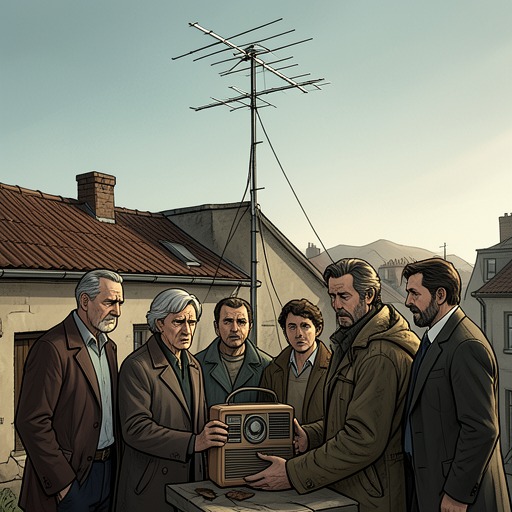
At night, Werner Pfennig and Jutta Pfennig tune a shortwave receiver and encounter a French-speaking broadcaster whose lessons move among optical illusions, electromagnetism, coal, sea creatures, and the North Pole. His voice reaches them through static and a sound that hisses and pops; its source remains undisclosed. The transmission is itself an example of the invisible world it describes: an unseen signal arriving from elsewhere and making a distant speaker intimate. For the siblings, listening becomes a way to inhabit a larger reality without leaving their room.
The program’s appeal lies partly in how it makes a difficult idea personal. The broadcaster addresses children and asks how a brain enclosed in darkness can construct a world full of light. The question unsettles the assumed equivalence between seeing and knowing. Light is not simply an obvious substance presented to the eye; the brain, which never receives light directly, builds the illuminated world that consciousness experiences. The explanation gives Werner Pfennig a scientific account of perception while also making the familiar fact of seeing strange again.
Their nightly listening becomes habitual. They return to the Frenchman’s broadcasts around bedtime, often finding him midway through a script they have heard before. Jutta Pfennig favors a program about magnets; Werner Pfennig is especially drawn to light, including eclipses, sundials, auroras, and wavelengths. He imagines radio waves as long harp strings bending and vibrating over Zollverein, passing through forests, cities, and walls. This image links the physical operation of transmission to music: what cannot be seen can still move, connect, and be received.
Light, Matter, and Deep Time
A broadcast about coal extends the invisible world backward through geological time. The Frenchman asks his listeners to imagine a piece of coal glowing in a family stove as a plant that once grew in sunlight. The plant captured solar energy and made it into leaves, bark, and stems; after it died, it decayed into peat and was folded into the earth. Over immense stretches of time, the peat changed until it became coal, was dug up, carried to a home, and burned for warmth. The stove’s ordinary fuel is thus presented as sunlight from a remote past, transformed and stored in matter.
The account changes the scale of the household scene without discarding it. A lump of coal is at once something carried home and the remainder of a plant whose life belongs to a deep geological history. Human measures such as a month, a decade, or a lifetime become brief against those eons. In the broadcast’s sequence, the distance between ancient sunlight and a warm room closes through a chain of transformations: a plant grows, dies, becomes peat and coal, and is finally burned. The invisible is not only what lies beyond the visible spectrum; it is also the past concealed inside a present object.
The lesson has a particular force for Werner Pfennig, whose life is centered on a coal town and whose curiosity reaches beyond the work and surroundings that seem to define it. The Frenchman’s invitation to open one’s eyes before they close forever joins observation to urgency. It asks listeners to attend closely to what is available to them, while the coal story shows that attentive looking can disclose histories no eye could witness directly. Science here enlarges perception by teaching the mind to infer what sight alone cannot supply.
The Spectrum Beyond Sight
Later programs make invisibility a precise scientific problem. The broadcaster explains that visible light is what people call color, but that the electromagnetic spectrum extends beyond the portion humans see. The range running from zero toward infinity makes visible light only one part of a larger continuum. The apparent world of color is therefore not the whole of light; it is the portion accessible to unaided human vision. By making the boundary of sight a subject of inquiry, the program turns limitation into a reason to investigate rather than a reason to stop.
Werner Pfennig’s interest in waves and fields deepens when he studies Heinrich Hertz’s The Principles of Mechanics, a water-stained, decades-old book he finds forgotten in a church basement. The rector lets him take it home, and Frau Elena lets him keep it. Working through its difficult mathematics, he learns about static electricity and about how its coupling with magnetism produces movement—waves—and encounters fields, circuits, conduction, induction, space, time, and mass. The book gives technical form to the wonder first awakened by the broadcasts: the air around him is full of processes that his eyes cannot disclose.
At a gathering, Werner Pfennig’s attention drifts from the people around him to the book in his lap. When he looks up, everyone is staring; Frau Elena’s eyes are alarmed, and Hans Schilzer pulls the heavy volume from him, needing both hands to hold it. The scene brings the invisible world into contact with a visible social consequence. Werner Pfennig’s absorption in scientific ideas is legible to the others only through the book and his distracted behavior; what captivates him is the hidden activity he imagines in the air, not what the room expects him to attend to.
Imagination as a Form of Knowledge
The broadcasts do more than supply facts: they alter how Werner Pfennig imagines his surroundings and his future. As he listens, the attic seems to disappear, along with Jutta Pfennig beside him; his attention has been carried into the subject the voice makes vivid. When the siblings imitate the Frenchman’s experiments, they build speedboats from matchsticks and magnets from sewing needles. These small constructions turn listening into action. Scientific ideas become things they can test and handle, even while the phenomena that inspire them remain partly beyond direct perception.
The repeated signal also produces a sense of distance. Werner Pfennig thinks the voice and piano sound fainter each time, as though the Frenchman were broadcasting from a ship traveling farther away. The source is never identified in these scenes, and Jutta Pfennig wonders why the man does not say where he is. Werner Pfennig suggests that he may not want them to know. Their uncertainty makes the broadcasts both a source of knowledge and a continuing mystery: the lessons explain unseen processes, but the speaker himself remains out of reach.
With Jutta Pfennig asleep beside him, Werner Pfennig looks into the night and feels restless. He imagines a future as an engineer in a laboratory, among steaming cauldrons, machinery, and charts, then carries a lantern up a winding staircase to an observatory and looks through a telescope into the dark. The imagined journey gives the broadcasts a consequence beyond intellectual excitement. They allow a boy from a coal town to picture himself pursuing questions of importance in places not yet available to him. The invisible world is at once a scientific reality and an opening in the limits of his present life.