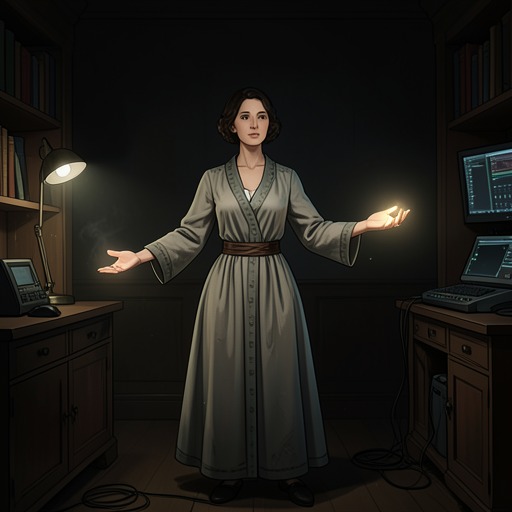
The mind constructs the world
All the Light We Cannot SeeThe mind constructs the world is an idea the novel places between perception and material life: the brain makes a world it cannot directly see, while bodies move through circumstances that shape what can be known. It appears in Werner’s encounter with Marie-Laure, in a lesson heard by Reinhold von Rumpel, and in a passage that traces human life from a single cell to birth.## Perception and the world made from sensation On rue Vauborel, Werner watches Marie-Laure leave a house and move through the street. He first sees a girl approaching him; then her roving cane and opaque glasses reveal that she is blind. As she walks, the cane finds storm drains, and she crosses the street to a bakery. Later she comes near him again, counting softly in French and veering around a poodle. Her measured movements show a world navigated through attention, sound, touch, and practiced judgment rather than sight.
Werner’s interpretation is as revealing as the encounter. At Schulpforta, he has been taught to admire an ideal of purity; seeing Marie-Laure apparently absorbed in the morning, he thinks he is looking at that ideal. The thought exposes how an ideology can pre-shape perception: he reads her presence through the school’s language even as the details of her independent movement exceed that frame. The scene asks the reader to distinguish the girl’s sensory experience from Werner’s projection onto it.## The brain and the unseen world The idea becomes explicit in the lesson von Rumpel hears through the ceiling of the damaged house. The recorded voice explains that the brain is enclosed in darkness yet constructs the world it experiences. As the batteries weaken, the voice drops in pitch and slows until it stops. This physical failure makes the lesson more than an abstract claim: a voice, carried through a recording, depends on a device and its diminishing power, while the brain it describes must make sense of what reaches it.
The setting supplies clues that von Rumpel struggles to interpret. He studies old clothes, spotted mirrors, boots, a whisk broom, and a photograph of a boy on a beach at dusk. Only after noticing trails through the wardrobe’s dust—made by fingers or knees—does he recognize evidence of someone’s passage into its depth. The room is not immediately legible to him; he has to infer an unseen person from marks left among objects. In this way, the scene joins the lesson’s account of mental construction to the reader’s own work of assembling a hidden story from partial signs.## From cells to the world A later reflection expands the idea from perception to the origins of embodied life. It follows existence from a single cell smaller than a speck of dust through division and multiplication, as atoms and molecules change places and the body’s systems take shape. At forty weeks, six trillion cells pass through the pressure of birth; the newborn cries, and then the world begins to act upon it.
The passage holds two truths together. The brain constructs the world it experiences, but that construction belongs to a body made of matter and exposed to forces beyond itself. The world is neither simply given to consciousness nor merely invented by it: experience arises through a living organism whose parts are formed, connected, and continually acted upon.## Recognition and connection When Werner reaches Marie-Laure in the wardrobe, the idea returns as an encounter between two people who have been separated by what each can know. He identifies himself through the radio and the song, and she nearly smiles; then he helps her slide out, and her feet find the floor of her grandfather’s room. Her first concern is that she cannot find her shoes. The moment brings a voice heard at a distance into physical presence, and replaces Werner’s earlier watching with contact and assistance.
Across these scenes, the idea is both cognitive and ethical. Perception depends on the mind’s acts of construction, but those acts can misread another person, as Werner’s initial idealization of Marie-Laure shows. They can also be revised by attention to concrete signs and by meeting someone beyond the image already formed. The novel’s account of a brain constructing a world therefore concerns not only how experience becomes possible, but how fragile and revisable one person’s understanding of another can be.