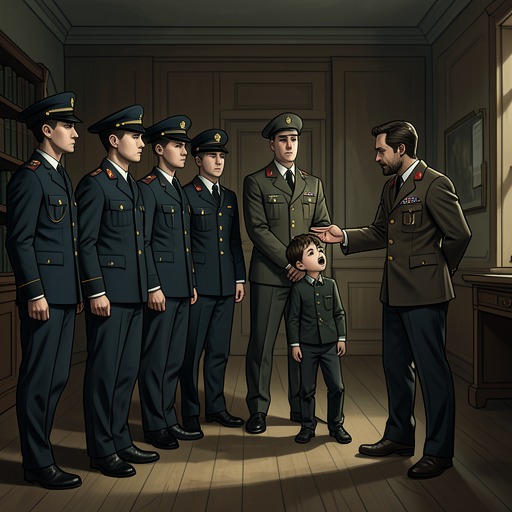
The prisoner-freezing ordeal at Schulpforta
All the Light We Cannot SeeThe prisoner-freezing ordeal at Schulpforta is a staged act of violence that makes obedience visible: cadets are ordered to soak a bound prisoner in winter cold, and Frederick’s refusal to join them becomes a test of conscience under coercion.
Setting and Staging
One February morning at two o’clock, the cadets are roused from their beds and driven into the glittering cold of the quadrangle. Torches burn in its center. Bastian waddles out with his bare legs showing beneath his coat, while Frank Volkheimer emerges from the shadows dragging a tattered, skeletal man in mismatched shoes. A stake has been driven into the snow. Volkheimer sets the prisoner beside it and methodically ties his torso to the wood as the cadets’ breath gathers above them in the night air.
The commandant presents the captive not as a person but as an enemy category, calling him “a creature,” “a foul beast,” “a centaur,” and an “Untermensch.” The prisoner’s ankles are cuffed and his arms bound; his thin shirt has split at the seams, and he gazes into the distance with the slackness of hypothermia. He appears to be Polish, perhaps Russian. Bastian tells the cadets that the man escaped from a work camp and was stopped after attempting to violate a farmhouse and steal a liter of fresh milk. He warns that the prisoner would tear out their throats if allowed. The accusations and racialized language turn his exposure to the cold into a demonstration of authority, while the man’s weakened body stands before the school as its prescribed image of an enemy.
The Ritual of Collective Participation
Volkheimer returns with a clattering raft of buckets, while two senior cadets uncoil a hose across the quadrangle. Bastian explains that the instructors will go first, followed by the upperclassmen, until every man in the school has filed past and soaked the prisoner. The first instructors throw their buckets from only a few feet away. Cheers rise after each splash. For the first two or three dousings, the prisoner seems to wake, rocking on his heels; vertical creases appear between his eyes, as if he is struggling to remember something vital. The procedure turns cruelty into an organized school exercise, with each participant’s small act incorporated into a prescribed sequence.
The upperclassmen disappear inside the castle, and the buckets clank as they are refilled. The sixteen-year-olds finish, then the fifteen-year-olds; as the cheers fade, Werner feels an urgent longing to escape. While he waits, he tries to summon other images, but his mind returns to the hauling machine above Pit Nine and the hunched miners, to the boy trembling during the entrance examination, and to people trapped in roles: orphans, cadets, Frederick, Volkheimer, the old Jewish woman upstairs, and Jutta. When his turn arrives, Werner throws his water like the others. It strikes the prisoner in the chest, drawing a perfunctory cheer. Werner joins the cadets waiting to be released, his boots and cuffs wet and his hands so numb they seem not to belong to him.
Frederick’s Refusal and Its Cost
Five boys after Werner, Frederick reaches the prisoner. He can scarcely see without his glasses, has not cheered as the buckets struck, and now frowns at the captive as though he recognizes something in him. Nudged forward by the boy behind him, he takes the bucket and empties it onto the ground. Bastian orders him to take another. Frederick again pours the water onto the ice at his feet and says, “He is already finished, sir.” Given a third pail and commanded to throw it, he refuses: “I will not.” The small, repeated gesture interrupts the school’s carefully ordered procession. Frederick does not free the prisoner, but he declines to make his own hands part of the punishment.
The refusal does not stop the ordeal or protect Frederick from the institution around him. For a week the prisoner’s corpse remains tied to the stake, frozen gray. Boys ask it for directions; someone dresses it in a cartridge belt and helmet. Crows stand on its shoulders and pick at it before the custodian and two third-year boys hack its feet from the ice with a maul, tip it into a cart, and roll it away. The casual uses of the corpse extend the violence beyond the prisoner’s death: the school turns the remains into scenery and an object of mockery before removing them.
In the following nine days, Frederick is chosen three times as the weakest during field exercises. Bastian walks farther out and counts faster, forcing Frederick to run four or five hundred yards, often through deep snow, while the other boys chase him; each time they catch and beat him as Bastian watches. Werner does nothing to intervene. Frederick lasts seven blows, then six, then three. He neither cries out nor asks to leave, and his endurance only intensifies the commandant’s frustration. Set beside the earlier refusal, these repeated punishments show the cost of resisting the school’s demand for conformity, while Werner’s inaction sharpens the contrast between seeing the cruelty and acting against it.
The Refusal’s Uneasy Afterlife
Bastian gives the prisoner’s depleted appearance a schoolroom label, calling it “circling the drain.” The phrase turns a person’s visible suffering into a contemptuous category, continuing the lesson in which the captive is made into an object to be judged rather than someone whose exposure might demand care. The ordeal’s moral contrast is therefore not simply between the prisoner and his tormentors: it also lies between the institution’s ready-made descriptions and Frederick’s refusal to treat the man as already beyond concern.
Much later, when Werner visits Frederick, the scene offers no simple image of the defiant cadet restored to triumph. Frederick still wears his black-framed glasses; porridge clings to his whiskers and to the place mat as Franny feeds him by the spoonful and wipes his chin. Werner cannot look at the mess, and realizes that Frederick now needs to shave—or someone must shave him. The visit does not establish the ordeal as the cause of Frederick’s later condition, but it changes the scale on which his refusal can be remembered: one small act of conscience remains distinct from the long, painful life that follows, and does not cancel the vulnerability the school’s violence exposed.