The prisoner-freezing ordeal at Schulpforta and Frederick's refusal
All the Light We Cannot SeeThe prisoner-freezing ordeal at Schulpforta and Frederick's refusal is a staged act of violence in which the school makes its cadets participate in the slow destruction of a captive. On a February night, instructors and boys are ordered to pour water over a bound prisoner in the snow. Werner Pfennig complies; Frederick does not. The difference between their actions gives the episode its moral force: a ritual designed to make cruelty ordinary produces, in Frederick, a refusal that the institution will not tolerate.
The captive and the schoolyard
The cadets are roused at two in the morning and driven into the glittering cold. Torches burn in the quadrangle. Frank Volkheimer brings a skeletal man in mismatched shoes out of the shadows and ties his torso to a stake driven into the snow. The prisoner’s ankles are cuffed and his arms bound; his thin shirt has split at the seams. He gazes with the slackness of hypothermia and sways lightly despite his restraints. The boys are made to look at him as a spectacle before they are made to act upon him.
The school authorities supply a story that turns the prisoner into a permissible target. Bastian says the man escaped from a work camp and tried to violate a farmhouse and steal a liter of milk, presenting him as a barbarian who would attack the cadets if allowed. The commandant calls him a “foul beast” and an “Untermensch.” These accusations and labels do not alter the immediate scene: a nearly incapacitated, bound person stands before an armed institution. Instead, the language gives the assembled boys a frame in which his suffering can be treated as deserved and his humanity discounted.
The procedure is announced as a collective duty. Instructors will go first, followed by the upperclassmen, and then every man in the school will file past with a bucket of water. Volkheimer brings out the buckets; two other seniors uncoil a hose across the quadrangle. The cold is described as invasive and mindless, while the cadets’ breath gathers above the courtyard. The setting makes the punishment bodily and public: there is no private act of cruelty to disavow, only a line of boys waiting for their turn under the torches.
A ritual of participation
The instructors begin. Each takes a full bucket from Volkheimer and throws it at the prisoner from a few feet away, while cheers rise from the assembled cadets. After the first dousings, the prisoner comes more fully awake and rocks on his heels; vertical creases appear between his eyes, as if he is trying to remember something vital. Dr. Hauptmann accepts his bucket, throws the water, and does not linger to watch it land. The gesture is brief, but the sequence makes participation institutional: the school’s adults enact the order before the younger boys inherit it.
As the water keeps coming, the prisoner’s face empties. He slumps against the ropes and slides down the stake; from time to time Volkheimer returns from the shadows and hauls him upright. The upperclassmen eventually disappear inside the castle, and the buckets make a muted clanking as they are refilled. The sixteen-year-olds finish, then the fifteen-year-olds. The cheering fades, but the procession continues. Its repetition is part of the punishment: each cadet encounters the same captive and receives the same instruction, so individual choice is folded into a practiced routine.
Werner’s turn comes before Frederick’s. With three boys ahead of him, Werner tries to call up other images, but his thoughts settle on people caught in roles they did not choose: miners at Pit Nine, the boy who trembled during the entrance examinations, orphans, cadets, Frederick, Volkheimer, and even Jutta Pfennig. When called forward, Werner throws the water. It strikes the prisoner in the chest; a perfunctory cheer follows. His boots and cuffs are wet, and his hands are so numb they seem not to belong to him. The narration does not excuse his action, but it places his obedience inside the accumulating pressure of the line, the cold, and the school’s enforced unanimity.
Frederick's refusal
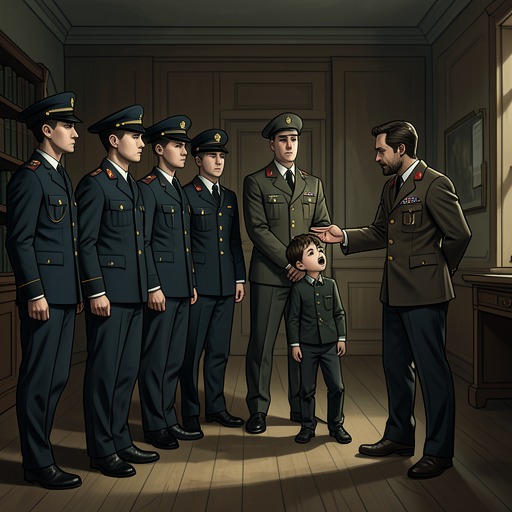
Five boys after Werner, Frederick reaches the prisoner. He has not been cheering as the buckets land, and he frowns at the man as if recognizing something in him. Werner understands what Frederick is going to do. Nudged forward by the boy behind him, Frederick takes a bucket and pours the water onto the ground. The act is a refusal before it is an explanation: he will not direct the water at the prisoner.
Bastian steps forward, his face red in the cold, and orders Frederick to take another bucket. Frederick again empties it onto the ice at his feet. In a small voice, he says, “He is already finished, sir.” The statement identifies what the ritual’s justifications are designed to obscure: the prisoner is already at the end of his strength, and more water can only worsen his condition. When Frederick is handed a third pail and told to throw it, he pours that one onto the ground too. “I will not.” Against the school’s repeated commands, the words are plain and final.
Frederick’s refusal does not stop the ordeal or free the captive. It does, however, make the distinction between compelled conformity and personal participation visible. Werner has already thrown his bucket; Frederick makes an alternative action imaginable at the cost of standing alone before the authority directing the scene. The episode does not present his act as a victory over the institution. Its immediate power lies in the refusal itself, and in the school’s response to a cadet who declines to help complete the ritual.
Death and consequences
The prisoner remains dead, strapped to the stake, for a week. Boys stop beside the corpse to ask for directions; someone dresses it in a cartridge belt and helmet. After several days, two crows perch on the man’s shoulders and pick at him. Eventually the custodian and two younger boys hack his feet out of the ice with a maul, tip the body into a cart, and roll it away. This aftermath extends the ordeal beyond the night of the buckets: the captive’s body is left exposed to cold, ridicule, and scavengers before the school disposes of it.
Frederick’s refusal is followed by a broader pattern of punishment. Three times in nine days he is chosen as the weakest in field exercises. Bastian walks farther out and counts faster, forcing Frederick to run four or five hundred yards, often through deep snow, while the boys chase him. Each time he is caught and beaten as Bastian watches. Werner does nothing to stop it. Frederick withstands seven blows before falling, then six, then three; he does not cry out or ask to leave. His silence frustrates the commandant, while the school’s repeated trials turn his dissent into a target for discipline.
The event thus connects a single refusal to the coercive habits surrounding it. The prisoner is reduced by official language to an enemy and by the cadets’ repeated actions to an object of punishment; Frederick recognizes that the man is already finished and refuses to add another blow of water. The school answers not by reconsidering its violence but by continuing to test and beat the cadet who resisted. Werner’s participation, Frederick’s defiance, and the later treatment of both the prisoner’s body and Frederick’s body leave the ritual’s lesson unsettled: the institution can compel an outward act, but it cannot make that act morally identical to refusal.