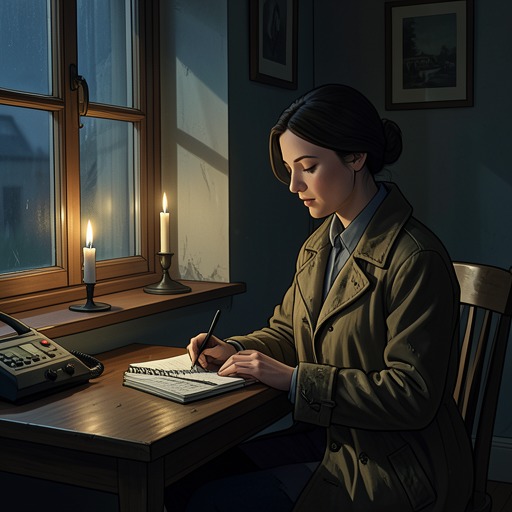
Volkheimer returns Werner's belongings to Jutta
All the Light We Cannot SeeFrank Volkheimer’s return of Werner Pfennig’s belongings transforms a fragmentary military record into a personal encounter with loss. A package, its numbered photographs, and a canvas bag connect the missing soldier to his former commanding officer; the final delivery brings that evidence to Jutta, for whom the objects are unmistakably about Werner.
The package and its provenance
On a rainy evening, Frank Volkheimer goes down three flights of stairs to check his mail, something he has not done for more than a week. Among flyers, a paycheck, and a utility bill is a small package from a veterans’ service organization in West Berlin. The ordinary mail surrounding it gives the arrival a quiet, domestic setting, but the package contains a record of wartime loss: photographs of three objects, each set against a white background with a carefully numbered card beside it.
The organization explains that it is trying to return possessions to the next of kin of dead soldiers whose names have been lost. Its letter identifies Frank as the staff sergeant who served as ranking officer of a unit that included the owner of a canvas soldier’s bag. The bag had been collected by a United States Army prisoner-of-war processing camp in Bernay, France, in 1944. The description supplies a chain of custody, but not, by itself, the owner’s name. The objects have survived; the identity that would make them legible to a family has not traveled with them.
Three objects, one recognition
The numbered photographs show a mouse-gray canvas soldier’s bag with two padded straps; a small wooden model house, partly crushed; and a soft-covered rectangular notebook. The third photograph records a single word across its cover: Fragen. These are initially presented as catalogued items, separated from their owner and arranged for inspection. Their numbering makes the objects administratively distinct, while the shared white background makes them parts of the same recovered group.
Frank does not recognize the model house, and the bag could have belonged to any soldier. The notebook, however, is immediately familiar. Its lower corner bears the initials W.P., and Frank recognizes it as Werner’s. He places two fingers on the photograph as though he could take the notebook out of the image and turn through its pages. That gesture marks the difference between seeing an object in a record and recognizing something once known: the photograph cannot restore the notebook to his hands, but its inscription makes the absent owner present to him.
Recognition also resolves the uncertainty in the organization’s letter. The institution has a possible connection to a unit and a recovered bag; Frank supplies what the paperwork lacks by identifying Werner through the notebook. The identification depends on personal memory rather than on the bag’s appearance or the camp’s documentation. The scene thus makes the return possible through two kinds of evidence, archival tracing and intimate recognition, neither of which would be sufficient in quite the same way on its own.
From record to delivery
The organization’s work begins with objects gathered under the broad category of property belonging to dead soldiers whose names have been lost. Its letter asks for help from someone who had served with the unit, turning Frank’s military role into a link between recovered possessions and their owner’s family. The account does not describe a complete wartime history of the objects: it gives the bag’s recovery place and year, while the notebook’s initials and Frank’s recognition establish the personal connection.
Frank then takes the matter beyond correspondence. When he reaches Frau Wette, he carries a faded canvas duffel bag and presents it to her. Before he can explain that he has something for her, or she invites him inside, she already knows that the visit concerns Werner. The order matters: her recognition precedes the formal handover, just as Frank’s recognition of the notebook preceded his ability to identify the owner from the organization’s information. The scene gives the delivery a recipient who understands its meaning before the explanation is complete.
Frank explains that once the organization had the address, he asked to deliver the belongings himself. He has brought the organization’s letter as well. His choice to make the journey turns an impersonal return process into a meeting between people connected by Werner. The evidence does not specify every conversation or every item’s final disposition; what it does establish is that Frank comes in person, carries the recovered bag, and provides the letter that explains how the possessions reached him.
Memory carried by objects
The scene’s movement is from a package to photographs, from a photograph to recognition, and from recognition to a visit. At each step, the objects acquire a more particular meaning. The numbered cards belong to an effort to identify and return property; the initials W.P. identify Werner for Frank; and the faded bag, physically carried to Frau Wette, makes the recovery tangible to the person awaiting news of him.
The return is not a recovery of Werner himself. It is a limited answer to the disappearance of a soldier’s belongings, made possible by an institution’s search, Frank’s memory, and a personal delivery. The damaged wooden house remains unfamiliar to him, and the bag alone could not distinguish Werner from any other soldier. The notebook supplies the decisive recognition, while Frank’s presence carries that recognition across the distance between the former unit and Werner’s family. In this way, the episode gives a lost name and a recovered set of possessions a human connection without pretending that the objects undo the loss.