Von Rumpel's search for the Sea of Flames at the museum
All the Light We Cannot SeeReinhold von Rumpel’s search for the Sea of Flames at the Muséum National d’Histoire Naturelle transforms a museum inspection into an exercise in coercion—and a first, inconclusive encounter with the stone he believes can secure his future. The museum’s concealment measures have divided the diamond’s trail among one real stone and three replicas, leaving even those carrying a specimen uncertain of its identity. Von Rumpel gains access to the hidden collection, but what he sees there proves to be a convincing copy, not the prize itself. The encounter begins a more methodical pursuit based on the replicas’ provenance and the people who made them.
A Collection Under Protection
Before von Rumpel arrives, the museum has already moved into emergency preservation. As the threat of war sharpens, memos direct staff to protect the collections; couriers begin carrying objects to country estates, locks and keys become scarce, and Daniel LeBlanc works late securing crates and transport manifests. Fossils, manuscripts, minerals, and precious objects are among the holdings being safeguarded. The Sea of Flames is only a possibility in Marie-Laure’s mind at this point, but the preparations establish the material stakes of the later search: the institution is trying to protect an immense collection while keeping its most vulnerable contents out of reach.
The diamond has been made especially difficult to track. The museum’s director arranges for three decoys to accompany the real stone into separate channels: one remains at the museum, while three others are sent in different directions, including one with Daniel LeBlanc. The rule is deliberate uncertainty: no carrier is to know whether the stone in their possession is genuine, and each is to behave as if it is. This security strategy protects the real object by multiplying plausible locations, but it also creates the problem that will occupy von Rumpel: a visible blue stone cannot be identified by appearance alone.
The Inspection Becomes a Threat
Von Rumpel arrives at six in the morning, dressed formally and carrying the tools of his search, including a loupe and tweezers. The assistant director and Professor Hublin show him the Gallery of Mineralogy. Its length, emptied display cases, and surviving specimens make the collection’s breadth visible: among the minerals left on display are topaz, beryl, tourmaline, and many other stones. Hublin explains the collection’s history and the scale of its catalogue, while von Rumpel takes notes and gives the tour time to run its course.
His politeness is a tactic, not an acceptance of the limits set by his hosts. When the tour ends, he asks to see collections not on public display. The officials tell him they have shown him everything they can. Von Rumpel insists that he is interested in a recently retrieved specimen and waits while the assistant director describes the museum’s public duty to preserve mineral knowledge. The conflict is not simply between a collector and curators: the museum’s claim to protect a shared heritage meets an occupying officer’s ability to apply pressure until its safeguards give way.
He makes that pressure personal. Over bread and cheese, he tells the officials that he wants something small, then names the assistant director’s daughter’s school and Hublin’s twin sons’ school. He recalls the boys’ instruments and the streets they must cross on their way home. Neither man answers. Von Rumpel says he knows the diamond is not kept in the public galleries, but wants to see where the museum has hidden it. He then waits through the afternoon, refusing to let the officials end the encounter. His method is patient intimidation: rather than seize the collection in a display of force, he uses the vulnerability of the officials’ families and the hours of waiting to make refusal increasingly costly.
Into the Hidden Rooms
The officials eventually take him below the galleries. A woman brings a ring of keys and a separate key on a chain; access requires both. The party descends a winding stone staircase, passes a second gate, and moves through a network of corridors into an ordinary storeroom of dropcloths, pallets, and crates. Behind a sheet of plywood is a combination safe. There are no elaborate alarms and only one guard. The route reveals a layered but limited security system: multiple doors and concealment protect the inner room, yet the officer’s coercion has turned its custodians into guides.
Inside the safe is another, heavier box, which the assistant director and Hublin must lift together. A felt bag contains a wrapped bundle. When it is opened, a blue stone as large as a pigeon’s egg appears in the mineralogist’s palm. For von Rumpel, this is the decisive sight of the visit: the hidden collection has yielded an object whose size and color make the Sea of Flames seem suddenly tangible. Yet the display does not resolve the question he came to answer. A convincing stone can still be a decoy, and the museum’s security plan has ensured that the officials themselves may not be able to tell him whether it is real.
The Replica and the Unfinished Trail
Over the following three months, von Rumpel travels to Berlin and Stuttgart, assesses confiscated jewelry, and continues to pursue the diamond between other assignments. The museum stone returns to his thoughts as the pear-shaped specimen he examined through his loupe. At first he had almost persuaded himself that it was the legendary 133-carat Sea of Flames, associated with stories of a sultan’s son, blinding brilliance, and a keeper who could never die. The attraction is both professional and personal: the stone promises wealth, but its legendary power also gives his search an almost absolute significance.
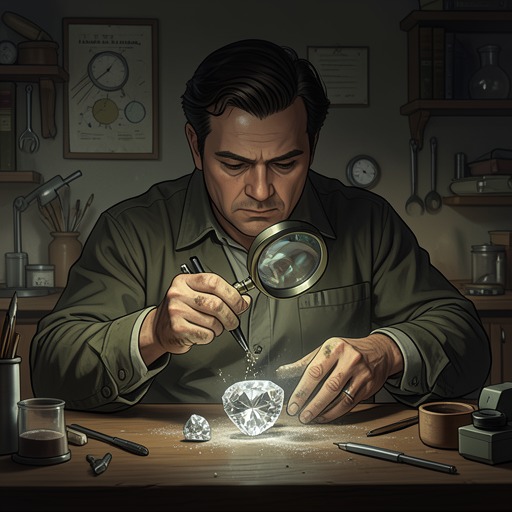
Close inspection overturns his hope. The facet edges are not sharp enough, the girdle is slightly waxy, and the stone has none of the cracks or inclusions he expects in a real diamond. His father’s maxim—that a real diamond is never entirely free of inclusions—gives him a practical test against the seductive perfection of the specimen. The apparent treasure at the museum is therefore not the real Sea of Flames. The discovery does not end his pursuit; instead, it strengthens his conviction that the museum must possess the genuine stone somewhere, since it went to the trouble of commissioning so accomplished a fake.
Von Rumpel follows that reasoning to Dupont, a lapidary who had cut opal and, before the war, faceted spinels into imitation diamonds. In Dupont’s shop he finds repeated versions of a mold matching the size and pear shape of the stone kept in the museum vault. Under questioning, Dupont provides the number von Rumpel needs: in the two months before the invasion of France, he made three replicas for the museum from a casting and never saw the real diamond. The resulting count is four stones in all—one real, three copies—with one held in the museum basement and three still to find. The museum search thus ends not with possession but with a more precise map of uncertainty: von Rumpel has disproved one candidate, established the replicas’ origin, and turned the search into a hunt for the people and routes that might connect each copy to its carrier.