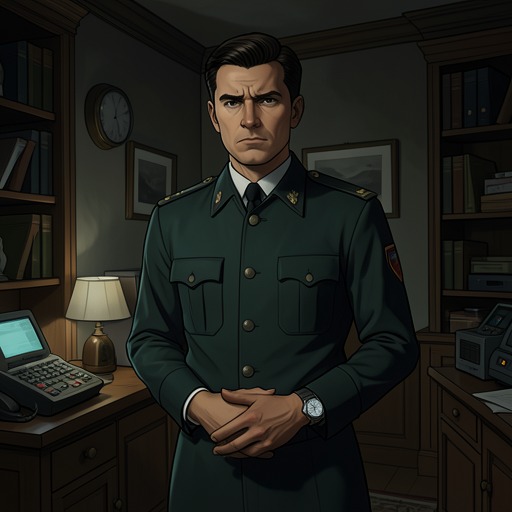
Walter Bernd
All the Light We Cannot SeeWalter Bernd is an engineer whose brief life in the narrative is defined by two kinds of work: repairing equipment for a German anti-partisan mission and, near death, recalling a moment of private regret. His sudden return to speech beneath the rubble gives the trapped men a glimpse of the life he had left behind, just before he dies.
Identity and Military Role
Bernd is introduced as a taciturn, pungent man with misaligned pupils. He serves as an engineer alongside Werner Pfennig and Sergeant Frank Volkheimer during a mission prompted by partisan attacks on trains. The captain suspects that the partisans are coordinating their attacks by radio, and the unit has equipment to put into service. When Neumann One remarks that the previous technician found nothing, Werner says he can have both devices functioning within an hour; Bernd is part of the technical team sent into this dangerous search.
The mission’s larger purpose is conveyed through its equipment and urgency: the soldiers are trying to track radio activity, while Werner’s technical skill is expected to make their apparatus useful. Bernd is not given a separate account of his work or opinions, but his identification as the engineer places him among the men whose specialized labor supports the military operation.
Final Hours Beneath the Rubble
Later, Bernd is trapped with Werner and Volkheimer beneath the rubble. For an hour he murmurs incoherently, then falls silent. Volkheimer believes the silence may be final and prays for mercy. Bernd unexpectedly sits up and asks for light; the men give him the last of the water in their first canteen. Werner watches a thread of water run through Bernd’s whiskers, a small, physical detail set against the uncertainty of whether he will survive.
In the field light, Bernd looks from Volkheimer to Werner and tells them about visiting his father while on leave the previous year. His father had been old for as long as Bernd could remember and seemed especially frail then, taking a long time to cross the kitchen. He had set out a package of small almond cookies on a plate, but neither man ate any. Instead, his father repeatedly told Bernd that he did not have to stay, while also making clear that he wanted him to.
Bernd says that he left. He went down the stairs and into the street, though he had nowhere to go and no friends in the town; he had travelled by train all day to see his father. The plainness of the memory gives it force: the loss he describes is not a dramatic rupture but a departure he could have chosen otherwise. When he falls quiet, Volkheimer lays him on the floor and covers him with Werner’s blanket. Not long afterward, Bernd dies.
Relationships and Regret
Bernd’s relationship with his father appears only in this final account, but it is rendered through concrete gestures rather than explanation: the slow crossing of the kitchen, the untouched almond cookies, and the repeated permission to leave. His father’s words held both welcome and release; Bernd remembers choosing the release, then emphasizes that afterward he had nowhere else to be. The story does not establish what became of his father, but it shows how sharply Bernd recalls the visit and the choice he made.
With Werner and Volkheimer, Bernd shares his last hours as a fellow soldier and trapped survivor. Their response is practical and immediate: they bring him water and light, and, after he falls silent, Volkheimer repositions him and covers him. Bernd’s memory reaches the two men at the point when the group’s survival is uncertain, making his confession an intimate exchange within a military catastrophe.
Death and Narrative Significance
Bernd’s death leaves Werner with the image of Volkheimer carrying him into a corner and piling bricks over his hands, chest, and face. Werner turns to repairing the radio, gathering a small hammer, jars of screws, and wire, and finding an American eleven-volt battery in a warped drawer. The work may give his mind something to do besides dwell on Bernd’s body, the men upstairs, and the rest of what he fears and misses. Bernd’s death therefore persists not only as a loss but as part of the pressure under which Werner keeps working.
The final confession also places the wartime danger beside a regret that is neither strategic nor grand. Bernd cannot return to his father or revise the day he left; he can only tell the story to the men beside him. His brief revival makes that recollection possible, and his death follows before it can become anything more than testimony. The contrast gives his small, ordinary decision an enduring weight within the larger violence surrounding him.