Werner Pfennig and Jutta Pfennig’s brother-sister relationship
All the Light We Cannot SeeWerner Pfennig and Jutta Pfennig’s brother-sister relationship is the emotional counterweight to the forces that try to claim Werner for themselves. Raised together in poverty, they make a world from discarded objects, imagined cities, and voices carried over the radio. Their intimacy is not proof against history: when Werner wins a place at a state school, the siblings’ shared radio becomes both the material sign of their closeness and the point around which trust breaks. Jutta sees his departure as betrayal; Werner hopes it is a temporary separation that will let him protect her and build a future for them both.
A shared childhood at Children’s House
Werner and Jutta grow up together at Children’s House, an orphanage in the coal-mining district of Zollverein. The place is marked by illness, want, and the possessions left behind by dead parents. In the leanest years, there is no butter or meat, fruit is only a memory, and the house directress sometimes has nothing for the children but cakes made from mustard powder and water. Their shared upbringing is therefore not an abstract bond of kinship: it is a daily experience of scarcity, in which each sibling learns to notice what might still be found or made.
Their play gives that resourcefulness a gentler shape. Jutta draws while Werner makes things, and after lessons he pulls her through the mine complex in a wagon assembled from cast-off parts. When a wheel comes loose, Werner patiently threads the bolts back in. The children sift black dust, climb over rusting machinery, and gather berries, discarded vegetable scraps, paper, and old toothpaste tubes whose dried residue can be used as chalk. Around them, laid-off miners sit idle and exhausted workers move between shifts. The siblings explore this industrial landscape side by side, turning the remnants of other people’s hardship into material for their own small adventures.
Their imaginations also reach beyond Zollverein. Jutta draws Paris from a single photograph on the back of one of Frau Elena’s romance novels, filling the page with roofs, bridges, and crowds along a river. Though two years younger than Werner, she is the gifted artist, and the city she has never visited becomes a shared imaginative destination. At other times, the siblings draw together on the floor, passing a single pencil between them. Such scenes establish a closeness built not just on Werner’s care for Jutta but on her creative vision and their habit of making things together.
The radio as a shared discovery
When Werner is eight, he finds a discarded object behind a storage shed: a wire-wrapped cylinder between two pinewood discs, with frayed electrical leads and an earphone. Jutta crouches beside him to ask what it is. Werner guesses that they have found a radio, and the discovery opens a new shared world. The device is not simply his private technical interest. It becomes something the siblings investigate and use together, extending their curiosity beyond the orphanage and the mine complex.
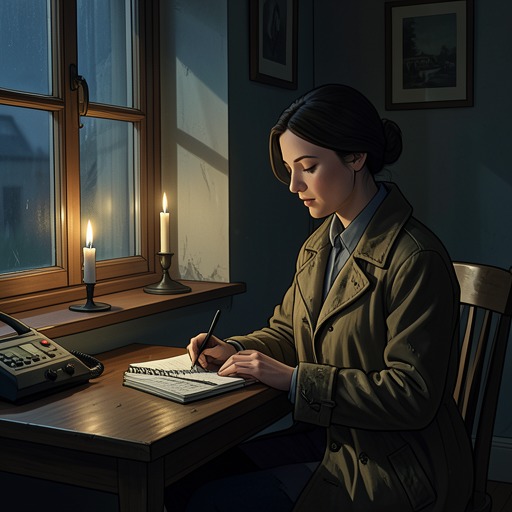
Jutta later discovers ten yards of copper wire among refuse by a creek. She makes Werner swear to keep their plan secret, and they smuggle the wire home and loop it through nail holes in the eave outside his attic window. Connected to the radio, their improvised aerial brings in shortwave voices from across Europe. Werner marks cities on the tuning coil; Jutta keeps a log of the stations they receive, spelling out names including Verona, Dresden, and London, as well as Rome, Paris, and Lyon. After prayers and lights-out, she slips to the dormer and listens beside him until midnight, one, or two. Their intimacy takes the form of a shared practice: listening, recording, and imagining places beyond the boundaries of their lives.
The broadcasts also give their private conversations a political edge. When Jutta tells Werner that a girl has been excluded from a swimming hole for being called a half-breed, she asks whether they, too, are half-breeds because they are each half their mother and half their father. Werner lowers the danger of the question by whispering that the insult means half-Jew and insisting that they are not. Jutta’s answer—that they must be half something—does not resolve the threat around them; it exposes how racial categories have entered even a conversation between two children who are trying to understand who they are.
Diverging responses to the broadcasts
As they grow older, the radio continues to connect them, but its meanings begin to divide. Jutta hears the broadcasts from Paris that contradict the German state station. She tells Werner that those voices describe Germans as devils and report atrocities, and asks whether it is right to act merely because everyone else is doing so. Her question brings their shared listening into direct conflict with the pressure to conform. Werner asks her to be quiet, while Jutta insists on naming what the broadcasts say. The radio that once carried distant cities into their attic now carries competing accounts of the world into their relationship.
The contrast is especially painful because listening began as a joint adventure. Jutta had helped build the aerial, kept the reception log, and stayed awake beside Werner to hear unfamiliar voices. By the time she is eleven, she still comes to his cot at night with the shortwave in her lap and a partly drawn city beside her. She asks why the League of German Girls has them making so many socks. Her question connects the ordinary work imposed on the girls with the larger war she has learned to hear about through the radio. Werner cannot give her an answer that makes the work or the broadcasts harmless.
Acceptance and the breach between them
Werner’s chance to leave Zollverein gives their differences immediate consequences. After the news of his acceptance spreads, neighbors crowd into the house, bring food, and celebrate. The children join in patriotic excitement. In the commotion, Werner does not see Jutta run upstairs; she stays away from dinner. Frau Elena tells him she will speak with Jutta and asks him to remain downstairs with the guests. His success is publicly treated as a triumph, but the scene is also an intimate separation already beginning: the celebration that makes Werner feel chosen leaves Jutta alone upstairs.
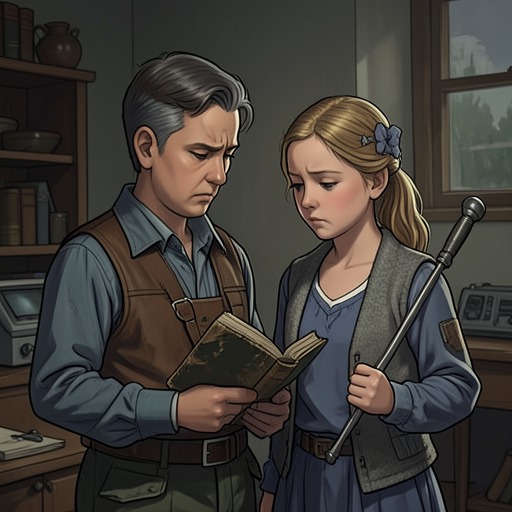
Before the recruits arrive, Werner imagines the argument he will make to her in terms of duty and obligation. He asks whether she expects him to stay and go down in the mines. Jutta answers with the broadcasts they used to hear before he ruined their radio, and presses him to consider whether following the crowd makes an action right. Werner pleads for silence. He imagines that school might teach him to become an engineer, perhaps even to fly an airplane; he pictures taking Jutta and Frau Elena west, through forests and villages, perhaps as far as Paris. The plan expresses his continuing attachment to his sister, but it is also a promise he cannot guarantee.
Jutta refuses the reassurance. She tells Werner not to lie to her, even if he chooses to lie to himself. Ten hours later, he is on a train. The departure does not cancel their shared childhood or erase the tenderness behind Werner’s imagined journey west. Instead, it leaves their relationship suspended between his belief that he is protecting Jutta and her conviction that his choice is a betrayal. Their bond is shaped by that unresolved tension: they have made a world together, but they do not agree on what Werner must do when the world outside demands his allegiance.