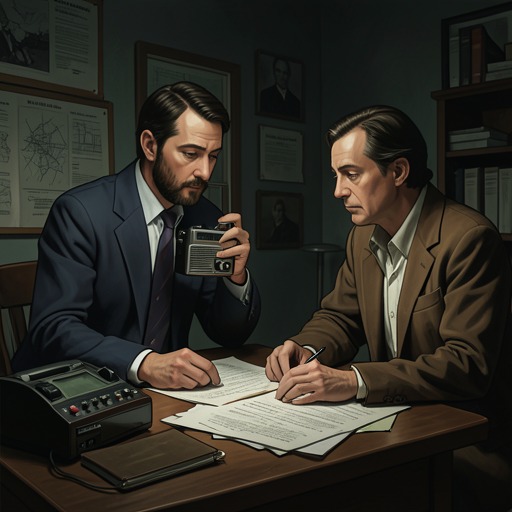
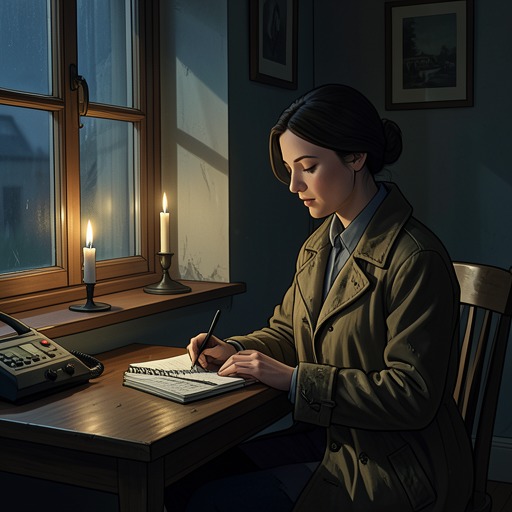
Werner and Jutta receive the French professor's broadcasts
All the Light We Cannot SeeWerner Pfennig and Jutta’s reception of a French professor’s broadcast begins with a homemade radio assembled from refuse and develops into an intimate encounter with distant voices, scientific ideas, and music. In a dim attic at Zollverein Coal Mine, the siblings discover that their improvised receiver can bring an immense, otherwise inaccessible world into their home; the professor’s account of light and deep time, in particular, gives Werner a way to imagine possibility beyond the industrial landscape around him.
A Radio Made from Discarded Materials
Werner Pfennig is eight when he searches through refuse behind a storage shed and finds an object like a large spool of thread. Its central cylinder is wrapped in wire and held between two pinewood discs; three frayed electrical leads protrude from the top, one carrying a small earphone. His six-year-old sister Jutta crouches beside him to ask what it is. Werner recognizes it as a radio, and the discovery opens a new path for the two children: rather than simply possessing a receiver, they will learn how to make it useful.
Jutta soon finds ten yards of copper wire amid rusted drums, torn inner tubes, and creek-bottom muck. She makes Werner swear to keep the discovery secret. Together they smuggle the wire home and thread it back and forth through nail holes in the eave outside the attic window, attaching it to the radio. Their work is improvised but purposeful: the wire serves as an aerial, extending the receiver’s reach beyond the nearby surroundings. Almost at once they hear a shortwave voice in a language they do not recognize. Jutta wonders whether it is Russian; Werner guesses Hungarian. Their first reception makes distance tangible before either child can measure it.
Mapping Voices Across Europe
As they continue listening, the siblings discover that broadcasts arrive from across the continent, carried through clouds, coal dust, and the roof. Werner marks a scale on the tuning coil, while Jutta keeps a log of the cities they receive. The record includes Verona at 65, Dresden at 88, and London at 100, as well as Rome, Paris, and Lyon. The numbers and place names turn tuning into a shared practice of observation: the radio is not merely producing sound but letting the children trace an audible geography from their attic.
Their listening takes place after prayers and lights-out. Jutta sneaks to Werner’s dormer, and the two lie side by side until midnight, one o’clock, or two. They encounter broadcasts they cannot fully understand, including British news and a Berlin woman discussing cocktail-party makeup. The range of voices makes shortwave an unruly world rather than a single source of instruction: news, social talk, and eccentric late-night speech arrive together, without regard for the children’s local surroundings or bedtime.
The French Professor’s Lesson
One night, Werner Pfennig and Jutta receive a scratchy broadcast from a young man speaking French with a soft accent. The signal hisses and pops, but the speaker’s voice holds Werner’s attention. Though the accent differs from Frau Elena’s, he finds the professor’s ardent, hypnotic delivery intelligible. The broadcast moves among optical illusions, electromagnetism, and coal, making the subjects feel connected rather than remote from one another.
The professor asks how a brain that lives in darkness can construct a world full of light. The question takes on particular force in Werner’s listening: a voice arriving through static makes an unseen process vivid, just as the brain’s unseen work makes visible experience possible. The broadcast then turns to a piece of coal in a family stove. It traces the coal backward from the household fire through the peat and decaying plant matter from which it formed, and further back to the fern or reed that captured sunlight millions of years earlier. The professor’s explanation links domestic heat to ancient solar energy and stretches the children’s sense of time, making a stove’s coal a remnant of a world far older than any human life.
The talk closes by urging its young listeners to look while they still can; a piano follows. Werner hears the music as a golden boat moving along a dark river. In his imagination, the sound transforms Zollverein: houses become mist, mines fill in, smokestacks fall, and an ancient sea spills through the streets. The broadcast does not change the physical town, but its sequence of scientific explanation and music changes how Werner can picture it. For a moment, the familiar industrial landscape is not the only world available to him.
Radio as Memory and Material Practice
The scene establishes a lasting association between radio and the possibility of reaching beyond confinement. Years later, while Werner and Frank Volkheimer are trapped beneath the ruins of Saint-Malo, Werner makes another receiver from what is available. He crimps wire around a shorn pipe, coils it a hundred times to form a tuning coil, and connects the circuit with a diode, battery, and earphone. The careful attention to ground, antenna, and power recalls the practical ingenuity of his childhood without making the two situations equivalent: the attic radio first opens an imaginative world, while the ruined-city apparatus is an urgent attempt to restore contact.
Radio also reappears as military equipment. In a truck used in the war, Werner finds listening decks, a folding radio-frequency antenna, headsets, maps, and two transceivers he designed with Dr. Hauptmann. The movement from a discarded spool and scavenged copper to field communications shows how a child’s fascination with signals becomes an applied technical skill, now embedded in the machinery of war. At another point, Marie-Laure LeBlanc raises the antenna of Etienne’s transmitter, hoping that someone—the fire brigade, the resistance, the Americans, the Germans, or Etienne—might hear her. Across these episodes, reception and transmission depend on concrete apparatus and vulnerable acts of listening. The early broadcast matters not as an isolated lesson, but as the first vivid instance of radio making distant voices present and giving Werner a means to imagine beyond the world immediately around him.