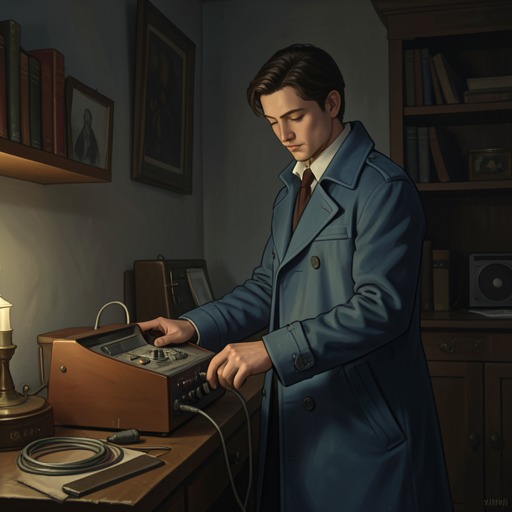
Werner is recruited into Hauptmann's radio project
All the Light We Cannot SeeWerner Pfennig’s recruitment into Dr. Hauptmann’s radio project turns a cadet’s exceptional technical instinct into sustained military work. The turning point is not a speech about Werner’s future but a sequence of tests: he builds circuits faster than his classmates, solves a problem in triangulation, and is ordered to spend every evening in the laboratory improving a directional radio transceiver. The project gives his childhood fascination with radios a new scale—and binds his ingenuity to the military uses of communication and tracking.
From salvage to technical aptitude
Werner’s ability predates his encounter with Dr. Hauptmann. At eight, rummaging through refuse behind a storage shed, he finds what appears to be a large spool of thread: a wire-wrapped cylinder between two pinewood discs, with frayed electrical leads and an earphone dangling from one. His six-year-old sister, Jutta Pfennig, asks what it is. Werner recognizes the object as a radio. The discovery begins in discarded materials, not in a school laboratory, and establishes the alertness with which he sees a possible working device where others might see scrap.
Years later, at the cadet school, Dr. Hauptmann gives Werner’s class a formal test of that practical intelligence. The technical-sciences instructor opens a locked cabinet and distributes hinged metal boxes containing gears, lenses, fuses, springs, shackles, resistors, copper wire, a small hammer, and a large two-terminal battery. The assignment is to assemble a simple Morse-code practice circuit from a chalkboard schematic. While most cadets hesitate over the unfamiliar equipment, Werner draws on the questions and experiments of his earlier life at Children’s House. In less than a minute he builds an oscillator that matches the diagram, and Dr. Hauptmann tests it and finds that it works.
The demonstration that secures Hauptmann’s attention
Dr. Hauptmann immediately raises the difficulty. He asks the class to use only a disk-shaped magnet, a wire, a screw, and the battery to build a simple motor. Although the challenge is addressed to the boys generally, his attention settles on Werner. Werner places the magnet on the screw, touches the screw’s point to the battery’s positive terminal, and connects the negative side to the screw’s head with the wire. The screw and magnet begin to spin; the construction takes about fifteen seconds.
The speed and effectiveness of the demonstration make Werner’s ability unmistakable. Dr. Hauptmann asks his name, and Werner identifies himself by his surname. The encounter is an assessment, but it also marks a shift in their relation: the instructor has seen a capacity that can be developed and put to work. Werner’s talent is not merely theoretical. He can read a schematic, select useful components, and make a functioning mechanism from a restricted set of parts.
Triangulation and the laboratory assignment
Dr. Hauptmann next summons Werner to his office, where three hounds move around the room and Frank Volkheimer, a much larger upperclassman, sits in a chair in the shadows. Among the books, scientific models, and instruments, Hauptmann tests Werner’s understanding of triangulation: using two known points to locate a third, unknown point. When asked whether he can draw the triangle if given the known points and the distance between them, Werner believes he can. Hauptmann invites him to the desk and provides a pencil, turning the exchange into a working mathematical problem rather than a routine classroom question.
Afterward, Dr. Hauptmann tells Werner that he will work in the laboratory after dinner every night, Sundays included, beginning the next day. This order is the concrete act of recruitment. Werner accepts without hesitation. The promise of intellectual work, the firelit office, and the shelves of books kindle his sense that important events take place in such rooms. At the same time, the assignment places his skill within an institution whose authority reaches well beyond the laboratory.
The project and its military purpose
Werner’s nightly work combines mathematical calculation with engineering. Dr. Hauptmann wants him to improve the efficiency and power of a directional radio transceiver. The device must be quickly retuned to transmit on multiple frequencies and must measure the angle of incoming transmissions. Werner reconfigures nearly the entire design. The work therefore extends the skills displayed in his first circuit exercises: he is no longer simply making a mechanism function but changing a complex device to meet operational requirements.
The rhythm of the apprenticeship is uneven. On some evenings, Dr. Hauptmann explains the function of components such as a solenoid or resistor, identifies a spider on a rafter, or talks about scientific gatherings in Berlin and topics including relativity and quantum mechanics. He is willing, at those times, to follow Werner’s questions. On other nights he becomes closed and supervises in silence. Werner is impressed not only by the apparatus but by the reach suggested by Hauptmann’s telephone and connections to powerful men. The laboratory’s promise of scientific possibility is thus shadowed by the scale of the authority that may direct it.
From laboratory design to wartime equipment
The transceivers Werner helps design later appear in a radio truck during his military service. Inside the truck are listening decks, an antenna that can be raised and lowered from within, headsets, maps, compasses, and two of the transceivers he designed with Dr. Hauptmann. The instruments are no longer classroom exercises or laboratory prototypes: they are equipment in a field setting. Werner finds one damaged, with a cracked meter, blown fuses, and a missing transmitter plug, and begins examining it with tools and copper wire. The earlier assignment has carried his work from a school laboratory into the material conditions of war.
The project’s significance also lies in the distance it opens between technical mastery and the uses to which that mastery is put. Werner’s introduction to radio begins with a salvaged set and a child’s recognition of what it might do; Hauptmann’s training refines that curiosity into circuits, triangulation, and directional reception. Later, Werner makes a tuning coil from wire wound around a shorn pipe while trapped beneath rubble, using improvised materials to restore a radio. Across these different circumstances, the same capacity to make connections work persists. Recruitment gives that capacity a military function, but the radio remains a device whose meaning can change with its use: it can be engineered for locating transmissions, improvised for survival, or made to carry a human signal across distance.