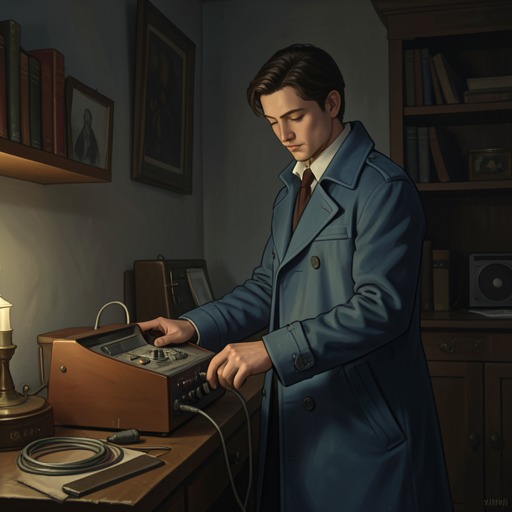
Werner repairs Rudolf Siedler's radio and earns his recruitment offer
All the Light We Cannot SeeWerner repairs Rudolf Siedler’s radio and earns his recruitment offer in a scene that turns a moment of apparent danger into a possible route out of poverty—and into the reach of Nazi institutions. The repair displays Werner’s unusual technical ability, but its reward is not simply money or praise: Siedler identifies that ability as something the state can cultivate and direct.
The Knock After Curfew
The encounter begins in the crowded room where Werner and Jutta Pfennig are doing schoolwork with six other children at a long wooden table. After curfew, Frau Elena pins her party insignia to her lapel before opening the door. A lance corporal enters in a pistol and swastika armband. Against the room’s low ceiling he seems absurdly tall, and the handgun in his belt commands Werner’s attention. Werner thinks of the shortwave radio he has hidden beneath his cot, inside an old wooden first-aid cabinet, and fears that its discovery has brought the soldier there.
The corporal surveys the coal stove, laundry, and undersized children with condescension and hostility. The threat feels physical and immediate; the room’s poverty and Werner’s concealed radio make arrest seem possible. Yet the visit takes a different course. At Rudolf Siedler’s house, Werner learns that he has been summoned to fix a radio, not taken away for the one he fears the authorities have found. That reversal does not erase the danger surrounding the hidden set. It instead places Werner’s technical skill under another kind of scrutiny, in a setting where his work can attract powerful interest.
The Philco and the Repair
Siedler’s home contrasts sharply with the room Werner has left: a thick red carpet, electric chandelier, roses on the wallpaper, a fireplace, and portraits of severe-looking ancestors. Siedler appears in a bright white shirt and introduces himself; a woman nearby turns the pages of her magazine without looking up. The radio is a massive American Philco. Two other men have already tried to repair it, while the woman is eager to hear her program. Siedler mentions news bulletins too, but Werner understands that this is not her real concern.
Werner switches on the set, lets its tubes warm, and searches the dial. When nothing comes through, he unscrews the back. The tubes are intact and no obvious fault presents itself. He sits cross-legged and concentrates on the circuitry until the surrounding people, books, and rain recede from his attention. He mentally follows the signal through the radio’s stages, from the incoming radio-frequency signal through amplifiers, variable condensers, and transformer coils. His method is not a lucky guess: he reconstructs how the circuit should work and uses that model to find where it fails.
The fault is two breaks in a resistance wire. Werner rewinds the resistance track, splices the wire, and plugs the radio in again. Rather than a burst of fire, the repaired set produces the smoky sound of a saxophone. The woman sets down her magazine and presses her fingers to her cheeks; she exclaims that Werner has fixed it by thinking. For a moment, Werner’s attention settles into triumph. The machine that had been silent now makes audible the value of a kind of intelligence that his circumstances have given him little reason to expect anyone important to notice.
Recognition and Recruitment
While the radio plays, Siedler speaks of history as something shaped by victors and of people and nations acting in their own interests. The lesson fits the imbalance in the room: the woman can treat listening as a private pleasure, while Werner has arrived frightened that a concealed receiver might expose him. Siedler’s manner signals confidence in his own privileges, and his attention quickly shifts from the repaired set to the boy who repaired it.
He praises Werner’s practical ability and intelligence, then describes schools associated with General Heissmeyer. They teach mechanical sciences alongside subjects such as code breaking and rocket propulsion. Siedler presents these institutions as open to working-class boys, emphasizing that they seek industrious and exceptional candidates rather than boys shaped by middle-class life. Werner answers that his family cannot afford such schooling. Siedler’s reply makes financial exclusion seem surmountable: he says he will write to a recruiting board in Essen and send a letter to Heissmeyer. The offer is a recommendation and an opening, not evidence that Werner has already enrolled or that admission is secured.
Before Werner leaves, Siedler gives him seventy-five marks. Werner quickly puts the bills into his pocket, while the corporal laughs that they seem to have burned his fingers. Siedler frames the arrangement as serving both Werner and himself, and as serving the wider world. The money is concrete and immediate; the promised letter points toward a future in which Werner’s gift could receive formal training. Both forms of recognition come from a man who presents self-interest as natural and institutional recruitment as mutually beneficial.
The Turn in Werner’s Prospects
The episode links an intimate act of concentration to a public machinery of selection. Werner has succeeded because he can imagine a hidden process inside a tangled device and locate the small interruption that defeats it. Siedler translates that capacity into the language of usefulness: mechanical science, code breaking, and rockets. The same skills that let Werner repair a domestic receiver can therefore become the grounds on which an institution claims him.
The scene’s change in value is sharp but incomplete. Werner begins under the pressure of imagined arrest, and the visit instead brings success, cash, and a possible route to education. Yet its promise is inseparable from recruitment by Siedler, whose confidence about power and self-interest shadows the opportunity he offers. The working-class boy is recognized, but not outside the interests of those doing the recognizing. The repair closes with music coming through the Philco; Werner’s next possibility is a letter that may carry his talent into a much larger system.