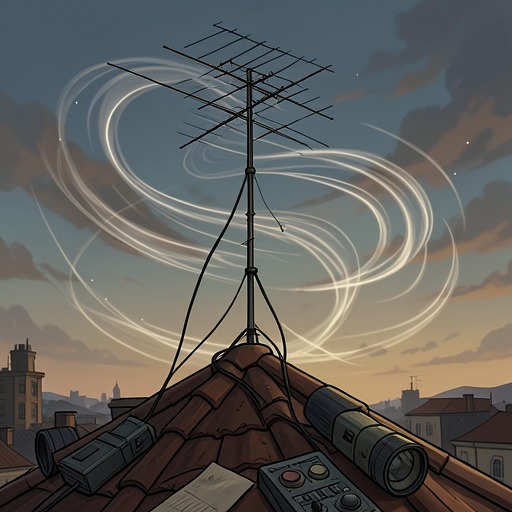
Werner repairs the radio he picked up
All the Light We Cannot SeeWerner Pfennig’s repair of a radio salvaged from a refuse pile is the first concrete expression of the ingenuity that shapes his life: he studies a broken device patiently until he can make it receive a signal. The radio offers more than a technical puzzle. Its fragile wire and uncertain sounds open a path from the confined world of Zollverein to voices and music beyond it, a path Werner will later reconstruct under very different conditions.
Discovery and Diagnosis
Werner is eight when he finds the radio behind a storage shed. At first glance it resembles a large spool of thread: a cylinder wrapped in wire, held between two pinewood discs, with three frayed electrical leads and an earphone dangling from one. Jutta Pfennig crouches beside him to ask what it is. Werner recognizes the possibility before he can know whether the machine works; until then, radios have been things glimpsed through the lace curtains of an official’s house or seen in shared rooms, never something he could handle.
The siblings take it to Viktoriastrasse 3, clean away the mud, untangle the wires, and wash the earphone. But the receiver remains silent. The other children gather around, marvel briefly, then lose interest and decide it is hopeless. Werner does not. He carries it to his attic dormer, disconnects what can be disconnected, and lays the pieces out one by one, holding them up to the light. The failed machine becomes legible through attention: instead of treating its silence as proof that it cannot work, he treats it as a problem with parts that can be examined.
The First Signal
Three weeks after finding the radio, Werner notices that the longest wire has several breaks. The filament is coiled hundreds of times around the central cylinder. He carefully unwinds it, carries the looped wire downstairs, and asks Jutta to hold the pieces while he splices the damaged sections. Then he winds the wire back around the cylinder. His repair is neither a sudden flash of genius nor a replacement of the device; it is the slow restoration of a connection already present in its materials.
Werner presses the earphone to his ear and moves what he takes to be the tuning pin along the coil. At first there is only a fizz of static, followed by a fleeting stream of consonants. The sound vanishes as he adjusts the pin. He tries again, moving it by small increments while the ordinary sounds of the household and alley continue around him. Then, when he is about to hand the earphone to Jutta, he finds a clear signal halfway down the coil: the quick strokes of a violin bow, followed by another violin. Jutta watches as the music grows to include piano and woodwinds. The successful repair is thus also a lesson in tuning: the wire must be intact, but reception depends on finding the precise position at which the receiver catches a signal.
Repair as a Lasting Skill
The salvaged receiver is not the only radio Werner later handles. In a wartime truck, he finds two transceivers he had designed with Dr. Hauptmann. Their presence reassures him, but they are damaged: one has a cracked meter, blown fuses, and no transmitter plug. Werner reaches for tools and copper wire to work on it. The scene extends the childhood episode from one repaired object to military equipment, while also marking a change in scale: the boy who once studied a found receiver now encounters his own designs deployed in a radio truck equipped with listening decks, an antenna, headsets, maps, and storage lockers. The passage records his preparation to repair the equipment, not the outcome of that particular attempt.
Later, trapped beneath rubble with Frank Volkheimer, Werner makes another radio from available materials. He crimps wire around a shorn pipe and winds a hundred turns to form a tuning coil; another length serves as an antenna, threaded through a bent strut in the debris overhead. He connects a diode and battery to complete the circuit, then prepares the earphone leads. The improvised apparatus is distinct from the radio he found as a child, but the method recalls that first repair: understand the circuit, work with the materials at hand, and make a fragile route for a signal.
Significance
Werner’s early repair establishes radio as both a material craft and a means of reaching beyond immediate surroundings. The device does not simply become useful when he finds it: its broken wire, tuning pin, earphone, and uncertain reception demand his sustained attention. The scene gives his technical ability a specific origin in salvage, patience, and experiment, rather than presenting it as effortless talent.
That origin also lends weight to the later radios in the story. Werner’s damaged transceivers and improvised circuit show how the childhood habit of taking machines apart and restoring connections persists into wartime, where radio equipment belongs to military operations and survival. Elsewhere, Marie-Laure LeBlanc raises the antenna of the transmitter in Etienne LeBlanc’s house, hoping that someone might hear a flicker of hope. Her action is not Werner’s repair, but it echoes the same material condition of communication: a signal can travel only when someone builds, tunes, or raises the equipment that makes transmission possible.