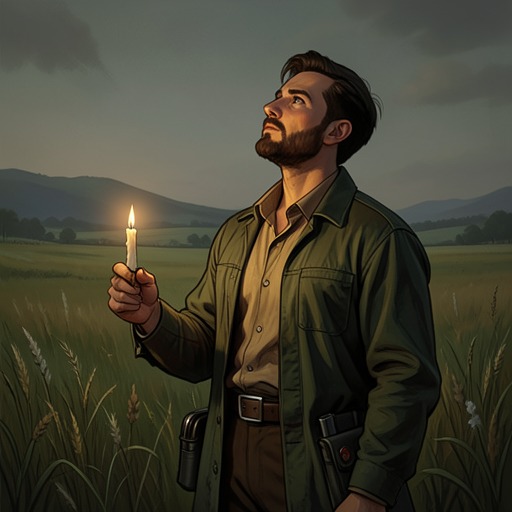
Werner triggers a land mine and dies
All the Light We Cannot SeeWerner Pfennig’s death comes not in battle but in a field at night, after he quietly leaves a tent full of sick and wounded men. The scene turns a gusting wind, a walk through the grass, and a soldier’s belated warning into the last movements of his life; the mine that kills him was planted by his own army three months before. His death is sudden, but the narrative approaches it through dreams and remembered images, making the crossing of the field feel both physical and strangely weightless.
The tent and the night
A few dozen sick or wounded men lie in cots around Werner. Outside, a warm September wind presses at the tent, rippling its walls and straining the corners against their guy ropes. Trees bend and sway beyond the open flaps; clouds race over the treetops. The resting men remain asleep, and a man beside Werner murmurs questions to himself. Against this exhausted stillness, the weather seems almost to move the whole scene: the tent strains, the trees buck, and everything rustles.
Werner packs his old notebook and a little house into his duffel. The act is small and deliberate, set against the sweeping motion outside. His thirst has faded; what fills his attention instead is the moonlight striking and scattering across the tent. Through its open ends he sees the clouds moving toward Germany, toward home. The direction gives the scene a pull toward return, but it does not provide Werner with a safe passage there.
As the night continues, moonlight and wind move according to different rhythms. Broken clouds scud above the trees and leaves fly, but the light seems to Werner to pass through cloud and air in slow, untroubled rays, hanging over the buckling grass. The contrast gives the landscape an uncanny calm even as it records the force of the storm. Werner wonders why the wind does not move the light; the question belongs to his altered, inward attention, not to any explanation the scene supplies.
Dreams and remembered images
Before Werner rises, the narration moves through images that mix dream, memory, and longing. He sees a crystalline night, frozen canals, miners’ houses lit by lanterns, and farmers skating between fields. Another vision places Jutta at the porthole of a submarine in the dark Atlantic. He half expects Frank Volkheimer’s huge hand to appear and help him up, as it once did when Volkheimer could clap him into the Opel. The absent hand makes the comradeship of the past present at the edge of the tent, without changing the fact that Werner is alone in this moment.
A question about Marie-Laure LeBlanc follows: the passage wonders whether she can still feel the pressure of his hand against the webbing between her fingers, as he can feel hers. The scene does not establish where she is or what she knows now. Instead, the remembered touch sits among the other images as a trace of connection that the present cannot confirm.
Werner also remembers building a small sailboat with Jutta from scraps of wood. She painted it in purple and green and set it afloat formally, but the current made it sag and carried it beyond their reach; the black water swallowed it. Werner had reassured her that things rarely worked on the first try and that they could make a better boat. Now he is unsure whether they ever did. He seems to remember a sturdier boat sailing around a bend and leaving them behind, but even that recollection is uncertain. The memory gives his final movement a quiet echo of something once released onto water and lost from sight; it does not turn his walk into a deliberate reenactment.
Leaving the cot
Werner’s body seems weightless beneath the blanket. He swings one leg and then the other over the edge of the bed. A man beside him addresses him as Ernst, repeating the name, but no one in the cots responds. The American soldier guarding the tent entrance is asleep. Werner walks past him and out into the grass. The sequence is spare: a mistaken or unanswered name, sleeping witnesses, an unguarded exit, and a boy moving beyond the shelter of the tent.
The wind moves through Werner’s undershirt, and he feels like a kite or a balloon. This image gives lift to a movement that has no safe destination. Outside, the moonlight remains slow and unmoved while the clouds and leaves race above the field. The landscape’s competing motions accompany Werner without explaining why he rises or what he expects beyond the tent. The scene offers no stated plan, farewell, or final conversation; its force lies in the difference between the dreamlike lightness of his passage and the hard danger waiting in the ground.
The mine and its consequence
Across the field, an American soldier sees Werner leave the sick tent against the trees. He sits up and calls for him to stop, then calls again in German. Werner has already crossed the field’s edge. There he steps on a trigger land mine set by his own army three months earlier, and disappears in a fountain of earth. The warning does not arrive in time to prevent the blast, and the mine’s origin makes the killing an effect of the war’s own abandoned defenses rather than a direct encounter with an enemy in combat.
The ending sharply interrupts the scene’s drift through recollection and light. Werner’s packed notebook and little house, the recalled boat, and the touch associated with Marie-Laure LeBlanc belong to a consciousness moving among fragments of home and connection; the mine reduces the walk to a fatal instant. The passage gives no further exchange after the explosion. Its final image is therefore not a return to Germany, despite the wind and clouds seeming to travel in that direction, but an abrupt disappearance into the earth. The death closes Werner’s story through the collision of private memory with a weapon left behind by the army he served.