Werner's transfer to the Wehrmacht and deployment to the Eastern Front
All the Light We Cannot SeeWerner's transfer to the Wehrmacht and deployment to the Eastern Front turns the radio expertise he developed under Dr. Hauptmann into military service. Presented by the authorities as an opportunity to serve, the transfer is also a coercive reassignment: an age discrepancy becomes the means by which the state removes Werner from Schulpforta and sends him toward a devastated front, with his own transceivers waiting there for him.
From Schulpforta to the commandant's office
Werner's reassignment begins with a summons, not an offer. An eleven-year-old in full regalia brings him to the commandant's office, where Werner waits on a wooden bench in mounting panic. He fears the authorities may have uncovered something ruinous about his parentage. His anxiety recalls an earlier conviction: that the instruments of the Reich could see through walls and skin into the soul of every subject. The scene makes the state's power feel both bureaucratic and almost supernatural to the boy it is about to redirect.
After several hours, the commandant's assistant tells Werner that his age has been recorded incorrectly. The official version is that he is eighteen, not sixteen as he has claimed. Werner puzzles over the assertion; his small stature, he knows, makes the claim seem absurd beside boys younger than he is. Yet the discrepancy is not treated as a question for him to resolve. The assistant presents it as an established fact and immediately links it to a new destination.
Dr. Hauptmann, formerly Schulpforta's technical sciences professor, has drawn attention to the age discrepancy and arranged for Werner to be sent to a special technology division of the Wehrmacht. The commandant had urged disciplinary action, but Dr. Hauptmann argued that Werner would be eager to offer his abilities to the Reich. The contrast is consequential: what might have become punishment is recast as service, while Werner's technical skill supplies the rationale for removing him from the school. The assistant's assurance that service is an honor cannot disguise how little control Werner has over the decision.
The uniform and the journey east
The transfer is made tangible in the uniform the assistant produces: slate gray, marked with an eagle on the breast and Litzen on the collar, followed by a green-black coal-scuttle helmet obviously too large for Werner. The school band practices a triumphal march outside as the assistant speaks. Through the window, Werner watches a Nordic-looking boy stagger under a tuba's weight; the rehearsed pageantry of the school continues alongside the administrative act that sends him away.
The deployment begins in August 1942. A dangerously underweight corporal arrives on foot to collect Werner. Werner is almost fifteen, yet he is now equipped as a soldier, in a field tunic, an oversized helmet, and a regulation Gott mit uns belt buckle. The corporal's first assessment is simply that Werner is little. He searches Werner's duffel and finds three carefully folded NPEA uniforms, none remotely his size. The change of institution is registered in the clothes he carries as much as in the uniform he wears: the school garments remain packed, but they no longer determine where he is going.
Neumann Two takes Werner by train into Russia. At dusk he leads him through ruined houses, where beams and bricks lie in charred heaps and the standing walls are crosshatched with machine-gun fire. The route delivers Werner to a musclebound captain dining alone on a sofa made of a wooden frame and springs. A cylinder of boiled gray meat steams in a tin bowl on the captain's lap. His tired amusement at Werner's size makes the boy's mismatch with military expectations visible even as he is accepted into the unit. The destination is not an abstract technology post: its surroundings are already marked by destruction and combat.
The radio truck and Werner's technical role
Neumann Two brings Werner to the open back of an unwashed Opel Blitz, a three-ton cross-country truck with a wooden shell. Dented gasoline cans are strapped to one side; bullet trails perforate the other. He gives Werner a kerosene lantern and says only that the gadgets are inside, then disappears without explanation. For Werner, the arrival sharpens the distance from the life he has left behind. He longs for Children’s House, Frau Elena's songs, warmth from the potbelly stove, and the sight of Jutta drawing her imagined city at the far end of the table.
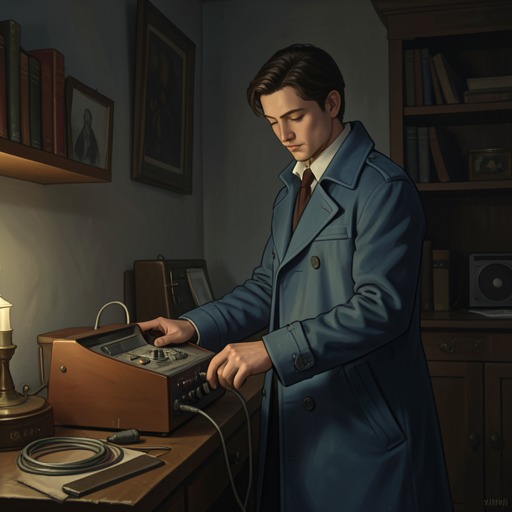
Inside, the truck is a mobile radio station. Its equipment includes grimy listening decks, a folding RF antenna that can be raised or lowered from within, three headsets, a weapon rack, storage lockers, wax pencils, compasses, and maps. In battered cases sit two transceivers Werner designed with Dr. Hauptmann. Their presence offers him a brief sense of recognition amid the strange camp: the devices are familiar objects, and his own work has arrived with him across the distance from Schulpforta.
That recognition does not mean the equipment is ready to operate. Werner removes one transceiver from its case and unscrews the back plate. Its meter is cracked, several fuses are blown, and the transmitter plug is missing. He searches for tools, a socket key, and copper wire, beginning with the concrete work of examining the damage. The passage establishes his technical function through the instruments themselves: the Reich has sent him east because of the knowledge embodied in devices he helped design, and the field unit now depends on that knowledge. The evidence shows him inspecting the broken set, not yet completing its repair.
Coercion, usefulness, and the limits of the transfer
The official language surrounding the move repeatedly tries to turn compulsion into privilege. Werner is told he has been fortunate and that service is an honor; Dr. Hauptmann's intervention is framed as a chance to contribute his abilities. But the sequence gives those assurances an uneasy counterweight: Werner's panic in the commandant's office, the uniform and helmet chosen for him, the corporal's brusque collection, and the absence of any explanation when he reaches the truck. The transfer takes place through decisions made by adults and institutions, not through a choice Werner is shown making.
At the same time, the deployment confirms the practical value of Werner's earlier work. The transceivers have been carried to the Eastern Front, and his place in the truck is among listening equipment, maps, and military supplies. His technical talent has not been left behind at school; it has been absorbed into the war's machinery. That shift gives the transfer its decisive significance: Werner crosses from a controlled educational institution into a military unit where his abilities are immediately material, while the boy himself remains conspicuously small beneath the uniform and helmet intended to make him a soldier.