Werner’s Homemade Radio
All the Light We Cannot SeeWerner’s Homemade Radio is a salvaged receiver that Werner Pfennig painstakingly restores and adapts, first opening a world of music and distant voices to him and Jutta Pfennig, then becoming an object he destroys as war closes around them. Its changing forms matter as much as what it receives: a handful of damaged parts becomes a working instrument through patient skill, a shared channel of discovery, and finally a casualty of fear; years later, Werner builds another receiver from rubble, carrying that skill into a military radio unit.
Discovery and Repair
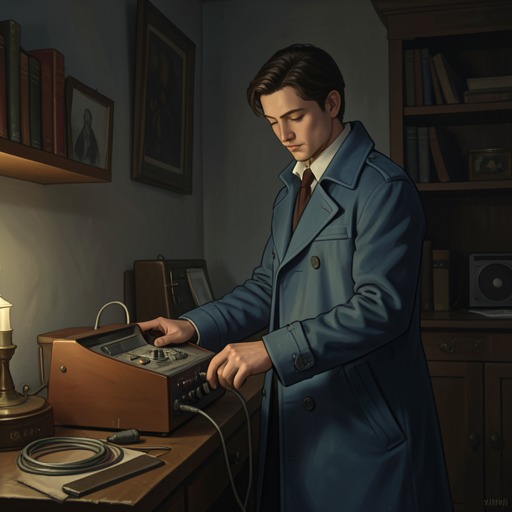
Werner is eight when he finds the radio in refuse behind a storage shed. It looks like a large spool of thread: a wire-wrapped cylinder held between two pinewood discs, with three frayed electrical leads and a small earphone dangling from one. Radios have been objects glimpsed at a distance in official, miners’ and church spaces; this one is the first he can touch. His sense that it is a radio turns discarded material into a technical puzzle and the beginning of an absorbing pursuit.
He and his six-year-old sister, Jutta Pfennig, smuggle it to Viktoriastrasse 3. Beneath an electric lamp they wipe it clean, untangle its wires, and wash mud from the earphone. It does not work. Other children inspect it, lose interest, and decide it is hopeless, but Werner carries it to his attic dormer and studies its parts individually, disconnecting what can be disconnected and holding each piece to the light. The failed receiver does not yield to a quick fix: it demands sustained attention to its construction.
Three weeks after finding it, Werner notices small breaks in the longest wire, a slender filament coiled hundreds of times around the cylinder. He slowly unwraps it, brings the looped wire downstairs, and asks Jutta to hold the pieces while he splices the breaks. Then he winds the coil back into place. The repair depends on both his close observation and his sister’s practical help; the radio’s eventual voice comes from work shared between them, not from an intact or mysterious machine.
First Reception and Shared Listening
Werner presses the earphone to his ear and moves what he takes to be the tuning pin along the coil. At first there is only static. Then consonants come through, followed by the quick strokes of a violin bow. He holds the pin still as a second violin joins the first; piano and woodwinds follow, and the music gathers speed. The device makes sound available only within a narrow, delicate adjustment: Werner must keep the pin steady to preserve the signal.
The reception is weak. When Werner passes the earphone to Jutta, he cannot hear the song from six inches away, but watches her listen. She identifies what she hears as music. In the kitchen, Frau Elena pauses with her flour-whitened hands raised and tilts her head; two older boys enter and stop. The small radio rests between them, physically unimpressive beside the change its signal produces in the room. Its effect depends on a transmission that Werner himself can no longer hear, and on the attention of those gathered around it.
The Aerial and a Larger World
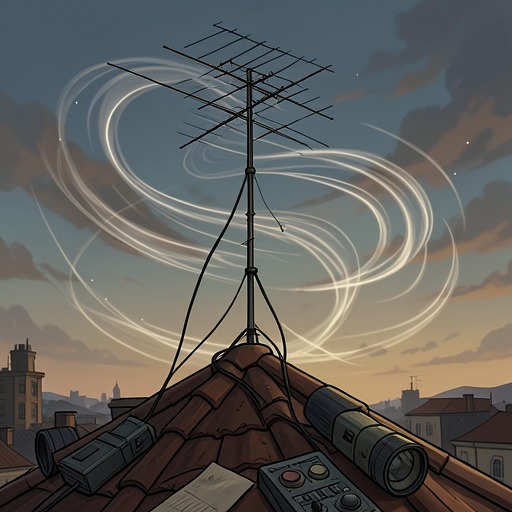
Jutta later finds ten yards of copper wire and asks Werner to swear that he will use it. Together they smuggle it home, thread it through nail holes in the attic eave, and attach it to the radio. With the added aerial, they receive shortwave voices from across the continent. The wire is not merely an accessory: by extending the receiver’s reach, it changes what the children can encounter through it.
Werner marks a scale on the tuning coil, while Jutta keeps a log of the cities they receive and carefully spells their names. Their recorded stations include Verona at 65, Dresden at 88, and London at 100, as well as Rome, Paris, and Lyon. The numbers and names turn tuning into a shared practice of locating and recording signals. The voices seem to arrive in Zollverein through the clouds, coal dust, and roof, so that the air around the children becomes a medium crowded with distant speakers.
After prayers and lights-out, Jutta sneaks to Werner’s dormer. Instead of drawing together, the siblings lie side by side listening late into the night. They hear British news reports they cannot understand and a Berlin woman discussing the proper makeup for a cocktail party. One night they find a scratchy French broadcast by a young man speaking about how a brain enclosed in darkness constructs a world of light. The receiver does not make these transmissions equally clear or comprehensible; it brings their difference and distance into the room, where the siblings listen, wonder, and sometimes cannot understand.
Destruction and Reconstruction
When Werner is older, the original shortwave set has been kept for six years in a first-aid box and altered with replacement wires, a new solenoid, and Jutta’s notations around the tuning coil. After counting to one hundred in the quiet house, he carries it into the alley and crushes it with a brick. The destruction is an abrupt reversal of the care that first made it work. This is not a radio that simply wears out: Werner deliberately ends the life of an object whose accumulated modifications preserve his history with Jutta and their earlier listening.
The radio’s destruction does not erase Werner’s technical knowledge. Beneath the rubble in Saint-Malo, he makes a new receiver from available scraps while Frank Volkheimer watches. Werner crimps wire around a shorn pipe, winds a tuning coil a hundred times around it, and runs another wire through a bent strut caught in the timber, stone, and plaster overhead. He connects a diode and battery, then strips the earphone leads against a screw to make contact. This later construction is not the original homemade set, but it repeats its central logic: a receiver must be assembled from specific materials and connections before it can bring a signal within reach.
From Homemade Receiver to Military Equipment
Werner’s skill also appears in the military radio truck to which he is assigned. Inside are listening decks, a folding radio-frequency antenna, headsets, maps, tools, and two transceivers he designed with Dr. Hauptmann. One has a cracked meter, blown fuses, and a missing transmitter plug; Werner immediately examines it and searches for tools and copper wire. His earlier attention to broken coils and leads has become practical expertise in equipment used by a military unit.
The radio truck and its transceivers are not the homemade receiver, but they mark a consequential change in the reach of Werner’s technical work. The child who once repaired a discarded set with Jutta and mapped distant stations now encounters his own designs amid weapons and wartime operations. Elsewhere in Saint-Malo, Marie-Laure LeBlanc raises the antenna of a transmitter built years before to talk to a ghost. That separate apparatus echoes the radio’s recurring association with signals sent across distance, while also underscoring that communication depends on particular machines, operators, and circumstances. Werner’s Homemade Radio begins as a means of wonder and shared listening; its afterlife reveals how the same practical knowledge can connect private lives to a world at war.