Werner’s partisan-radio hunting mission
All the Light We Cannot SeeWerner Pfennig’s partisan-radio hunting mission converts a childhood fascination with radio into a wartime search for the people transmitting beyond German control. Sent with Frank Volkheimer’s unit to locate illegal broadcasts believed to coordinate partisan attacks on trains, Werner follows faint signals through a landscape of burned villages and frozen roads. The mission’s central irony is that the ingenuity that once opened a world of possibility for him now helps the German military find and silence its hidden voices.
Assignment and Background
The mission begins with a military problem: partisans are striking trains, and their attacks are thought to be coordinated by radio. Frank Volkheimer explains that the captain believes the attackers are using transmissions to organize their operations. The previous technician failed to locate them. Werner, confident that he can get the equipment working, promises to repair both transceivers within an hour. Volkheimer’s response registers more than approval: Werner is nothing like the technician who came before him.
Werner’s aptitude has a history that predates the army. At eight, searching refuse behind a storage shed, he finds a rough device made from a wire-wrapped cylinder between pinewood discs, with frayed electrical leads and an earphone dangling from one end. His six-year-old sister, Jutta Pfennig, asks what it is; Werner recognizes it as a radio. The discovery marks radio as a source of wonder and imaginative possibility before it becomes an instrument of military surveillance. The mission does not give him a new skill so much as redirect an old one.
Equipment and Method
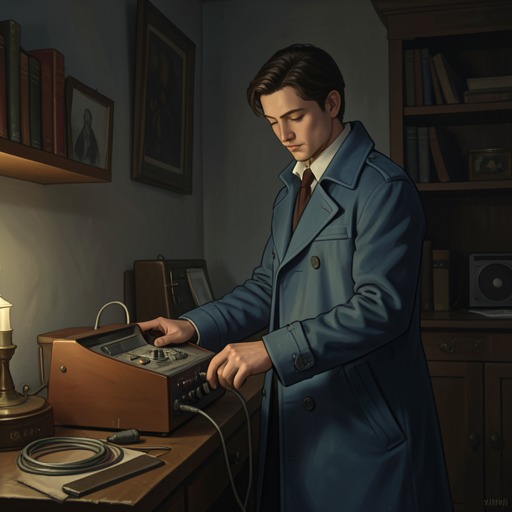
The unit’s radio truck is a battered Opel Blitz with a wooden body, dented gasoline cans, and bullet holes. Inside are two listening decks, a folding radio-frequency antenna that can be raised from within, three headsets, maps, compasses, wax pencils, and a weapon rack. Most significantly for Werner, the truck carries two transceivers he designed with Dr. Hauptmann. Their presence in the field steadies him, even as he finds that one has a cracked meter, blown fuses, and a missing transmitter plug. He retrieves tools and copper wire and begins repairs under the lantern’s light.
The search depends on repeated measurements rather than a single act of listening. Every few miles, the Opel stops on a rise or ridge. The men leave a transceiver at one point while the truck moves several hundred yards away, establishing the base of a triangle. Werner calculates distance, raises the aerial, puts on a headset, and scans the spectrum for a voice that is not sanctioned. Each set of readings is meant to narrow the possible location of a transmitter. The method makes the hunt a technical procedure, but its purpose is unmistakably military: to find radio users whom the German forces cannot otherwise see.
The Search Through Winter
At first the hunt produces little. Werner hears few voices through the static, and those he does hear are German. Each hour, Volkheimer checks the truck and asks whether anything has been found. Werner adjusts batteries and antennas and checks the fuses again. At Schulpforta, working with Dr. Hauptmann, he could treat radio as a controlled problem: he knew the frequencies and whether a transmitter was operating. In the field, he does not know whether a signal exists, when it will appear, or where it originates. The search becomes a chase after ghosts, while the unit spends fuel passing burned cottages, damaged artillery, and unmarked graves. The trains continue to be attacked, and the officers’ fury grows.
In January 1943, Werner finds another illegal transmission in an orchard where a shell has split most of the trees. Two weeks later he finds a third, then a fourth. Each discovery brings the triangulation closer to a point: a barn, cottage, factory basement, or encampment in the ice. The repeated sequence makes the mission feel almost like a puzzle whose boundaries contract with every successful measurement. But the signals are not abstractions. Every point on the map is a place from which someone has risked transmitting.
The winter turns the search into a bodily and imaginative ordeal. Werner prowls the static as he once prowled the alleys with Jutta, pulling her in a wagon through the settlements around Zollverein. A voice emerges from distortion and disappears; he follows it until it returns, imagining the effort as feeling along a long thread until his fingers find a knot. Days can pass between hearing a transmission and locating it. The work is dangerous, yet it offers a mechanical problem to solve in place of the prospect of fighting in a frozen trench. Its apparent cleanliness is deceptive: the hunt occurs across a war-scarred landscape, and each successful narrowing helps the unit reach its human target.
Consequences and Significance
The operation gives Werner’s technical skill a practical military consequence. He is not merely repairing receivers: he helps the unit detect communications that support attacks on German transport, and the search’s repeated geometry turns listening into a means of pursuit. The refrain of an unanswered check from Volkheimer, followed by Werner’s continued adjustments, emphasizes both the limits of the equipment and the persistence of the men using it. When signals do appear, the metaphorical trail ends in places where people are hiding and transmitting.
The unit’s operations also expose the violence surrounding the hunt. In a nearby episode, Volkheimer takes clothing from Russian prisoners, ordering them to remove their garments and eventually their boots. Werner understands that losing the boots means the prisoners will die; the prisoners nevertheless yield. This scene does not describe a transmitter’s discovery, but it places the radio mission within the coercive world of the unit carrying it out. The men who follow invisible voices are also participants in the occupation and violence of the front.
Later scenes give radio’s material construction and possible uses a different emphasis. Trapped beneath rubble at Saint-Malo, Werner makes a crude receiver from wire, a pipe, a diode, a battery, and an earphone. Elsewhere in the city, Marie-Laure LeBlanc raises the antenna of the transmitter installed by her uncle, hoping that someone will hear her. These episodes do not undo the purpose of the partisan hunt; they sharpen its contrast. Radio can expose clandestine speakers to armed pursuit, but it can also carry a voice across isolation. Werner’s mission is the point at which the wonder of his childhood discovery becomes inseparable from the power to search for, and endanger, the unseen people at the other end of a signal.